10 Customer Retention Best Practices for SaaS Teams in 2026
In the world of SaaS, acquiring new customers is only half the battle. True, sustainable growth comes from keeping the customers you've already won. Yet, many product-led teams focus relentlessly on acquisition, only to see their hard-earned revenue leak out the back door through preventable churn. The problem isn't a lack of effort; it's a lack of the right systems. Vague feedback, noisy feature requests, and prioritizing by the loudest voice in the room lead to a product roadmap that doesn't align with what your best customers actually need to succeed.
This guide moves beyond generic advice to detail 10 proven customer retention best practices designed specifically for the unique challenges of SaaS and product-led teams. We'll provide a concrete framework to turn scattered customer feedback into your most powerful retention engine, ensuring you build a product that customers can't imagine leaving. Each practice outlined below includes the specific problem it solves, step-by-step implementation guidance, and key metrics to track your success. For a comprehensive overview of strategies to keep your SaaS customers engaged and loyal, explore these 10 actionable SaaS customer retention strategies for additional context.
We’ll also show you how simple, integrated tools can put these best practices into motion. By implementing these systems, you can stop guessing what customers want and start building a product that proactively addresses their needs, reduces churn, and drives long-term growth. The goal is to create a systematic approach to retention, making it a core, measurable part of your product development cycle rather than a reactive effort. Let's dive into the strategies that will transform your customer base into your greatest asset.
1. Implement Proactive Customer Feedback Loops
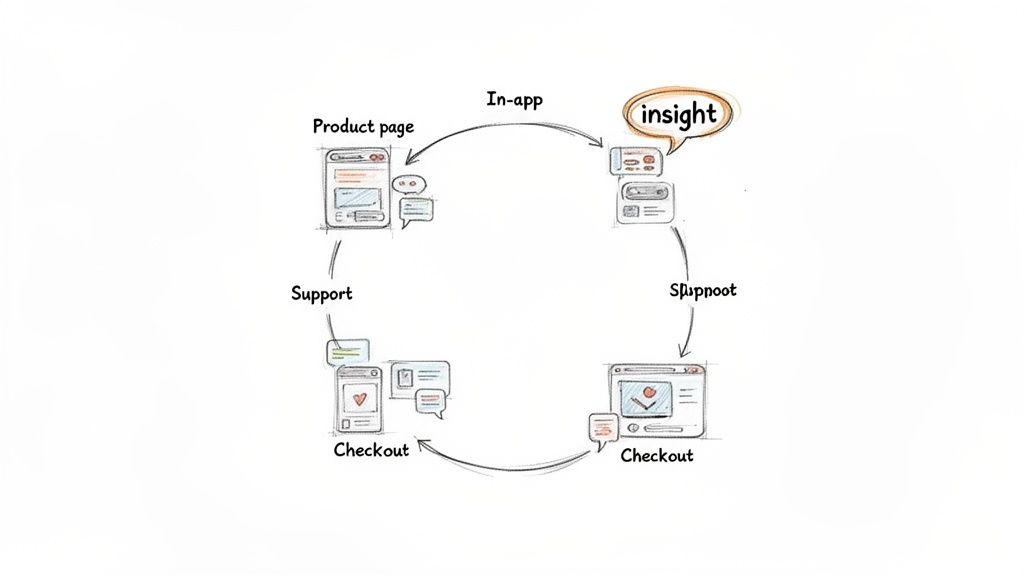
Reactive support is a recipe for churn. Waiting for customers to complain means you're already behind, addressing problems that have caused frustration and damaged trust. One of the most effective customer retention best practices is to shift from a reactive to a proactive stance by implementing systematic feedback loops throughout the customer journey. This means actively soliciting input before minor annoyances escalate into reasons for cancellation.
By embedding feedback mechanisms directly within your product, support channels, and key touchpoints, you create a continuous conversation with your users. This approach not only helps you identify friction points early but also demonstrates a genuine commitment to improving their experience, which builds loyalty.
Why It Works
Proactive feedback helps you understand the "why" behind user behavior. It uncovers hidden pain points, validates your product roadmap, and turns at-risk customers into valuable sources of insight. Companies like Slack master this by asking for feedback directly in-app after a new feature release, capturing impressions while the experience is fresh.
How to Implement This Practice
- Embed Feedback Widgets: Use non-intrusive tools to collect feedback on specific pages or after key actions. Instead of disruptive pop-ups, consider subtle widgets or buttons.
- Segment Your Feedback: Analyze feedback based on customer segments, such as plan type or monthly recurring revenue (MRR). A feature request from a high-value enterprise client may require more immediate attention than one from a free-tier user.
- Close the Loop: This is the most critical step. When you implement a suggestion or fix a bug, notify the customers who reported it. This simple act shows you're listening and makes them feel valued.
- Integrate into Workflows: Funnel feedback directly into the tools your team already uses, like Slack or GitHub. This ensures suggestions are seen, discussed, and actioned quickly. If you want a deeper dive, you can learn more about how to gather customer feedback effectively.
How Tools Like FeatureBot Help
Tools like FeatureBot streamline this entire process. You can install a feedback widget in your app with a few clicks, automatically route submissions to a dedicated Slack channel, and let users vote on suggestions to gauge demand. This transforms raw feedback into an organized, actionable backlog without manual effort, and you can get started on the Free plan.
2. Prioritize Features by Customer Revenue Impact
Not all feature requests are created equal. Prioritizing based on the sheer volume of requests often leads to a product roadmap that caters to your noisiest customers, not necessarily your most valuable ones. A more strategic approach, and one of the most powerful customer retention best practices, is to prioritize features by their direct impact on customer revenue. This means giving more weight to feedback from accounts with the highest MRR or lifetime value.
This method aligns your development resources directly with business outcomes. By focusing on features that solve problems for your top-tier customers, you strengthen relationships with the accounts that are most critical to your financial health. This ensures your engineering efforts are invested in retaining and expanding your most profitable customer segments.
Why It Works
Revenue-weighted prioritization provides a clear, data-driven framework for making tough roadmap decisions. It moves your team beyond subjective debates and anchors choices in tangible business value. For example, Calendly strategically prioritizes requests from its Business and Enterprise plan users, as these features often address complex scheduling needs that drive significant expansion revenue and prevent high-value churn.
How to Implement This Practice
- Combine Revenue with Other Factors: Don't rely solely on revenue. Create a balanced scoring model that includes strategic fit, development effort, and market opportunity alongside MRR or LTV.
- Track Revenue Impact Post-Launch: After shipping a feature prioritized by revenue, measure its adoption and impact on the requesting accounts. Did it lead to upgrades, expansion, or improved health scores?
- Be Transparent with Your Rationale: When communicating roadmap decisions, explain the "why" to all users. A transparent process builds trust, even when a user's specific request isn't prioritized immediately.
- Don't Ignore Smaller Accounts: Use feedback from free or low-MRR users to identify emerging trends and potential product-led growth opportunities that could become future revenue drivers. A deeper look can help you learn how to prioritize your product backlog with a balanced view.
How Tools Like FeatureBot Help
Tools like FeatureBot make this process simple by automatically enriching feedback with customer data. When a user submits a request, FeatureBot can pull in their MRR from Stripe, allowing you to instantly see the revenue tied to each feature idea. This transforms your backlog into a dynamic, revenue-ranked dashboard, helping your team make smarter decisions that boost retention without manual data entry. You can start using this feature on the Free plan.
3. Close the Loop with Customers on Feature Requests
Submitting a feature request into a black box is a frustrating experience that erodes customer trust. When users take the time to offer valuable feedback, silence is often interpreted as indifference. One of the most powerful customer retention best practices is to establish a clear and consistent communication process for feature requests, ensuring customers always know the status of their ideas.
This practice, known as "closing the loop," involves communicating back to customers whether their suggestion is being considered, actively developed, shipped, or even declined. This transparency transforms a one-way suggestion box into a collaborative dialogue, making customers feel heard, valued, and invested in your product's evolution.
Why It Works
Closing the loop on feedback demonstrates that you respect your customers' time and input. It builds immense goodwill and fosters a strong sense of community, even when the answer is "no." Companies like Airtable excel at this by crediting users in their changelogs when a requested feature is launched, which turns customers into advocates. This transparent communication prevents churn by managing expectations and reinforcing the value of the customer relationship.
How to Implement This Practice
- Set Clear Expectations Upfront: Let customers know what to expect after submitting feedback. A simple message like, "We review all suggestions and will provide a status update quarterly," can prevent frustration.
- Use Status Updates: Create a simple system with statuses like "Under Review," "Planned," "In Progress," and "Shipped." This keeps customers informed without requiring lengthy, custom responses for every request.
- Acknowledge All Feedback: Even if you decide against a feature, explain the reasoning. A response like, "Great idea, but it doesn't align with our current roadmap for these reasons," is far better than silence.
- Segment Your Communications: While automated updates work for most, consider sending personal messages to high-value customers who provide critical feedback. This strengthens key relationships.
How Tools Like FeatureBot Help
Tools like FeatureBot automate the entire feedback loop. When you update the status of a feature request in your backlog (e.g., from "Under Review" to "In Progress"), FeatureBot can automatically notify every customer who requested or upvoted that feature. This ensures no one is left in the dark, and it accomplishes this crucial communication without adding manual work for your team. You can set this up and start closing the loop on the Free plan.
4. Segment Customers by Health and Risk Level
Not all customers are the same, and a one-size-fits-all retention strategy is bound to fail. Instead of treating your entire user base as a monolith, one of the most impactful customer retention best practices is to segment them by their health and risk level. This involves categorizing accounts based on a combination of signals to predict their likelihood of churning or expanding.
By creating a customer health score, you can transform raw data into a clear, actionable indicator of account status. This allows your customer success and product teams to prioritize their efforts, focusing high-touch interventions on at-risk, high-value accounts while identifying healthy users who are prime for upselling.
Why It Works
Customer health scoring moves you from guessing to knowing. It provides an early warning system for churn and a clear roadmap for growth opportunities. By tracking metrics like product engagement, support ticket frequency, and payment history, you can identify patterns that precede churn. For example, a sudden drop in feature usage by a previously active account is a major red flag that warrants immediate, proactive outreach.
How to Implement This Practice
- Combine Multiple Signals: A robust health score uses a mix of inputs. Include product usage data (feature adoption, session frequency), support sentiment (ticket volume, resolution time), and commercial data (payment history, plan type).
- Weight Signals Appropriately: Not all signals are equal. For your business, a failed payment might be a stronger predictor of churn than a slight dip in logins. Analyze historical churn data to determine which factors have the most predictive power and weight them accordingly.
- Create Actionable Playbooks: Define clear next steps for each segment. For "at-risk" customers, this might trigger an automated email from a success manager. For "healthy" and "expanding" customers, it could enroll them in a new feature beta or an upsell campaign.
- Refresh Scores Regularly: Customer health is dynamic. Ensure your scores are updated daily or weekly to reflect the latest user activity, so your team is always acting on current information.
How Tools Like FeatureBot Help
While tools like Gainsight and Pendo offer enterprise-level health scoring, you can build a foundational system with more agile tools. For instance, you can use product analytics to identify low-engagement users and then use feedback tools to understand why they are disengaged. By inviting these specific at-risk segments to provide feedback through FeatureBot, you can directly ask what's causing friction and what would make their experience better. This turns a high-risk group into a source of actionable insights, and you can get started with this on the Free plan.
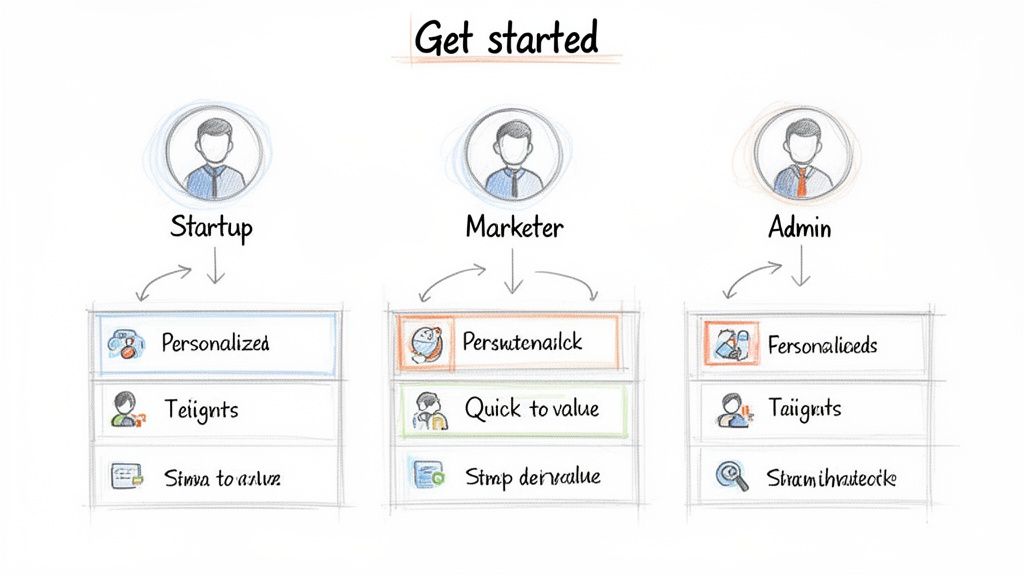
5. Personalize Onboarding and Feature Adoption Experiences
A generic, one-size-fits-all onboarding flow is a missed opportunity. It forces new users to navigate a complex interface to find the features relevant to them, increasing their time-to-value and the risk of early churn. One of the most impactful customer retention best practices is to personalize the onboarding and feature discovery experience based on each customer's unique goals, role, or industry. This approach makes users feel understood and guides them directly to the value they signed up to achieve.
By tailoring the initial setup and in-app guidance, you demonstrate immediate relevance and help customers build momentum. Instead of overwhelming them with every feature, you curate a journey that solves their specific problem, dramatically improving their chances of long-term success and retention.
Why It Works
Personalized onboarding accelerates the "aha!" moment by cutting through the noise. It focuses the user's attention on the tools and workflows that matter most to them, preventing feature fatigue and confusion. Companies like Notion excel at this by recommending specific templates based on a user's stated use case (e.g., "for students" or "for project management"), immediately making the product more accessible and valuable.
How to Implement This Practice
- Ask Qualifying Questions Early: During sign-up or the initial login, ask simple questions about the user's role, industry, or primary goal. Use this data to route them to a customized onboarding flow.
- Map Onboarding to Personas: Develop distinct onboarding paths for your key customer segments. A startup founder needs a different initial experience than an enterprise marketing manager.
- Prioritize Relevant Features: Showcase the features that align with the user's stated goals first. For example, a user who wants to "track team progress" should be guided to your project management tools, not your billing settings.
- Use In-App Contextual Help: Instead of a long, upfront product tour, provide contextual tips and guides as users interact with relevant parts of your application.
How Tools Like FeatureBot Help
While FeatureBot focuses on feedback collection, the insights gathered are critical for personalizing the user journey. By segmenting feature requests by user persona, you can identify which features are most important to different user groups. This data allows you to intelligently design and refine your onboarding flows, ensuring you highlight the functionality that will deliver the most value to each new customer. You can start gathering these insights with the Free plan.
6. Establish a Regular Cadence for Customer Communication
Out of sight, out of mind is a dangerous state for any SaaS business. When customers don't hear from you regularly, they can feel forgotten, miss out on valuable new features, and gradually drift away. Establishing a consistent communication cadence is a core customer retention best practice that transforms your relationship from a transactional one into an ongoing partnership, keeping your product top-of-mind.
A steady stream of meaningful contact, whether through newsletters, product updates, or webinars, ensures customers continuously see the value you provide. It prevents the silent disengagement that often precedes churn by building trust and making your brand a familiar, reliable part of their workflow.
Why It Works
Consistent communication reinforces your value proposition and educates users on how to get more from your product. It creates a sense of community and demonstrates that you are actively invested in their success. Companies like Zapier excel at this with weekly "automation ideas" emails that don't just announce features but inspire users to deepen their engagement with the platform.
How to Implement This Practice
- Start with a Realistic Cadence: Begin with a monthly update and adjust based on engagement. You can increase the frequency to bi-weekly or weekly for highly engaged segments.
- Segment Your Audience: Tailor your communications based on customer tier, use case, or engagement level. A power user on an enterprise plan has different needs than a new user on a free plan.
- Mix Your Formats: Keep your content fresh by using a variety of formats, including email newsletters, in-app announcements, blog posts, and educational webinars.
- Track Engagement: Monitor open rates, click-through rates, and webinar attendance. Use this data to refine your strategy and focus on what resonates most with your audience. To effectively establish a regular communication cadence and foster lasting relationships, consider how you can improve customer retention using platforms like Klaviyo.
How Tools Like FeatureBot Help
While FeatureBot focuses on in-app feedback, it plays a key role in your communication strategy by providing content for your updates. When you release a feature that users requested, you can announce it in your next newsletter and directly in-app. This creates a powerful, closed-loop narrative: you listened to their feedback, built the solution, and are now announcing it, which reinforces that you value their input. You can start gathering these valuable insights on the Free plan.
7. Create a Transparent Product Roadmap and Share It
Customers often churn not because a product is bad, but because they fear it isn't evolving to meet their future needs. Uncertainty about your product's direction can drive them to competitors who seem more innovative. Sharing a transparent product roadmap is one of the most powerful customer retention best practices because it builds trust and demonstrates a clear vision, giving customers a compelling reason to stick around.
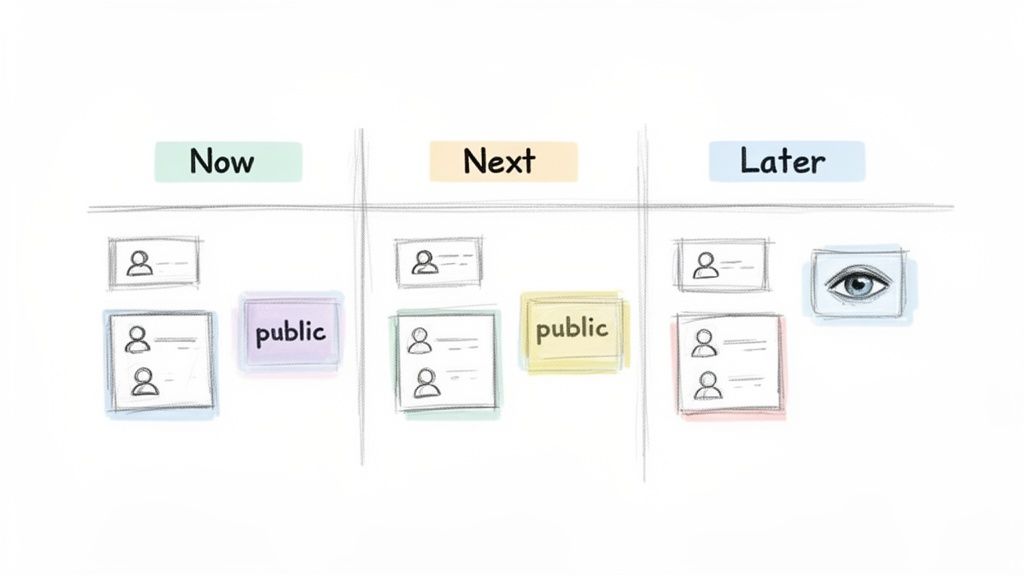
A public or semi-public roadmap acts as a promise of future value. It shows users that you are actively working on improvements and features that will make their experience better over time. This transparency makes customers feel like partners in your product's journey rather than just transactional users.
Why It Works
A transparent roadmap aligns customer expectations with your development reality, reducing frustration and support tickets related to missing features. It turns the question "When will you build X?" into an opportunity for collaboration. Companies like Notion and Figma excel at this by creating public roadmaps where users can see what’s planned and even vote on priorities, fostering a strong sense of community and investment.
How to Implement This Practice
- Choose the Right Format: A "Now, Next, Later" framework is often more effective than committing to strict deadlines, which can create pressure and disappointment if missed.
- Tie Roadmap to Feedback: Explicitly link items on your roadmap to the customer feedback that inspired them. A simple tag like "Popular Request" shows users their voice is heard.
- Communicate Changes Proactively: If priorities shift and a feature is delayed, communicate this openly and explain the reasoning. Transparency during setbacks builds more trust than silence.
- Keep It Updated: A stale roadmap is worse than no roadmap at all. Update it monthly or quarterly to reflect progress and maintain momentum. For a deeper look, you can read more about product roadmap best practices.
How Tools Like FeatureBot Help
Tools like FeatureBot make it easy to build a roadmap directly from customer feedback. You can automatically turn popular feature requests from your feedback board into roadmap items, ensuring your development plan is driven by real user needs. This system provides a single source of truth for your team and your customers, and you can get started on the Free plan.
8. Measure and Act on Net Promoter Score (NPS) and Customer Satisfaction
Understanding customer sentiment is not a guessing game; it's a science. Relying on intuition or support ticket volume alone gives you an incomplete picture of customer health. One of the most impactful customer retention best practices is to systematically measure satisfaction using metrics like Net Promoter Score (NPS), Customer Satisfaction (CSAT), or Customer Effort Score (CES). These surveys create quantifiable signals that identify at-risk customers long before they churn.
However, the real value isn't in collecting scores; it's in the follow-up. Acting on the feedback from dissatisfied customers, particularly NPS "Detractors," is what transforms a simple survey from a passive data point into a powerful retention lever. This process turns negative experiences into opportunities to demonstrate your commitment and fix core issues.
Why It Works
Regularly measuring metrics like NPS provides a consistent pulse on customer loyalty and benchmarks your performance over time. It helps you identify trends and understand how product changes or service improvements affect satisfaction. Companies like Salesforce integrate NPS tracking directly into their account management workflows, enabling their teams to proactively address issues raised by low-scoring enterprise clients and prevent churn.
How to Implement This Practice
- Survey at Moments of Truth: Deploy surveys at key journey points for maximum relevance, such as after resolving a support ticket (CSAT), completing onboarding, or after a renewal decision.
- Follow Up with Detractors Immediately: Contact customers who leave a low score (NPS 0-6) within 24-48 hours. A personal email or call to understand their feedback can often salvage the relationship.
- Analyze Open-Ended Feedback: The most valuable insights are in the comments. Use feedback to identify recurring themes and root causes behind low scores, then create action plans to address them.
- Segment Your Scores: Don't just track your overall NPS. Analyze scores by customer segment (e.g., plan type, user tenure, company size) to uncover specific pain points affecting high-value cohorts.
How Tools Like FeatureBot Help
Tools like FeatureBot can help you close the loop on the qualitative feedback you receive from NPS surveys. When a customer leaves a detailed comment about a missing feature or a product issue, you can quickly add that insight to your feedback board. This connects their sentiment score to an actionable product idea, ensuring that the root cause of their dissatisfaction is tracked and prioritized, not lost in a spreadsheet. You can start organizing this feedback on the Free plan.
9. Build Community and Enable Peer-to-Peer Learning
Simply selling a product creates a transactional relationship, but building a community fosters an emotional one. Creating spaces where customers can connect, share best practices, and learn from each other dramatically increases the emotional investment and practical value they derive from your platform. This approach is one of the most powerful customer retention best practices because it shifts customers from being isolated users into members of a connected network.
This network effect builds a powerful moat around your product. The collective knowledge, user-generated templates, and peer support become part of your platform's core value proposition, making it much harder for a competitor to replicate and for a customer to leave.
Why It Works
A strong community transforms your most engaged users into advocates and an extension of your support team. It creates a flywheel of value where users contribute content, answer questions, and showcase innovative uses of your product, which in turn attracts and retains new users. Companies like Notion and Figma have mastered this, with user-created templates and plugins becoming a primary driver of adoption and loyalty.
How to Implement This Practice
- Start Small and Private: Begin with a private, invite-only community (e.g., a Slack or Discord channel) for your most active power users. This allows you to cultivate a positive culture before opening it to a wider audience.
- Seed Initial Content: Don't expect a new community to thrive on its own. Seed it with company-created content, conversation starters, and exclusive insights to generate initial momentum and show users what's possible.
- Recognize Top Contributors: Publicly acknowledge and reward your most helpful community members. This could be through special titles, company swag, or early access to new features.
- Host Live Events: Drive consistent engagement by hosting monthly community calls, Q&A sessions with the product team, or user-led "show and tell" events.
How Tools Like FeatureBot Help
While community building is a broad effort, feedback tools can play a key role. You can use FeatureBot to create a dedicated channel in your community Slack or Discord for feature requests and feedback. This gives community members a direct line to your product team and allows them to vote on ideas from their peers, making them feel heard and directly involved in the product's evolution. You can get started with this on the Free plan.
10. Implement Win-Back Campaigns for At-Risk and Churned Customers
Losing a customer is a significant revenue hit, but it doesn't have to be a permanent one. Instead of writing off churned users, one of the most impactful customer retention best practices is to implement strategic win-back campaigns. This approach involves proactively identifying at-risk or recently departed customers and reaching out with targeted, value-driven offers to reignite the relationship.
These campaigns go beyond a generic "we miss you" email. They use data to understand why a customer left or disengaged and tailor the outreach accordingly. By addressing the root cause of churn, you can recover lost revenue and turn a negative experience into a story of renewed loyalty.
Why It Works
It is often more cost-effective to win back a former customer than to acquire a new one. These users are already familiar with your product, and their churn reason provides invaluable data for improving your offering. Netflix excels at this by sending compelling offers like a free month to lapsed subscribers, reminding them of the value they're missing. Similarly, Spotify uses personalized playlists to entice inactive users back onto the platform.
How to Implement This Practice
- Segment by Churn Reason: Don't use a one-size-fits-all approach. Create different campaigns for users who left due to price, missing features, or poor onboarding.
- Personalize the Offer: The incentive should match the churn reason. If they left over budget, offer a temporary discount. If they needed a specific feature that you've since built, notify them and offer a personalized demo.
- Time It Strategically: Reach out soon after churn, typically within 30-90 days, while your product is still relevant to their needs. For at-risk customers, trigger campaigns based on declining usage or failed payments.
- Show, Don't Just Tell: Use feedback data to demonstrate improvement. A message like, "You asked for a better way to export data, and we listened," is far more powerful than a simple discount.
How Tools Like FeatureBot Help
Effective win-back campaigns rely on knowing why customers churned. FeatureBot helps you capture this critical feedback before they leave. By analyzing their feature requests and bug reports, you can build a clear picture of their frustrations. When you launch a feature a churned user requested, you can easily identify them and craft a highly personalized outreach message, turning past feedback into a powerful re-engagement tool. You can start collecting this data today on the Free plan.
10-Point Customer Retention Best Practices Comparison
| Strategy | 🔄 Implementation Complexity | ⚡ Resource Requirements | 📊 Expected Outcomes | 💡 Ideal Use Cases | ⭐ Key Advantages |
|---|---|---|---|---|---|
| Implement Proactive Customer Feedback Loops | Moderate 🔄 — embed widgets, real-time capture | Moderate ⚡ — tooling + response workflows | High 📊 — earlier issue detection, richer insights | Product-led SaaS, frequent releases | Real-time actionable feedback; stronger customer engagement |
| Prioritize Features by Customer Revenue Impact | Moderate 🔄 — scoring & data integration | Moderate ⚡ — MRR/LTV data + prioritization tooling | High 📊 — higher ROI, reduced churn for top accounts | B2B/enterprise with varied account value | Aligns roadmap to revenue; maximizes development ROI |
| Close the Loop with Customers on Feature Requests | Low 🔄 — automated updates & templates | Low ⚡ — notification integration + comms templates | Moderate 📊 — improved satisfaction, fewer status queries | Any product with frequent feature requests | Builds trust via transparency; reduces friction |
| Segment Customers by Health and Risk Level | High 🔄 — data pipelines + scoring models | High ⚡ — analytics, dashboards, CSM processes | High 📊 — proactive interventions, churn reduction | Companies with many accounts or CSM teams | Prioritizes outreach; forecasts churn risk accurately |
| Personalize Onboarding and Feature Adoption Experiences | High 🔄 — multiple flows & contextual guidance | High ⚡ — content, product changes, segmentation | High 📊 — faster time-to-value, higher adoption | Complex products, varied user personas | Improves adoption and reduces early churn |
| Establish a Regular Cadence for Customer Communication | Low 🔄 — scheduling and content plan | Moderate ⚡ — content creation + distribution channels | Moderate 📊 — increased engagement, awareness | Broad user bases; community-focused products | Keeps product top-of-mind; builds habit and trust |
| Create a Transparent Product Roadmap and Share It | Moderate 🔄 — governance + roadmap tooling | Moderate ⚡ — PM time to maintain & communicate | Moderate 📊 — increased confidence; fewer surprises | Customer-facing products seeking feedback | Validates priorities; invites customer input |
| Measure and Act on NPS and Customer Satisfaction | Moderate 🔄 — surveying + follow-up workflows | Moderate ⚡ — survey tools + analysis + outreach | High 📊 — early warning system; measurable trends | Subscription businesses tracking retention | Quantified insights; targeted detractor recovery |
| Build Community and Enable Peer-to-Peer Learning | Moderate 🔄 — platform setup + moderation | Moderate ⚡ — community managers, events, content | Long-term High 📊 — advocacy, reduced support load | Products benefiting from shared templates/knowledge | Scales support; creates advocates and UGC |
| Implement Win-Back Campaigns for At-Risk and Churned Customers | Moderate 🔄 — churn signals + campaign automation | Moderate ⚡ — marketing/CS assets and personalization | Moderate 📊 — recoverable revenue; learn churn causes | Lapsed subscribers, declining-usage segments | Recovers revenue cost-effectively; informs product fixes |
From Best Practices to Daily Practice
Navigating the landscape of customer retention can feel overwhelming. We've journeyed through ten distinct yet interconnected customer retention best practices, from establishing proactive feedback loops and personalizing the onboarding experience to building community and implementing strategic win-back campaigns. The goal is not to execute every single one of these flawlessly overnight. Instead, it's about recognizing the powerful, unifying theme that weaves them all together: a deep, systematic commitment to listening to your customers and acting on what you hear.
Retention isn't a single department's responsibility; it's the output of an entire organization oriented around the customer. When your product team prioritizes features based on customer revenue impact, your success team can have more meaningful conversations. When you close the loop on feature requests, you transform passive users into active advocates. This creates a powerful, self-reinforcing cycle.
Weaving a Cohesive Retention Strategy
The true power of these practices emerges when they are combined. Think of them not as a checklist, but as building blocks for a customer-centric operating system.
- Feedback Drives Prioritization: Implementing proactive feedback loops (Practice #1) directly fuels your ability to prioritize features by revenue impact (Practice #2). You stop guessing what matters and start knowing.
- Transparency Builds Trust: A transparent product roadmap (Practice #7) becomes the tangible result of your prioritization efforts, and closing the loop on requests (Practice #3) makes that transparency feel personal and real to each user.
- Communication Prevents Churn: Segmenting customers by health (Practice #4) allows you to personalize communication (Practice #6) and target at-risk users before they disengage, preventing the need for a win-back campaign (Practice #10) in the first place.
This interconnectedness forms a flywheel. Better feedback leads to a better product, which leads to happier customers, who provide more insightful feedback, and so on. The momentum builds, transforming retention from a series of reactive firefights into a predictable, proactive engine for sustainable growth. Your churn rate becomes a lagging indicator of how well you're listening.
Your Actionable Next Steps
Mastering customer retention best practices begins with a single, deliberate step. You don't need a massive budget or a complex new initiative to start making a difference today. Your first move is simply to create a more efficient, centralized way to listen.
- Choose One Practice to Start: Don't try to boil the ocean. Pick the one practice from this list that addresses your most pressing pain point. Is it a lack of user feedback? Start with Practice #1. Is your roadmap a black box? Focus on Practice #7.
- Establish a Central Hub for Feedback: Before you can act on feedback, you must capture it effectively. Designate a single, accessible channel where customer insights can be collected from Slack, support tickets, and sales calls. This is the foundational step that enables nearly all other retention activities.
- Commit to Closing the First Loop: Find one recent piece of customer feedback, act on it, and then personally notify that customer of the update. This small act demonstrates your commitment and immediately begins building the trust and loyalty that underpins strong retention.
The journey from understanding these best practices to embedding them into your daily operations is where real competitive advantage is built. It's about shifting from simply having a product that people use to building a product that people feel a part of. Start small, stay consistent, and remember that every piece of feedback is a gift-an opportunity to make your product, and your relationship with your customers, just a little bit better.
Ready to turn customer feedback into your most powerful retention engine? FeatureBot centralizes requests from Slack and other sources into a prioritized roadmap, making it effortless to implement many of the customer retention best practices discussed here. Get started with our Free plan today and capture your first piece of feedback in minutes.
Ready to capture better feedback?
FeatureBot helps you collect, organize, and prioritize user feedback with AI-powered conversations.
Get Started Free