Increasing Customer Lifetime Value for SaaS Founders
When you’re trying to grow a SaaS business, it’s easy to get fixated on landing new customers. But the real secret to sustainable, long-term success isn’t just about acquisition—it’s about nurturing the customers you already have.
Shifting your focus to increasing customer lifetime value (CLV) is about playing the long game. It's the difference between a one-off transaction and a lasting, profitable partnership. We're talking about deepening engagement, slashing churn, and creating more opportunities for expansion revenue. That's how you build a business that lasts.
Why Customer Lifetime Value Is Your SaaS Growth Engine
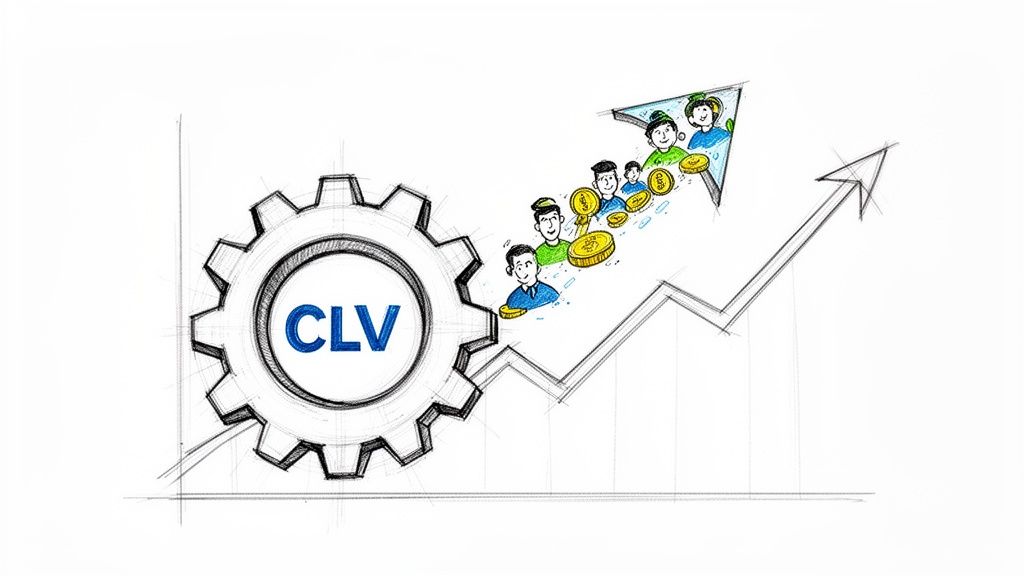
Too many SaaS founders get trapped in a costly cycle of chasing new leads. While bringing in new business is obviously important, it's only half the story. The true engine for scalable growth is maximizing the value of your existing customer base. This is where a laser-focus on CLV changes everything.
CLV isn't just another metric to track on a dashboard; it’s a vital sign for your company’s health. It tells you how good you are at building relationships that stick. In a world where customer acquisition costs (CAC) seem to climb every quarter, your current customers are your most precious asset.
The Financial Case for Focusing on CLV
Let's talk numbers, because they tell a powerful story. Research has shown time and again that a small 5% bump in customer retention can boost profitability by 25% to 95%. That's not a typo. When you consider that SaaS customer acquisition costs have jumped by a staggering 222% over the last eight years, the argument for prioritizing CLV becomes impossible to ignore.
This isn't magic. The financial impact comes from a few straightforward realities:
- Lower Costs: Keeping a happy customer is far cheaper than finding a new one. The math is simple.
- Higher Spending: Loyal customers grow with you. They upgrade plans, purchase add-ons, and become more invested in your product over time.
- Organic Referrals: A happy, long-term customer is your best salesperson. They bring in high-quality leads through word-of-mouth, often for free.
By making CLV your north star, you graduate from a short-sighted, transactional model to a more durable, relational one. Your business becomes less fragile and less dependent on a constant, expensive stream of new leads.
"Your most unhappy customers are your greatest source of learning." - Bill Gates
This idea gets to the heart of a CLV-driven strategy. Every interaction—from a support ticket to a feature request—is a chance to understand your customer better. Getting this right is the bedrock of retention and, by extension, a higher CLV.
Your Strategic Roadmap for Increasing CLV
Think of this guide as your playbook for systematically increasing customer lifetime value. We'll move from high-level concepts to concrete tactics you can implement right away. My goal is to show you exactly how to transform your customer relationships into a powerful engine for growth.
Here’s a quick overview of the ground we'll cover. These are the core strategies that form a robust, high-impact CLV program.
High-Impact Strategies for Boosting SaaS CLV
| Strategy Area | Key Action | Direct CLV Impact |
|---|---|---|
| Onboarding & Engagement | Nail the first-run experience to drive immediate value. | Reduces early-stage churn and increases long-term adoption. |
| Churn Reduction | Proactively identify at-risk customers and intervene. | Directly extends the "lifetime" component of CLV. |
| Expansion & Upsell | Create clear pathways for customers to upgrade and add value. | Increases the average revenue per user (ARPU). |
| Pricing & Packaging | Align your pricing tiers with the value customers receive. | Captures more value as customer usage and needs grow. |
| Customer Feedback | Systematically collect, analyze, and act on user feedback. | Builds a product customers love and won't leave. |
Each of these areas builds on the last, creating a compounding effect on your revenue. If you're looking for more ideas, you can always find other growth strategies on the FeatureBot blog. Now, let’s get started.
Getting a Grip on CLV: How to Calculate and Segment for Real-World Insights
Before you can even think about increasing customer lifetime value, you need to know what it is. For your business. Right now. Turning CLV from a fuzzy metric into a hard number is the first, non-negotiable step. Without that baseline, you’re just guessing at which customers are actually fueling your growth.
The good news is, you don't need a data science degree to get started. A simple, back-of-the-napkin formula is often all it takes to get a powerful snapshot of what a customer is truly worth to you over time.
The Go-To SaaS CLV Formula
At its heart, the CLV formula is about forecasting the net profit you can expect from a single customer. There are more complex ways to calculate it, but this version is perfect for getting your feet wet and uncovering some immediate "aha!" moments.
CLV = (Average Revenue Per Account × Customer Lifespan) – Total Cost to Serve
Let’s put that into perspective. Say a customer on your Pro plan pays $1,200 a year, and your churn data shows the average account stays for about four years. If you spend roughly $500 on onboarding and support for them during that time, their CLV is $4,300.
Suddenly, you're not just looking at monthly transactions anymore. You’re seeing a long-term relationship that represents thousands of dollars in value. That’s a powerful shift in mindset.
Why You Can’t Stop at the Average
Calculating a single, blended CLV for your entire user base is a fine starting point. But the real magic happens when you start segmenting. Let's be honest, not all customers are created equal. Some are vastly more valuable than others, and your job is to figure out who they are and find more like them.
The goal isn't just to know your average CLV. It's to understand which customer segments have the highest CLV and why. This is where raw data becomes a genuine strategic advantage.
Slicing your customer data into meaningful cohorts reveals patterns that a single average number would completely obscure. This is how you discover your actual ideal customer profiles—not just the ones you put in your pitch deck.
Practical Ways to Segment Your Customers
Segmentation is what turns broad assumptions into sharp, actionable insights. You stop treating everyone the same and start tailoring your product roadmap, marketing spend, and success playbooks to the users who matter most.
Here are a few high-impact ways I’ve seen work wonders:
By Plan Type: It's the most obvious place to start for a reason. Do you know if your Enterprise plan customers have a CLV that's 10x higher than those on your Starter plan? If they do, shouldn't their feature requests carry more weight? Even offering a Free plan can give you incredible data on user behavior before they ever pay you a dime.
By Acquisition Channel: Where are your best customers coming from? Are the ones you acquire through organic search sticking around longer than the ones from paid ads? Tracking CLV by channel is a game-changer for your marketing budget. It tells you exactly where to double down.
By In-App Behavior: This is where it gets really interesting. Start grouping users by what they do inside your product. For instance, you might discover that customers who adopt your new integration feature have a 30% lower churn rate. Boom. You’ve just found a direct lever for increasing CLV: drive adoption of that specific feature.
Once you have these segments defined, you can plug them straight into your feedback loop. A tool like FeatureBot can automatically weigh feature requests by the MRR of the customer who submitted them. This is huge. It ensures your roadmap is guided by the voices that have the most significant financial impact, aligning your product development directly with revenue growth.
Crafting an Onboarding Experience That Hooks Customers for Life
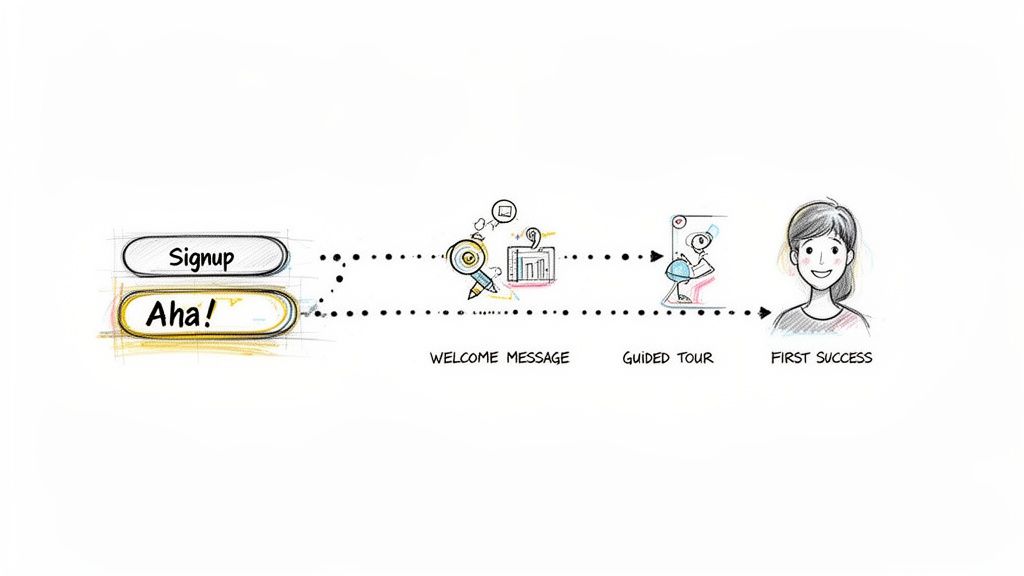
The first few moments a new customer spends inside your product are make-or-break. This isn't just a "welcome"; it's your first, best chance to prove your worth. A clunky or confusing onboarding experience is a fast track to churn. On the other hand, a smooth, value-focused process builds a foundation for a long and profitable relationship.
Your number one goal here is to race the user to their “aha!” moment—that flash of insight where they get how your product makes their life better. Nail this, and you're not just activating a user; you're making a direct investment in their lifetime value.
Personalize the First Five Minutes
First impressions are everything, and a generic "Welcome!" email just doesn't cut it anymore. You have to do better. Use the information you gathered during sign-up to tailor the welcome experience right from the get-go.
For instance, if a new user said they're a product manager struggling with feedback chaos, your in-app messages should immediately point them toward your feedback management features. This simple act shows you were paying attention and transforms a generic tour into a personalized solution.
This is worlds better than a one-size-fits-all product tour that mindlessly points out every button. Instead, serve up contextual guidance that appears precisely when and where the user needs it. That’s how you demonstrate value, not just features.
Guide Users to Their First Quick Win
The “aha!” moment isn’t theoretical. It’s about achieving a tangible result. A truly great onboarding flow is engineered to guide users to their first meaningful win, creating a shot of momentum that encourages them to stick around.
Think in terms of milestones, not just features.
- Focus on Checklists for Outcomes: Ditch the feature-based to-do list. Instead, build a checklist around a core "job-to-be-done." For a project management tool, that could be "Create Your First Project" or "Get Your Team Onboard."
- Give a Nudge When Needed: If a user gets stuck on a key step for more than 48 hours, send a gentle, automated email. A simple, "Looks like you haven't invited your team yet. Here's a 60-second video showing how easy it is!" can work wonders.
- Celebrate the Small Victories: When they complete a critical action, celebrate it! A quick pop-up saying, "Boom! You've published your first report," reinforces the positive behavior and makes them feel successful.
These small touches make users feel competent and supported—two absolute must-haves for long-term retention. And remember, with many SaaS companies offering a Free plan, this initial self-guided journey has to be flawless. You only get one chance to make a first impression.
Bad onboarding is a primary driver of early-stage churn. If a customer feels lost or overwhelmed in their first week, they’re gone. And their potential lifetime value goes right out the door with them.
Turn Onboarding into a Feedback Goldmine
Onboarding is also your best opportunity to gather raw, unfiltered feedback. New users have fresh eyes and will instantly spot the confusing workflows or missing instructions that your team stopped seeing ages ago.
This is the perfect place to embed a simple, non-intrusive feedback widget. When a user hits a wall, they can report it in the moment instead of giving up or trying to find a contact form. Using a tool like FeatureBot, they can even share their screen context with their comment, giving your product team a crystal-clear view of the friction point.
Fixing these early roadblocks doesn't just improve the experience for every user that follows. It sends a powerful signal to new customers: we are listening to you from day one. That simple act builds a mountain of trust and lays the groundwork for the kind of loyalty that truly maximizes customer lifetime value.
Driving Expansion Revenue with Smarter Upsells
Preventing churn is a solid defensive play, but driving expansion revenue is how you go on offense. The real magic in boosting customer lifetime value happens when you don't just keep customers, but you make your product more valuable to them over time. This means ditching the annoying "Upgrade Now!" pop-ups for smarter, data-driven upsell strategies.
The goal here isn't to squeeze more money out of people. It’s about being proactive. You want to pinpoint the exact moment a customer is outgrowing their current plan and be right there to offer the perfect solution for their next big challenge. When you do that, a pushy sales pitch becomes a genuinely helpful conversation.
Identify Key Usage Triggers for Upsells
Your product data is an absolute goldmine for spotting upsell opportunities. Stop guessing when a customer might be ready to upgrade. Instead, look for specific in-app behaviors that tell you they're hitting the limits of their current plan. These usage triggers are your cue to step in.
It's all about timing and relevance. An upgrade offer lands with maximum impact when it solves an immediate, tangible problem for the user.
Here are a few classic examples you can start tracking today:
- Approaching Usage Limits: Is a customer on your Free plan constantly bumping up against a feature limit, like project caps or file storage? They are a prime candidate for an upgrade. A gentle, contextual nudge at that very moment is incredibly effective.
- Adopting Advanced Features: When you see a user poking around features that are only fully unlocked on a higher tier, that’s a clear signal. They are telling you with their actions that they're getting more sophisticated and are ready for more power.
- Inviting More Team Members: A sudden flurry of team invites often means a small team is growing fast. This is the perfect time to introduce a plan with better collaboration tools, advanced user permissions, or slicker admin controls.
Connect Customer Feedback to Expansion Opportunities
Your customer feedback channels—support tickets, feature requests, community forums—are another fantastic source for uncovering expansion revenue. When users consistently ask for features that already exist in your higher-tier plans, you have a direct line to a warm upsell conversation.
Think about it. It’s not a cold pitch; it’s a direct answer to their request.
For instance, a user might submit feedback asking for better reporting. If your Pro plan offers advanced analytics, your customer success team can respond directly: "Thanks for the suggestion! We actually have a robust reporting suite on our Pro plan that does exactly what you're looking for. Would you be open to a quick demo?"
This is a critical mindset shift. You're not just logging a feature request; you're uncovering a sales opportunity hidden within a support interaction. It reframes the conversation from "we don't have that" to "here's how you can get that."
By organizing and tagging your feedback, you can spot these trends at scale. If you notice a bunch of customers on your Starter plan all asking for the same premium feature, it might even be a sign you need to rethink your plan packaging. Looking at how other companies structure their tiers can spark some great ideas. Our guide on alternatives to Productboard offers a look into different product management tools and their approaches.
Create a Seamless Omnichannel Upgrade Path
Once you’ve identified an upsell trigger, the next step is to make the upgrade process as smooth as possible. The conversation should feel like a natural part of their product experience, no matter where it begins.
This is where an omnichannel approach really shines. Omnichannel customers—the ones who engage with you across your website, app, email, and support channels—have a 30% higher customer lifetime value (CLV). And it gets better: companies with strong omnichannel strategies retain 89% of their customers, compared to just 33% for those with weak ones, according to this in-depth analysis of CLV statistics.
What this looks like in practice is a cohesive story. Your in-app upgrade prompt, a follow-up email from your success team, and a live chat with a support agent should all be on the same page. The context carries over, so the customer never has to explain their situation twice. By turning upsells into timely, helpful, and connected conversations, you systematically increase your average revenue per user and build a much healthier bottom line.
Turning Customer Feedback into Your Best Retention Tool
Let's be honest, most companies treat customer feedback like a digital suggestion box. It's there, comments pile up, but nothing really happens. But what if you saw it as a powerful engine for reducing churn and a direct line to increasing your CLV? When you get this right, you create a system that makes customers feel genuinely heard. This isn't just about collecting comments; it's about systematically capturing, organizing, and, most importantly, acting on them.
The real magic happens when you "close the loop"—actually telling users when that feature they asked for has shipped. That single action can turn a casual user into a die-hard fan. It's proof you don't just listen, you deliver.
This process is a cycle. It's about turning passive product usage into actionable business intelligence that fuels smarter upsells and keeps customers around longer.
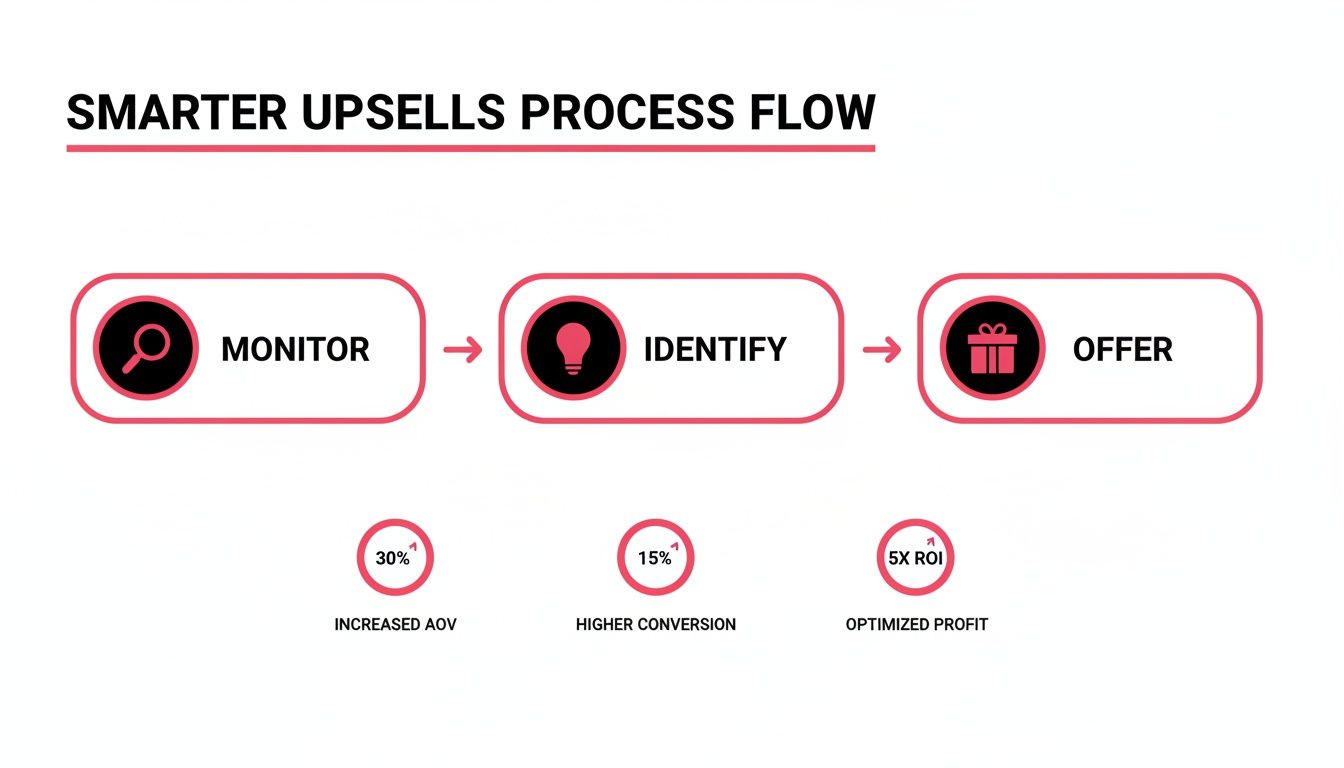
As you can see, it breaks down into three core moves: monitoring what people are doing, spotting opportunities for growth, and then making a relevant offer.
Create a Centralized Hub for All Feedback
Feedback comes at you from every direction. You've got support tickets, in-app widgets, sales call notes, and random mentions on social media. Without one central place to put it all, valuable insights are guaranteed to fall through the cracks. The first move is to funnel every single one of these streams into a single system.
Doing this stops different teams from working in silos. It means a brilliant idea from a support chat gets the same attention as a feature request from a VIP customer. You get a complete, 360-degree view of the customer experience, letting you spot trends you’d otherwise totally miss.
Once it's all in one place, you can start sorting. Most teams find it helpful to group feedback into a few key buckets:
- Bug Reports: Stuff that’s broken and causing immediate headaches.
- Feature Requests: New ideas or improvements to what you already have.
- Usability Issues: Workflows or parts of the UI that are just plain confusing.
This simple sorting takes you from a chaotic inbox to an organized backlog you can actually work with.
Prioritize Feedback by Business Impact, Not Just Volume
Here’s where so many SaaS companies go wrong: they prioritize features based on a simple vote count. Just because a request is popular doesn't mean it's valuable for your business. To really move the needle on CLV, you have to prioritize based on business impact.
This means connecting the feedback to actual customer data. Think about it: a feature requested by ten people on your Free plan is worlds away from a request made by two enterprise clients who together are worth $100,000 in ARR.
By weighting feedback by MRR, you ensure your product roadmap is aligned with your most valuable customer segments. You stop building for the loudest voices and start building for the customers who have the biggest impact on your bottom line.
Modern feedback tools can handle this for you automatically. For example, a platform like FeatureBot can automatically link every submission to that customer's revenue data. This gives you a clear, financially-driven roadmap that directly contributes to growing customer lifetime value.
Close the Loop to Build Unbreakable Loyalty
Collecting and building is only half the job. The final, and arguably most critical, step is to close the loop. This means you need to proactively reach out to every single user who requested a feature the moment you ship it.
This simple act of communication has a massive impact on customer loyalty. It shows them you didn't just hear their idea, but you valued it enough to build it. It makes them feel like a partner in your product's journey, not just a number on a spreadsheet.
You can automate this so no one gets missed:
- Tag Users to Requests: When a user submits feedback, their account gets tagged on that specific request in your system.
- Update Request Status: As the feature moves from "Under Consideration" to "In Progress" and finally "Shipped," you update its status.
- Trigger Automated Notifications: Changing the status to "Shipped" automatically fires off a personalized email to every single user tagged on that request.
This creates a powerful, positive interaction that reinforces the value of your company. It’s a small detail that makes a huge difference in how customers see your brand.
Use Feedback as a Proactive Churn Prevention Tool
Finally, your feedback system should be your early warning system for churn. By analyzing the trends, you can spot friction points long before they start showing up in your cancellation numbers. If you suddenly see a dozen complaints about a new workflow, that's a bright red flag.
Don't wait for them to leave. Dig into that feedback to understand the root cause of the frustration. Are they confused? Is something not working the way it should? This proactive approach lets you solve problems before they become reasons to cancel. Looking into different Canny alternatives can show you how various tools handle this kind of trend detection and help you pick one that fits this proactive model.
When you shift your feedback process from a reactive suggestion box to a proactive retention tool, you build a stickier, more valuable product that customers can't imagine living without.
Building a Company Culture Focused on Customer Value
Boosting customer lifetime value isn't a job you can just hand off to your success team and call it a day. It’s a mindset that has to permeate every corner of your company.
To really turn CLV into a growth engine, everyone—from engineering to marketing—needs to see exactly how their work impacts the customer experience. This is what shifts you from a collection of siloed departments into a single, unified force focused on the customer.
It all starts with making customer insights impossible to ignore. Imagine your engineering team seeing the direct MRR impact of a feature they're building. Suddenly, they're not just coding; they're solving a real, valuable problem. The same goes for marketing—when they see which channels consistently deliver high-CLV customers, they know precisely where to double down.
A customer-centric culture is built on shared accountability. When every team tracks metrics that reflect customer health, from Net Revenue Retention (NRR) to feature adoption rates, the entire company starts rowing in the same direction.
Fostering this kind of environment means constantly connecting the dots between day-to-day tasks and long-term customer happiness. It’s about creating a sustainable system for profitable growth.
When this focus is baked into your operations, every decision gets made through a customer-centric lens. Whether it’s a minor product update or a quick support email, the goal is always the same: deliver more value.
Still Have Questions About Increasing Customer Lifetime Value?
I get it. Shifting your focus from just acquiring new customers to maximizing the value of the ones you already have is a big change. It often brings up some tricky questions. Here are a few I hear all the time, along with my straight-to-the-point answers.
What’s the Real First Step in Improving CLV?
Before you do anything else, you need to know where you stand. The absolute first step is establishing a baseline. You have to calculate the CLV for your current customer base. Without that benchmark, you're flying blind.
Start with the simple formula, sure, but don't stop there. Immediately start segmenting your customers. You need to understand which groups—whether by subscription plan, how they found you, or what features they use—are your most valuable. That data is gold; it’ll inform every other decision you make.
How Can a Small Startup Possibly Track All This Data?
You don’t need a huge data science team right out of the gate. So many modern tools can automate the heavy lifting. The secret is to start small and focus on the metrics that actually move the needle.
To begin, just track these three:
- Customer Churn Rate: What percentage of customers are leaving you each month?
- Average Revenue Per Account (ARPA): On average, how much revenue are you making per customer?
- Customer Lifespan: How long does a typical customer stick around?
These three data points are enough to get a solid, basic CLV calculation. From there, you can start making much smarter decisions about where to invest your time and money.
A huge mistake I see founders make is waiting for "perfect" data. Don't do it. Start with what you have now. The insights you get from imperfect data are infinitely better than having no insights at all.
How Do I Balance Building New Features vs. Fixing Bugs?
Ah, the classic product management tug-of-war. The most effective way to handle this is to filter every decision through the lens of its potential impact on your most valuable customers.
Let's be honest: not all feedback is created equal. A nagging bug that's driving your highest-CLV enterprise accounts crazy should almost always jump the line ahead of a nice-to-have feature request from ten users on your Free plan. When you can tie feedback directly to MRR, the guesswork disappears, and you can build a roadmap that actually fuels retention and growth.
What's a Good CLV to CAC Ratio to Aim For?
The gold standard for a healthy SaaS business is a CLV to Customer Acquisition Cost (CAC) ratio of 3:1 or higher. Put simply, for every dollar you spend to get a new customer, you should be making at least three dollars back over their lifetime with you.
If your ratio is down around 1:1, you’re on a treadmill to nowhere—you're spending as much to get a customer as they'll ever be worth. But on the flip side, if you're at 5:1 or more, you might actually be underinvesting in your marketing and leaving growth on the table.
Ready to turn customer feedback into your best retention tool? FeatureBot helps you capture, organize, and prioritize user requests by MRR impact, so you can build a product that customers love and won't leave. Get started with our Free plan today.
Ready to capture better feedback?
FeatureBot helps you collect, organize, and prioritize user feedback with AI-powered conversations.
Get Started Free