The 12 Best AI Tools for Product Managers in 2026

The role of a product manager has always been a balancing act of strategic vision, user empathy, and relentless prioritization. Today, that balancing act has a new, powerful fulcrum: artificial intelligence. The right AI tools for product managers don't just automate tasks; they act as a co-pilot, surfacing insights, streamlining workflows, and freeing you to focus on high-impact strategic decisions. But navigating the crowded market of AI-powered platforms can be overwhelming. How do you choose between a dedicated feedback analysis tool and an all-in-one project management suite with AI features?
This comprehensive guide is designed to cut through the noise. We've compiled a detailed list of the top AI tools that can revolutionize your product management lifecycle, from initial discovery to roadmap execution. Instead of generic descriptions, we provide an honest assessment of each platform's strengths and weaknesses, ideal use cases, and key integrations with tools you already use, like Slack, GitHub, and Zapier. For many product managers, getting hands-on experience is key to understanding AI's potential. Experimenting in a sandboxed environment like the OpenAI Playground can be an excellent way to test prompts and grasp core model capabilities before committing to a specialized tool.
In the sections below, you'll find a curated breakdown of platforms categorized by their primary function. We will cover:
- Feedback & Feature Requests: Tools that centralize and analyze user feedback.
- Prioritization & Roadmap: Platforms for strategic planning and backlog management.
- Analytics & User Insights: Solutions for deep-diving into user behavior data.
- Writing & Microcopy: AI assistants for crafting clear, effective communication.
- Prototyping & Discovery: Tools to accelerate the ideation and design process.
Each entry includes screenshots, direct links, and a practical analysis to help you determine the best fit for your team’s specific needs and workflow, empowering you to build better products, faster.
1. FeatureBot
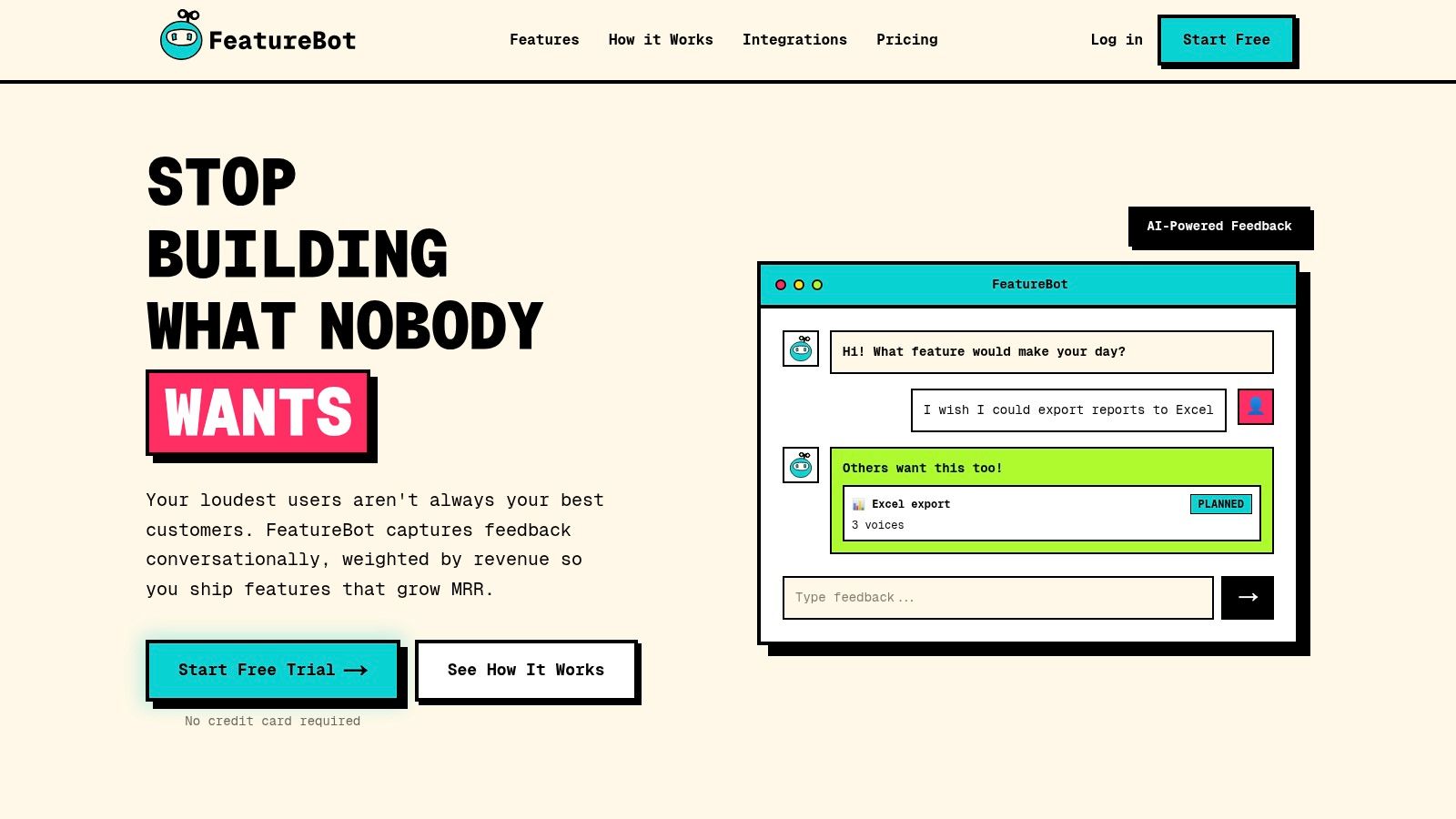
FeatureBot is a standout choice among ai tools for product managers, engineered specifically for product-led teams aiming to transition from guesswork to data-driven feature development. It replaces generic feedback forms and chaotic spreadsheets with an intelligent, conversational feedback widget. The platform excels at capturing high-quality user insights and translating them directly into actionable, revenue-impactful roadmap priorities.
What sets FeatureBot apart is its sophisticated AI engine that does more than just collect comments. As users share feedback, the AI asks intelligent follow-up questions to uncover the "why" behind the request. It then uses semantic analysis to automatically cluster raw, unstructured feedback into organized themes, drastically reducing duplicate entries and manual sorting. This ensures that product managers see emergent trends and pain points without spending hours manually categorizing submissions.
Key Features & Use Cases
FeatureBot is designed to close the loop between user feedback and engineering execution, making it a powerful end-to-end solution.
- Revenue-Weighted Prioritization: Instead of relying on simple vote counts, FeatureBot connects feedback to customer revenue data (MRR). This allows PMs to prioritize features that will have the most significant impact on the business, ensuring development resources are allocated effectively.
- AI-Powered Clustering & Summaries: The platform automatically groups similar feedback, identifies trends, and delivers weekly AI-generated digests. This saves teams countless hours and helps surface critical insights that might otherwise be lost in the noise.
- Complete Contextual Data: Every piece of feedback includes crucial context like the user's journey, session details, browser errors, and the specific page they were on. This gives engineers the information they need to reproduce issues and understand the user's experience fully.
- Seamless Integrations: With a simple one-line widget setup, FeatureBot integrates effortlessly into existing workflows. It connects with Slack, Zapier, and GitHub, and even offers an AI code generation feature that can create a new GitHub branch from a planned item to accelerate development.
Analysis
| Aspect | Evaluation |
|---|---|
| Ideal For | SaaS founders, product managers, and customer-facing teams who need a lightweight yet powerful system to capture, analyze, and act on user feedback. It is particularly effective for teams using Slack and GitHub for their daily operations. |
| Pros | Its core strength is linking feedback directly to revenue, providing a clear business case for prioritization. The full contextual data and AI-driven clustering are significant time-savers that improve the quality of product decisions. |
| Cons | The most powerful features, such as unlimited feedback submissions, AI summaries, and custom domains, are reserved for the higher-tier Growth and Scale plans. The AI code generation, while innovative, has monthly usage limits per plan. |
| Pricing | FeatureBot offers a Free plan to get started. Paid plans include Starter ($13/mo), Growth ($21/mo), and Scale ($83/mo), with discounts for annual billing. It also provides a 60-day money-back guarantee. |
Website: https://featurebot.com
2. Productboard
Productboard positions itself as a comprehensive product management platform, but its recent addition, Spark, makes it one of the most compelling AI tools for product managers available. Spark is a purpose-built AI agent designed to streamline core PM workflows. It can draft initial PRDs, generate user stories from high-level features, and conduct competitive analysis based on provided inputs. This AI functionality is integrated directly into the broader platform, allowing teams to connect AI-generated insights to their roadmaps and customer feedback portals.
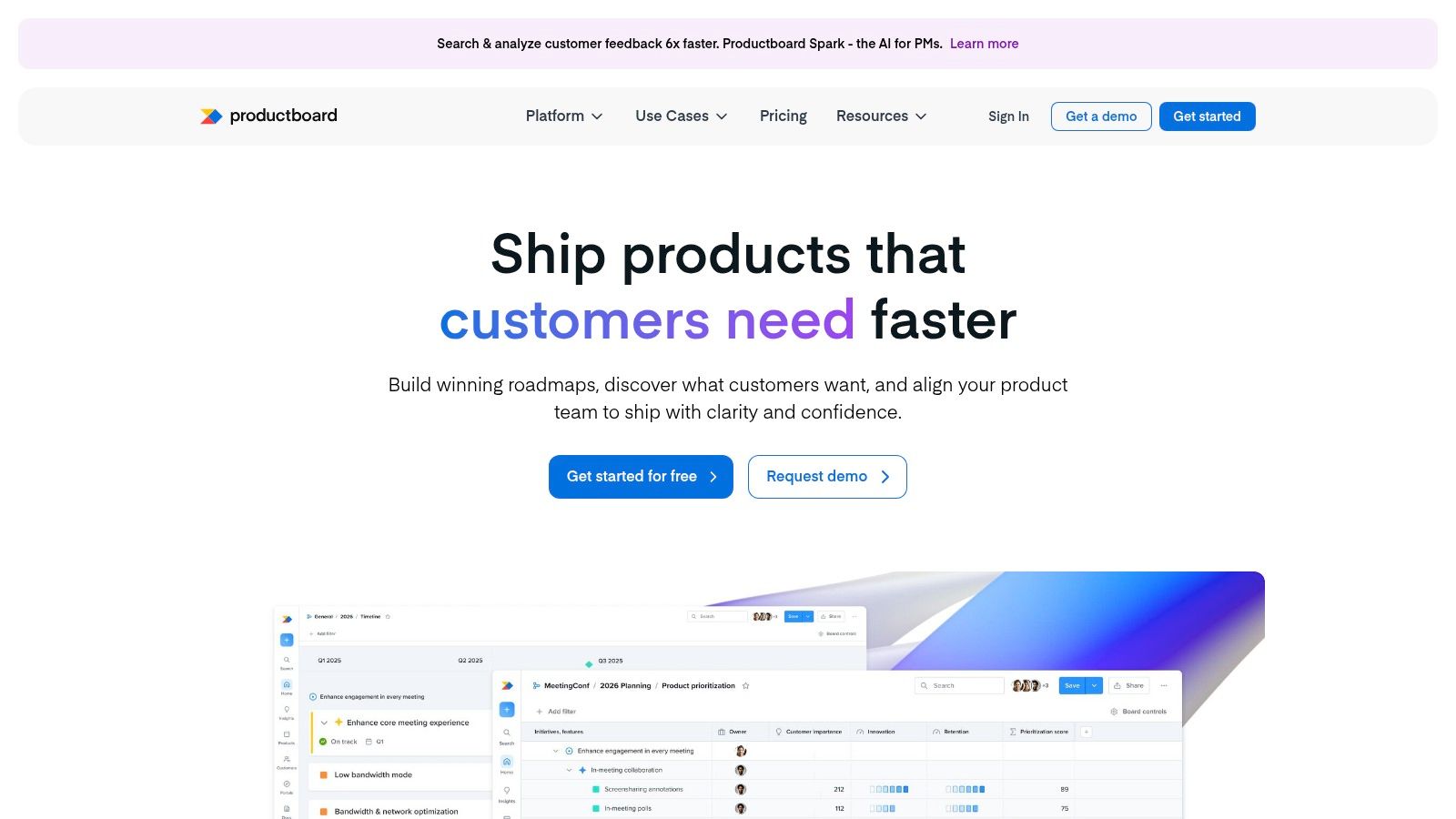
The platform also leverages AI to analyze and summarize large volumes of customer feedback, identifying key themes and sentiment automatically. This saves significant time in the discovery phase, helping teams surface critical insights without manual effort. Its strength lies in this deep integration between AI assistance and a robust roadmapping framework, making it a powerful choice for teams looking to centralize their product lifecycle. For more options in this category, you can explore other best product roadmap tools.
Key Features & Pricing
- Spark AI Agent: Specialized AI assistant for drafting briefs, PRDs, and competitive analyses.
- AI Feedback Analysis: Automatically synthesizes customer feedback to identify themes and sentiment.
- Integrated Roadmapping: Connect AI insights directly to strategic product roadmaps and share them via a customer portal.
Productboard offers a tiered pricing model, including a Free plan to get started. Paid plans like Pro ($25/maker/month) and Scale ($80/maker/month) unlock more advanced features, including the platform-level AI capabilities. Spark can also be trialed as a standalone workspace with free starter credits, offering a low-friction entry point to its AI suite.
Website: https://www.productboard.com
3. Atlassian (Jira & Confluence with Rovo/Atlassian Intelligence)
Atlassian has deeply embedded AI across its ecosystem, making Jira and Confluence powerful native AI tools for product managers. Through its Atlassian Intelligence engine (now part of Rovo), the platform offers AI-powered search, issue summarization, and content generation directly within the tools teams use daily. PMs can use it to instantly grasp the context of complex Jira tickets, draft project updates in Confluence, or find answers buried across disparate documentation and projects. This native integration is its key differentiator, bringing AI assistance directly into established workflows without requiring a separate tool.
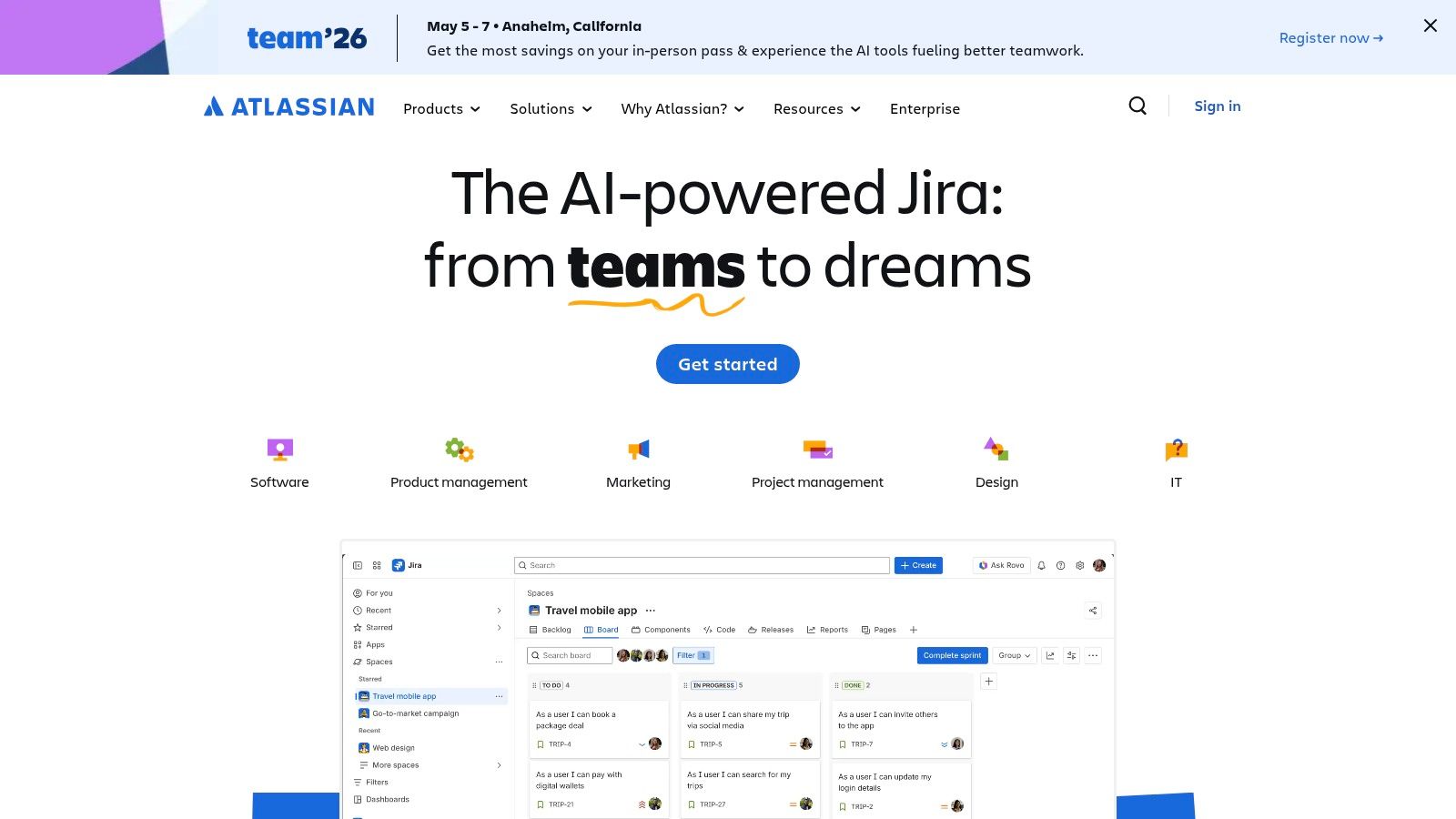
The platform’s strength is amplified by the Atlassian Marketplace, which hosts a vast array of third-party AI apps designed for specific PM tasks, such as advanced requirements analysis or automated user story creation. This combination of native AI capabilities and an extensible ecosystem provides enterprise-grade governance and flexibility. Teams can start with the built-in features and scale their AI usage with specialized apps as their needs evolve, all within a familiar and secure environment.
Key Features & Pricing
- Atlassian Intelligence (Rovo): Native AI for summarizing tickets, generating content, and enabling natural language search across Jira, Confluence, and connected tools.
- AI-Powered Agents: Automate routine tasks and workflows, such as summarizing sprint progress or creating action items from meeting notes.
- Extensible Marketplace: Access a large ecosystem of specialized AI apps to enhance product management workflows, from backlog refinement to feedback analysis.
Atlassian includes a quota of Rovo credits with its paid cloud plans (Standard, Premium, and Enterprise), meaning there is no separate base fee for AI usage. A Free plan is available to get started with the core products. While the quota model can be complex initially, it offers a scalable way to adopt AI with robust administrative controls.
Website: https://www.atlassian.com
4. Notion
Notion has evolved from a unified workspace into a powerful platform leveraging integrated AI, making it one of the essential AI tools for product managers. Notion AI is embedded directly into its docs, tasks, and databases, allowing PMs to draft PRDs, summarize discovery notes, and automate meeting takeaways. Its Q&A and enterprise search features can instantly find answers across the entire workspace, turning scattered project information into an accessible knowledge base. This consolidates the entire product documentation lifecycle within a single, AI-enhanced environment.
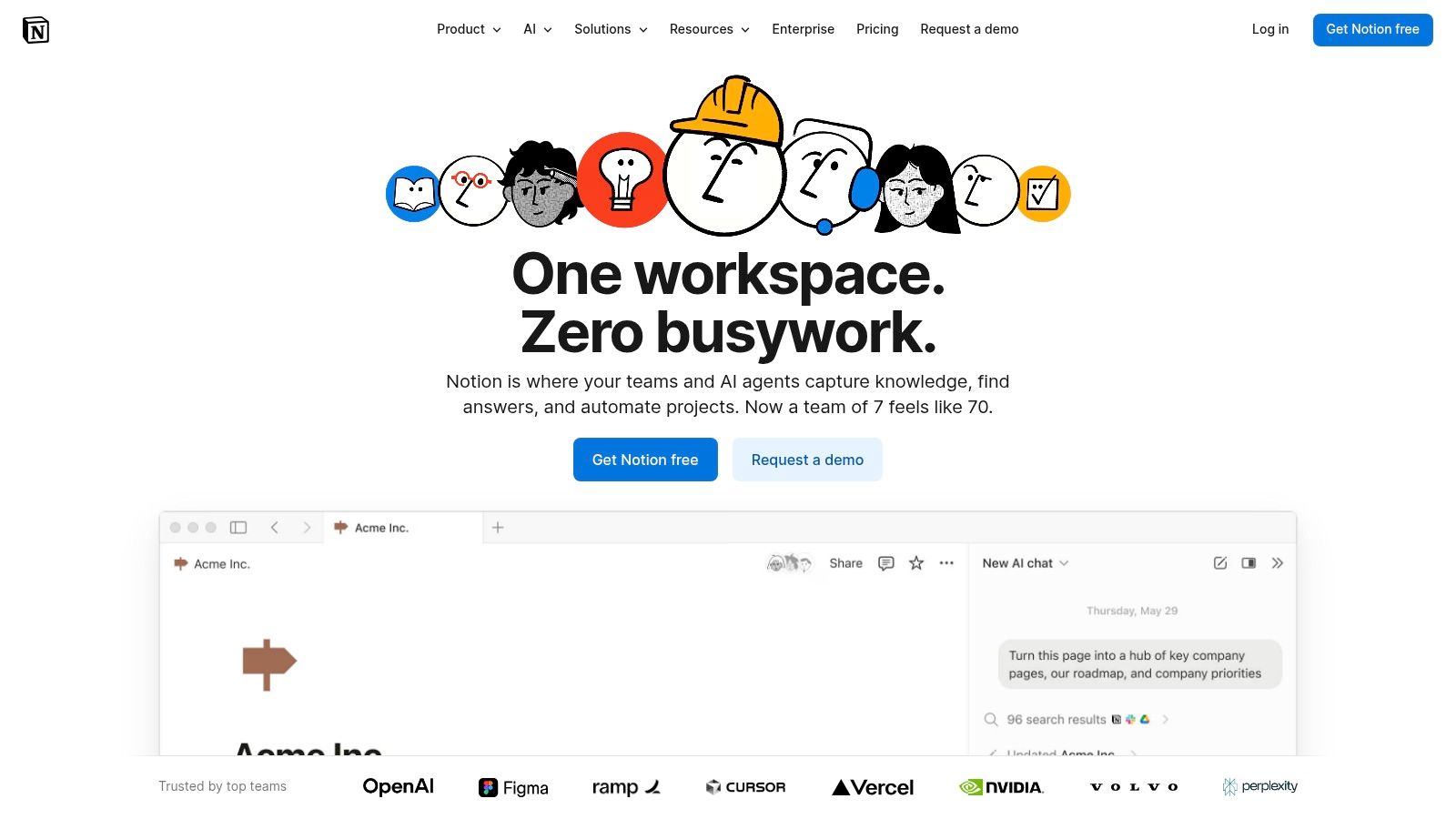
The platform’s strength is its unparalleled flexibility. Product teams can build custom roadmaps, research repositories, and sprint planners using interconnected databases, all while using AI to generate content, analyze data, and streamline workflows. For instance, you can create an AI agent to automatically tag and summarize user interview transcripts stored in a database. While its database-driven structure has a learning curve, the ability to centralize product documentation, research, and planning in one intelligent system is a significant advantage for cross-functional collaboration.
Key Features & Pricing
- Notion AI: Assists with drafting specs, summarizing meeting notes, and answering questions based on your workspace content.
- Consolidated Workspace: Unifies PRDs, research, roadmaps, and task management using interconnected databases.
- Collaboration & Permissions: Advanced controls for sharing documents and databases with engineering, design, and marketing teams.
Notion offers a Free plan to get started. Paid plans like Plus ($10/user/month) and Business ($18/user/month) unlock more collaborative features, while the Enterprise plan provides advanced AI capabilities like enterprise search and dedicated agents. Note that AI pricing and feature inclusions have evolved, so teams should verify current offerings.
Website: https://www.notion.com
5. ClickUp
ClickUp is a powerful all-in-one project management platform that has deeply embedded AI capabilities to streamline execution and planning. It stands out by treating AI as an integrated assistant across its entire suite of tools, from tasks and docs to communication. The platform's Brain AI and Everything AI add-ons provide a suite of agents and assistants that can automate routine product management work, such as generating release notes from completed tasks, summarizing long discussion threads, and even assisting with backlog grooming. This makes it one of the most practical AI tools for product managers focused on delivery and coordination.
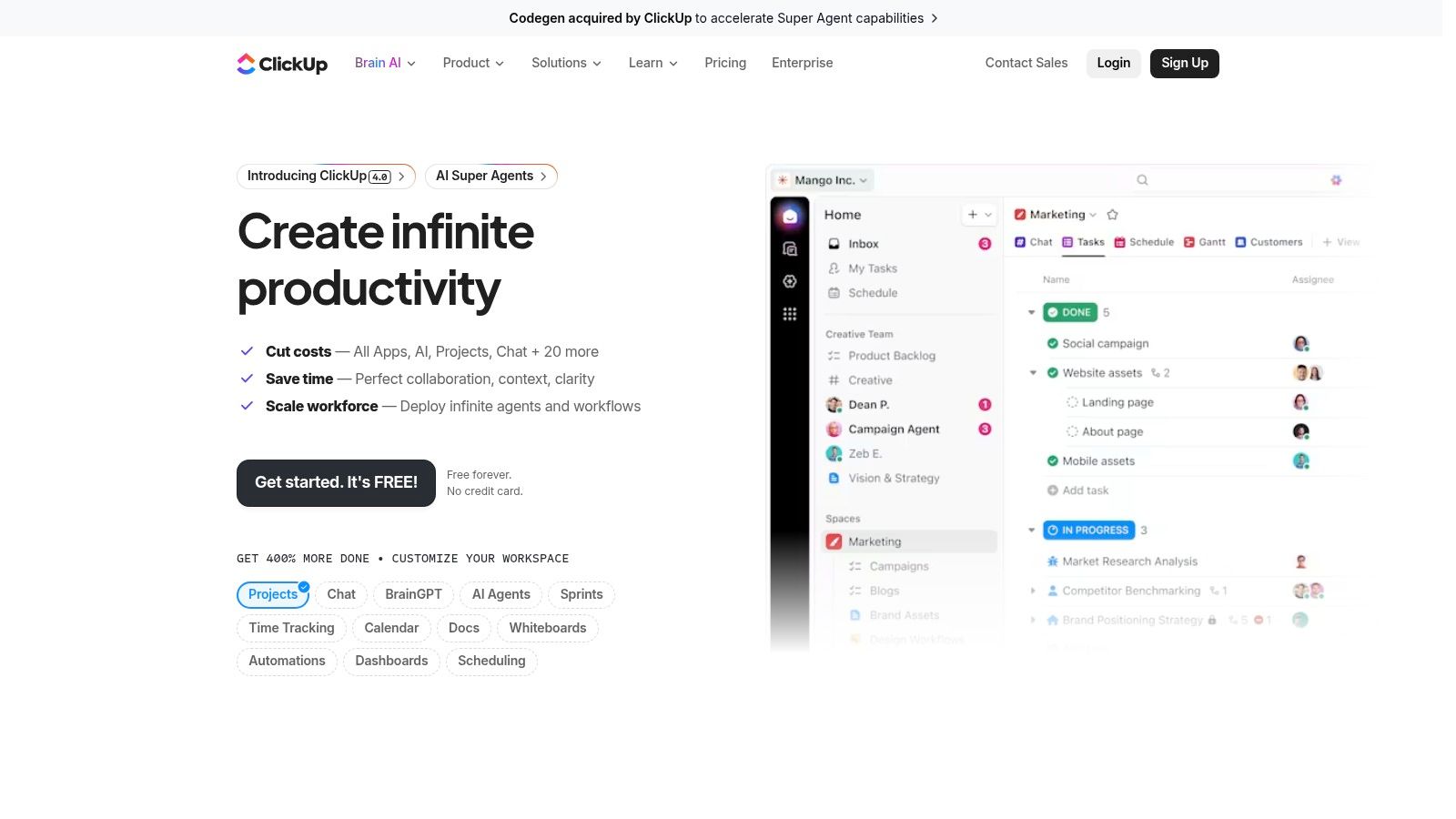
The key strength of ClickUp's AI is its direct connection to the work being done. Instead of operating in a separate environment, the AI pulls context directly from tasks, documents, and comments within a workspace. This allows it to generate highly relevant and actionable content, helping PMs bridge the gap between planning and execution. The platform's competitive base pricing, with AI available as a transparent, usage-based add-on, offers flexibility for teams to scale their AI adoption as needed without a massive upfront commitment.
Key Features & Pricing
- Brain AI & Everything AI: Add-on assistants and agents for automating tasks, generating content, and providing enterprise search.
- AI in Docs & Tasks: Directly generate summaries, action items, and release notes from your existing project data.
- AI Notetaker: Automatically transcribe and summarize meetings, identifying key decisions and action items.
ClickUp offers a robust Free Forever plan for teams to get started. Paid plans like Unlimited ($7/member/month) and Business ($12/member/month) add more advanced features. The AI functionality is available as an add-on for $5 per member per month, which includes a pool of credits for the entire workspace to use.
Website: https://clickup.com
6. Coda
Coda blends the flexibility of a document with the power of a database, and its integrated Coda AI assistant makes it one of the most versatile AI tools for product managers. Instead of disparate tools, PMs can create interconnected docs that serve as dynamic hubs for notes, briefs, and roadmaps. The AI can summarize unstructured meeting notes, extract key action items, and automatically populate structured data tables, turning raw feedback into organized insights instantly. This unique docs-as-apps approach allows teams to build repeatable, AI-powered workflows from the ground up.
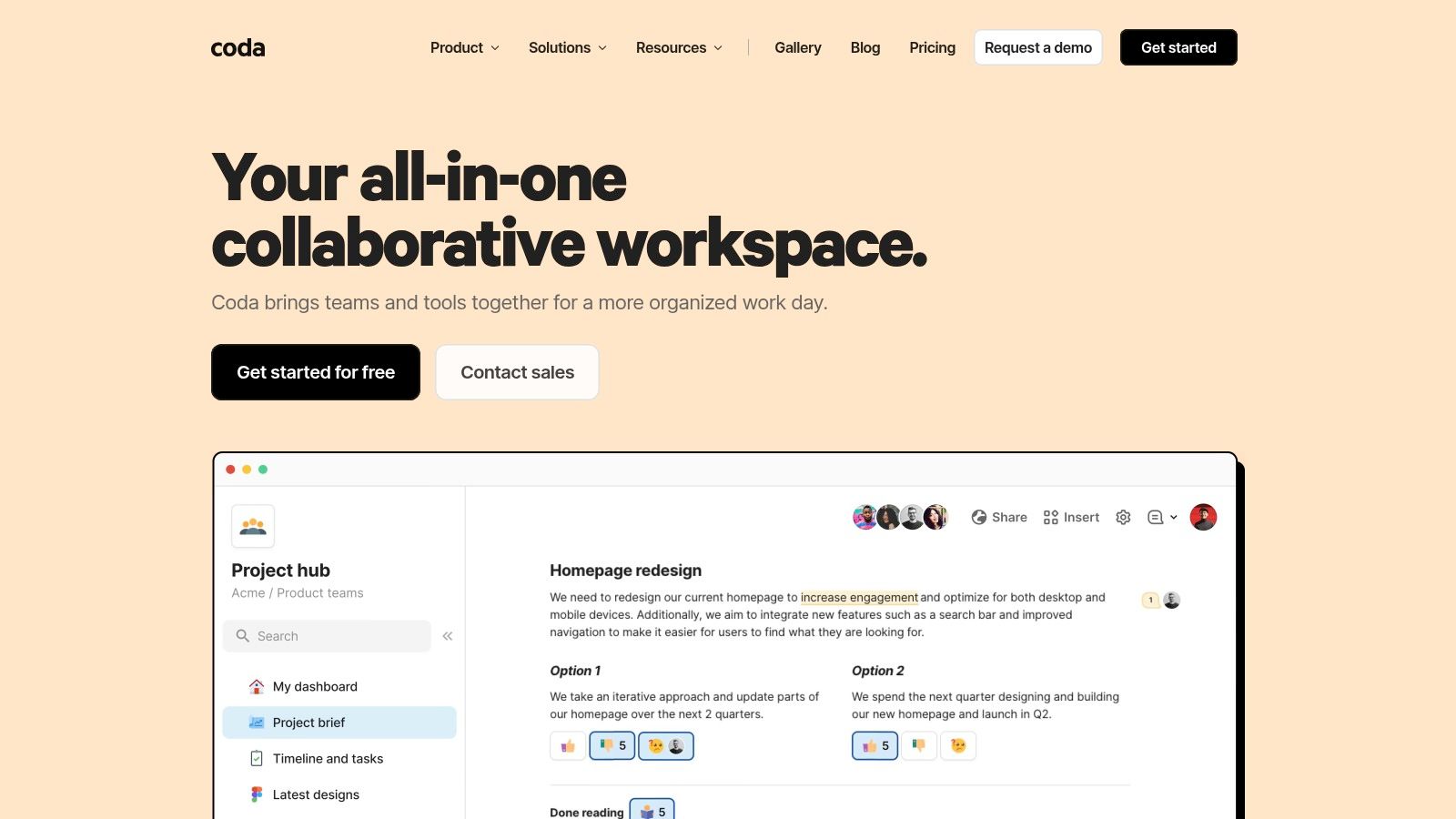
The platform’s strength lies in its fine-grained control and context-aware AI. Product managers can use AI columns to auto-fill fields across tables based on specific prompts, ensuring data consistency for tasks like sentiment analysis or feature categorization. The AI chat assistant understands the full context of a document, enabling PMs to ask complex questions about their data and receive synthesized answers. This makes Coda an excellent choice for teams that want to build custom, centralized product management systems powered by intelligent automation.
Key Features & Pricing
- AI Blocks & Chat: Summarize content, extract action items, and query your doc's data with a context-aware AI assistant.
- AI Columns: Automatically populate structured fields in tables based on custom prompts, ideal for repeatable analysis.
- Product Team Templates: A rich library of pre-built templates for PRDs, roadmaps, and sprint planning to accelerate setup.
Coda offers a Free plan to get started, with paid plans like Pro ($10/Doc Maker/month) and Team ($30/Doc Maker/month) providing more capacity. The Coda AI add-on is available on all plans, with pricing based on user roles and usage credits.
Website: https://coda.io
7. Linear
Linear is a modern issue and project management tool designed for high-velocity product and engineering teams. While known for its speed and minimalist UX, its built-in AI capabilities make it one of the most practical AI tools for product managers focused on execution. Linear's AI agents automate routine tasks like issue triage, labeling, and prioritization, freeing up valuable time. This allows PMs to focus on strategic work instead of administrative overhead.
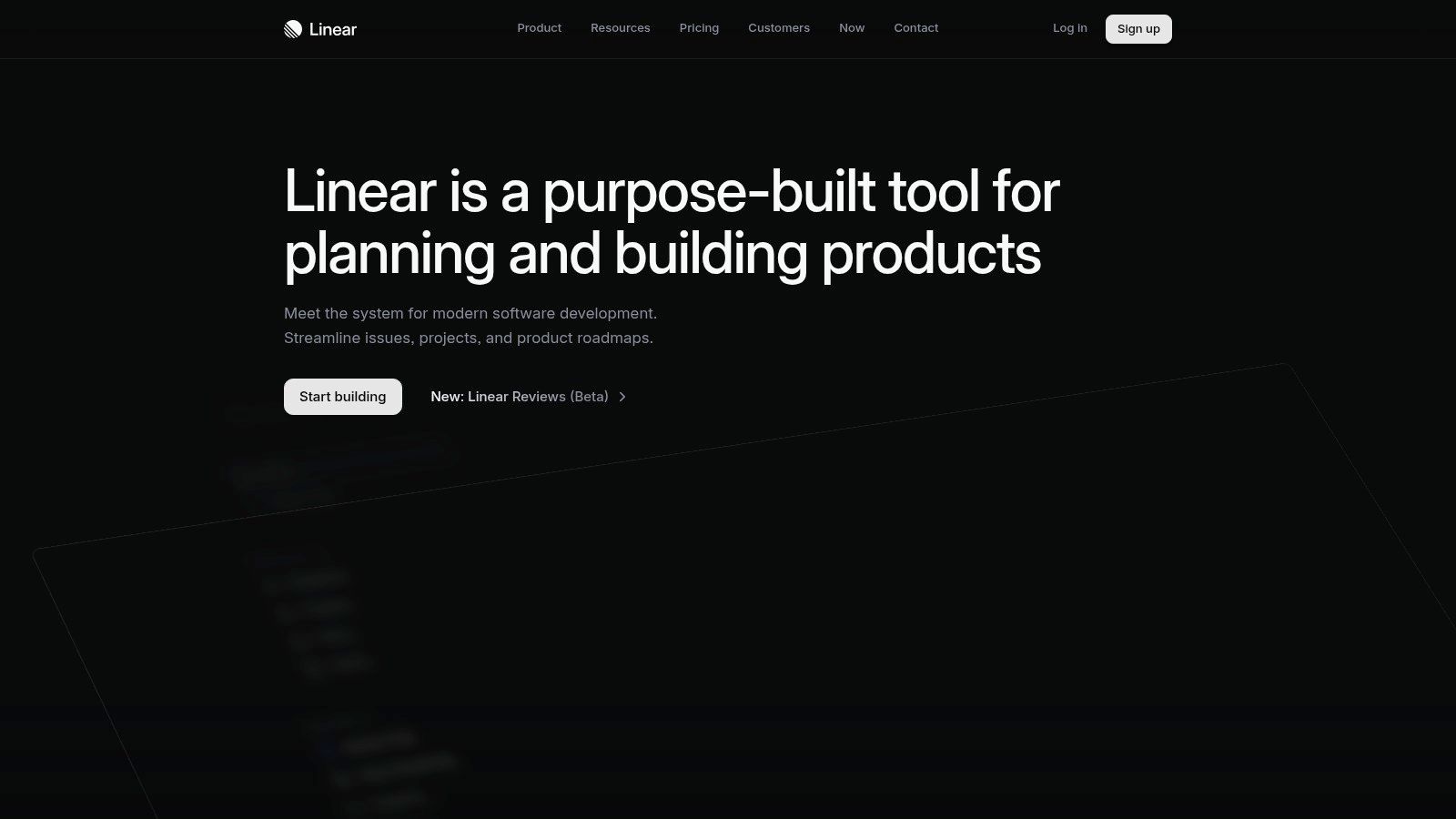
The platform’s strength lies in its Triage Intelligence and Linear Insights dashboards, which provide AI-driven analytics on development cycles. These features help teams identify trends, spot bottlenecks, and measure throughput without manual data crunching. By embedding AI directly into the issue lifecycle, Linear helps teams make data-driven decisions on a daily basis. For those looking to refine their backlog strategy, you can learn more about how to prioritize your product backlog with modern techniques. Its clean interface, popular with engineering-led teams, ensures that these powerful features remain accessible and don't slow down workflows.
Key Features & Pricing
- AI Triage & Agents: Automatically categorize, prioritize, and assign incoming issues to speed up the development cycle.
- Linear Insights: AI-powered analytics dashboards to monitor team throughput, cycle times, and project trends.
- Optimized UX: A fast, keyboard-driven interface built for speed and efficiency, favored by developers.
Linear offers a Free plan to get started, which is great for small teams. The Business plan ($14/user/month) unlocks the powerful Triage Intelligence and Linear Insights features, making it the most valuable tier for product managers seeking to leverage AI for data-driven planning and backlog management.
Website: https://linear.app
8. Dovetail
Dovetail is an AI-native customer research platform designed to transform raw voice-of-customer data into actionable insights. It serves as a central repository for user interviews, feedback, and surveys, using AI to transcribe calls, summarize key findings, and automatically cluster qualitative data into themes. This makes it an indispensable AI tool for product managers looking to streamline their discovery process and ground their decisions in evidence-based research. Its ability to ingest data from over 20 channels automates the collection phase, freeing up time for analysis.
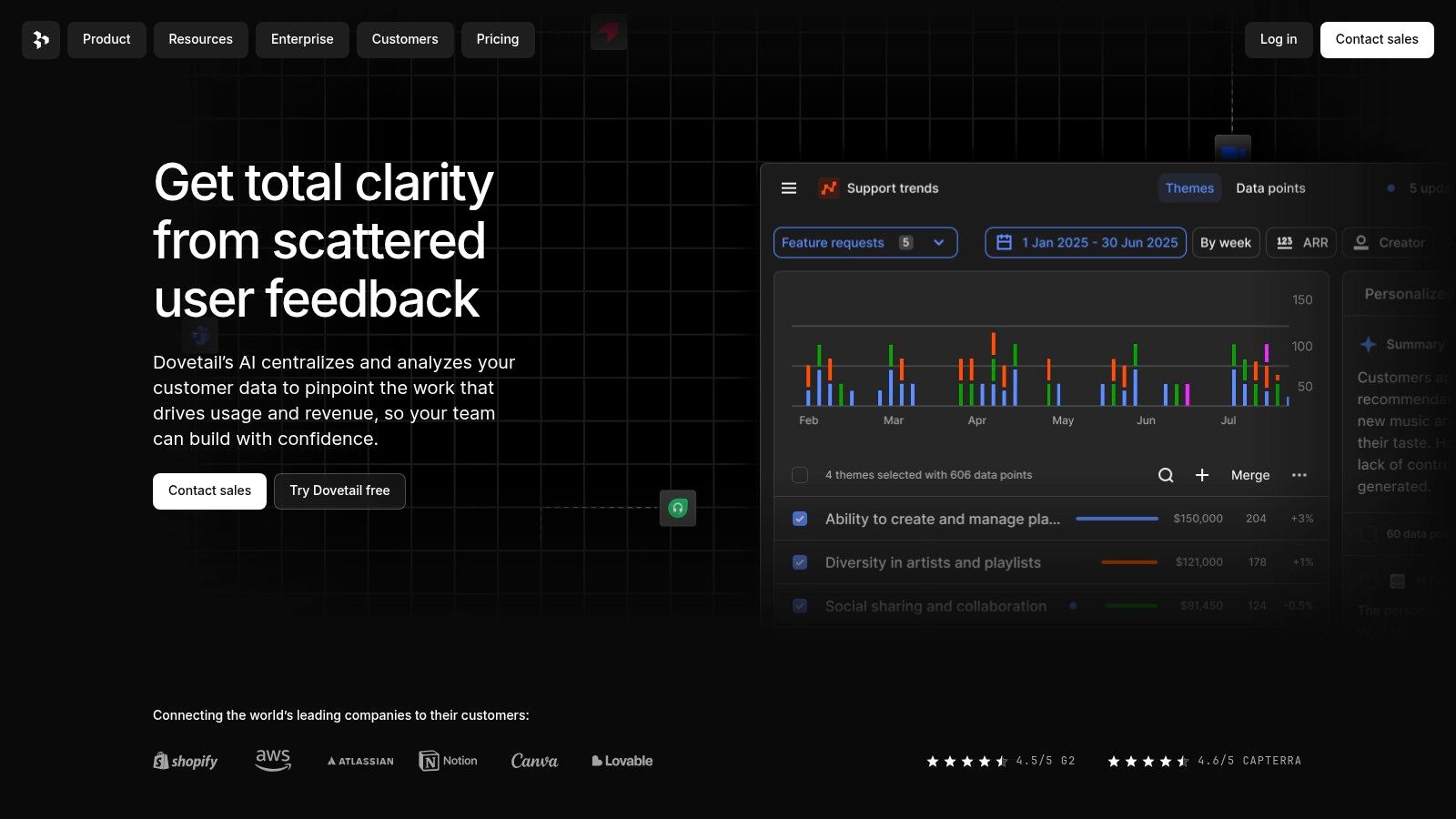
The platform excels at converting scattered qualitative inputs into a structured, searchable knowledge base. Product managers can use its semantic search to instantly find relevant quotes or feedback across multiple research projects, uncovering patterns that would be nearly impossible to spot manually. By turning interviews and feedback into organized, shareable insights, Dovetail helps teams build a deeper, more empathetic understanding of their users and make more confident, customer-centric decisions.
Key Features & Pricing
- AI Transcription & Summaries: Automatically transcribes and summarizes video and audio from user interviews.
- Thematic Clustering: AI-powered analysis that groups feedback and notes into relevant themes to identify trends.
- Centralized Feedback Channels: Ingests ongoing feedback from tools like Slack, Intercom, and Zendesk.
- Semantic Search: Advanced search capabilities to query insights across all projects and data sources.
Dovetail offers a Free plan to get started. Paid plans include the Professional tier ($30/creator/month), which is well-suited for smaller teams, and custom-priced Enterprise plans that add advanced governance and AI agents. Note that data ingestion from channels is metered, so teams should budget for their expected volume.
Website: https://dovetail.com
9. Mixpanel
Mixpanel is a powerful product analytics platform that leverages AI to make deep user insights more accessible. Its standout feature, the Spark AI query builder, allows product managers to ask complex questions about user behavior in plain English, eliminating the need for SQL. This transforms data analysis from a technical task into an intuitive conversation, enabling PMs to quickly understand funnels, retention drivers, and user flows without relying on data analysts. It’s one of the most practical AI tools for product managers looking to self-serve analytics and make data-informed decisions faster.
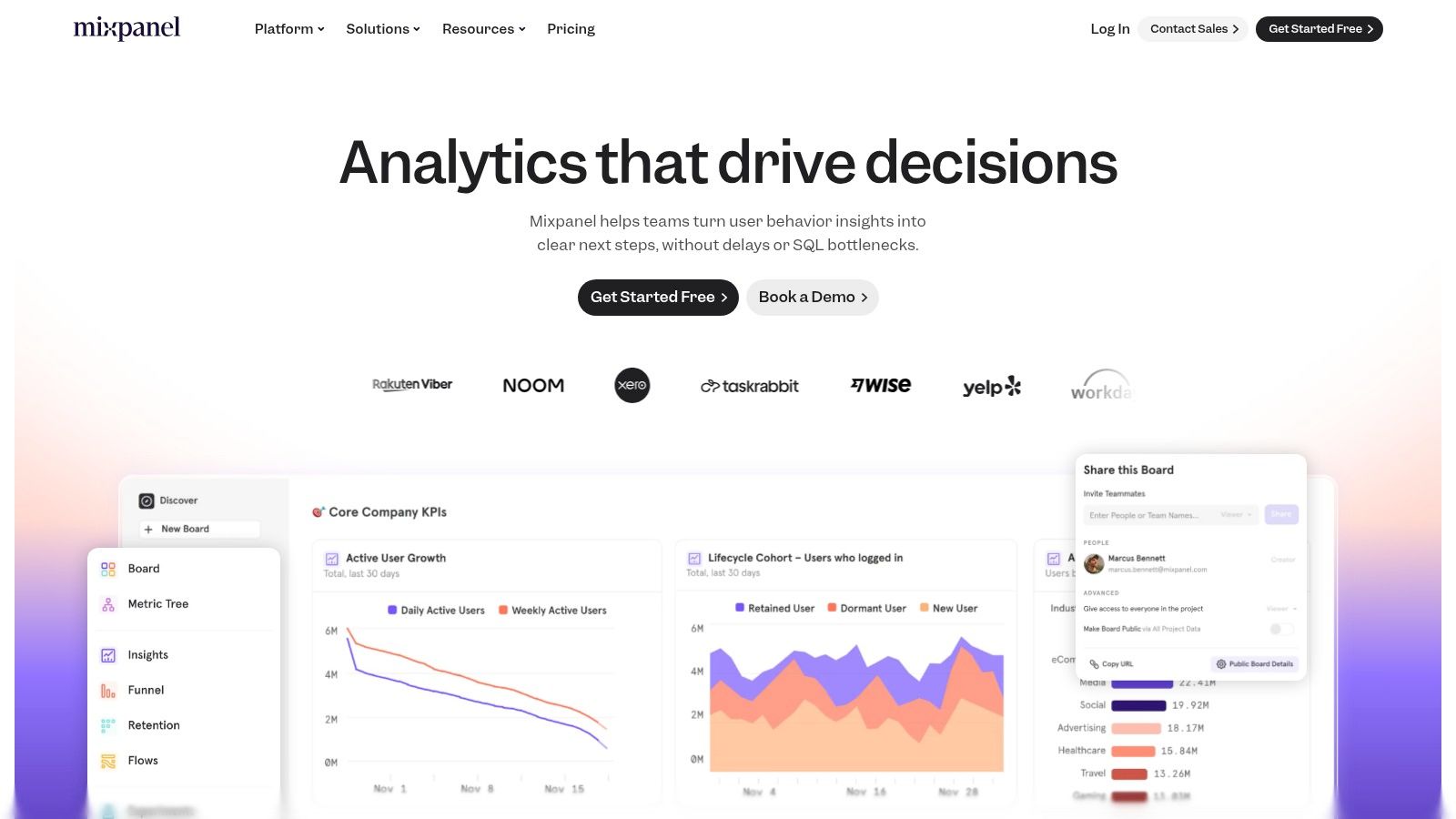
The platform's strength lies in its event-based tracking, which provides a granular view of how users interact with a product. By combining this rich data with AI-powered querying, session replays, and flow visualizations, Mixpanel helps teams uncover the "why" behind their metrics. While initial instrumentation is required to capture events, the long-term value comes from being able to rapidly test hypotheses and measure the impact of product changes on user engagement and retention. The scalable, event-based pricing model makes it accessible for startups and growing companies alike.
Key Features & Pricing
- Spark AI Query Builder: Ask product usage questions in natural language to generate reports and charts without writing SQL.
- Core Analytics Suite: Includes funnels, flows, retention analysis, and session replays for a comprehensive view of the user journey.
- Event-Based Tracking: Scalable infrastructure designed to handle billions of data points, with pricing tied to event volume.
Mixpanel has a generous Free plan that includes up to 1 million monthly tracked events. Paid plans like Growth (starting at $20/month) and Enterprise (starting at $833/month) offer higher event limits, more AI queries per month, and advanced features like data pipelines and dedicated support.
Website: https://mixpanel.com
10. Amplitude
Amplitude is a leading product analytics platform that has deeply integrated AI to supercharge its capabilities, making it one of the most powerful AI tools for product managers focused on user behavior. Its standout feature, "Ask Amplitude," allows PMs to query complex datasets using natural language, effectively acting as an AI data analyst. Instead of writing complex SQL queries, you can simply ask questions like, "What is the conversion rate for users who came from our latest campaign?" and get instant answers and visualizations.
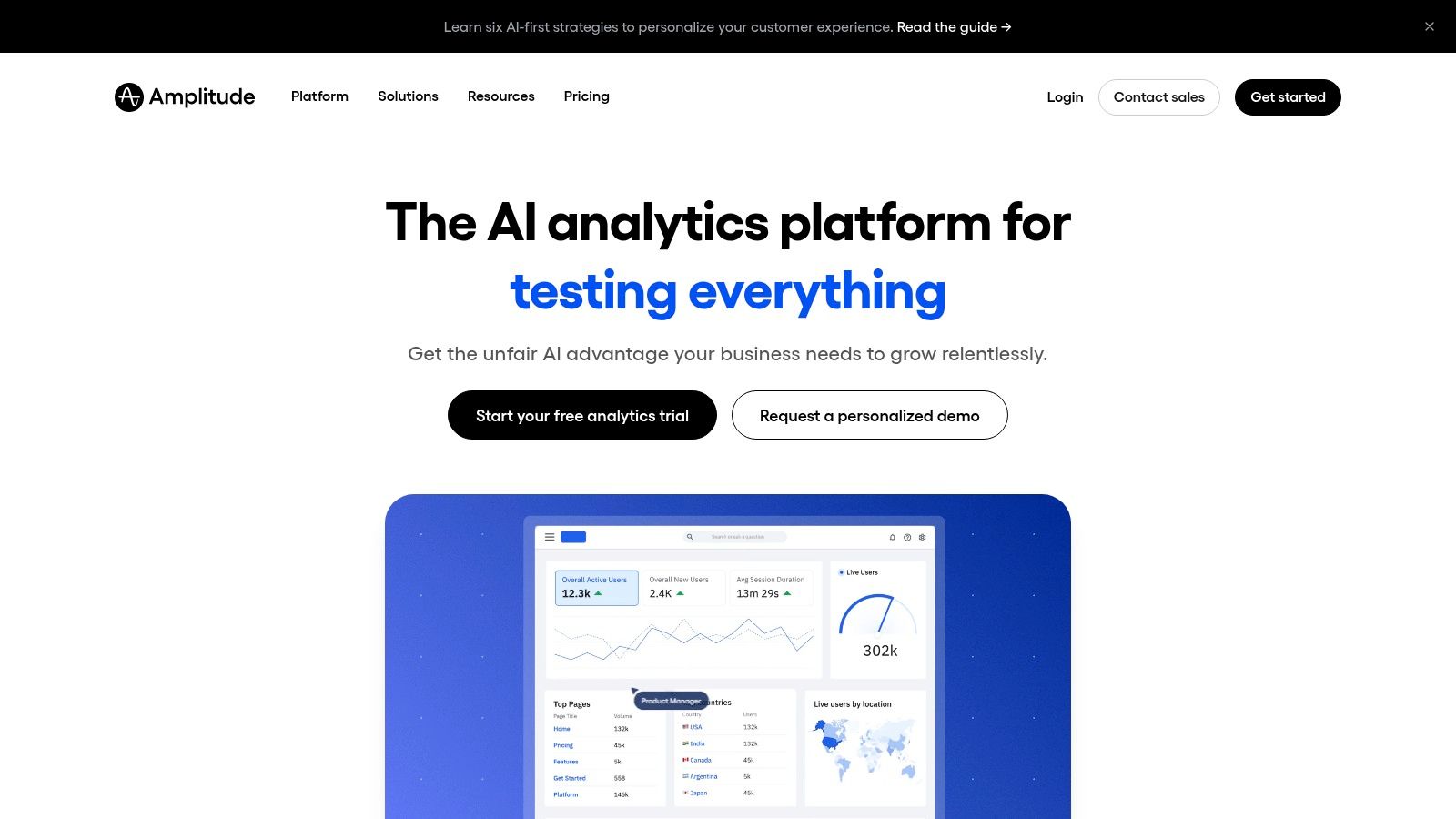
The platform also uses AI to proactively surface anomalies, identify drivers of key metric changes, and automatically generate behavioral cohorts. This saves countless hours in diagnostic work, helping teams quickly understand the "why" behind user actions and identify drop-off points in critical journeys. Amplitude's strength lies in its ability to translate raw data into strategic insights with minimal manual effort, making sophisticated data exploration accessible to the entire product team.
Key Features & Pricing
- Ask Amplitude: Conversational AI for querying data with natural language, no SQL needed.
- AI-Powered Insights: Automatically detects anomalies, key behavioral drivers, and predictive cohorts.
- Experimentation Platform: A/B testing and experimentation suite integrated with deep analytics to validate impact.
- Journey Analysis: Visualizes user paths to identify friction points and opportunities for improvement.
Amplitude offers a generous Free plan to get started with core analytics. Paid plans like Plus and Growth unlock more advanced features, including the AI-driven capabilities and higher event volume. Pricing for fuller enterprise packages typically requires engagement with their sales team to tailor a solution.
Website: https://amplitude.com
11. Aha!
Aha! offers a comprehensive suite of tools designed to cover the entire product development lifecycle, from strategy to execution. Its recent AI enhancements make it a noteworthy contender among AI tools for product managers. The platform's built-in AI assistant helps teams accelerate various tasks, including summarizing customer feedback from ideas portals, drafting release notes, and creating initial versions of strategic documents. This functionality is woven into the platform's core modules, such as Aha! Roadmaps and Aha! Ideas, providing contextual assistance right where PMs work.
The platform's strength is its all-in-one approach. Product managers can connect AI-driven insights directly to their roadmaps, discovery whiteboards, and knowledge bases without switching tools. By analyzing feedback themes automatically or helping draft interview questions, the AI features aim to reduce manual work and surface strategic insights faster. This tight integration makes Aha! a powerful option for mature product organizations seeking to streamline their end-to-end workflows with a single, unified system.
Key Features & Pricing
- AI-Powered Drafting: Assists in writing release notes, strategic documents, and feature requirements.
- Automated Idea Analysis: Summarizes and identifies key themes from large volumes of customer feedback submitted through its ideas portal.
- End-to-End Product Suite: Integrates roadmapping, discovery, idea management, and a knowledge base in one platform.
Aha! offers several product modules with their own pricing. Aha! Roadmaps starts at $59/user/month. While there is no free trial, the Aha! Ideas module has a Free plan for up to 10 contributors to get started. Advanced features and some AI capabilities may require higher-tier plans or add-on modules, making it a premium choice better suited for established teams.
Website: https://www.aha.io
12. Pendo
Pendo is a powerful product experience platform that combines deep product analytics with in-app user guidance, feedback collection, and roadmapping. While known for its analytics suite, Pendo is integrating AI across its platform to become one of the more comprehensive AI tools for product managers. Its AI capabilities aim to automatically generate insights from quantitative user data and qualitative feedback, bridging the gap between what users do and what they say. This allows PMs to quickly identify friction points, segment users for targeted in-app guides, and validate hypotheses without extensive manual analysis.
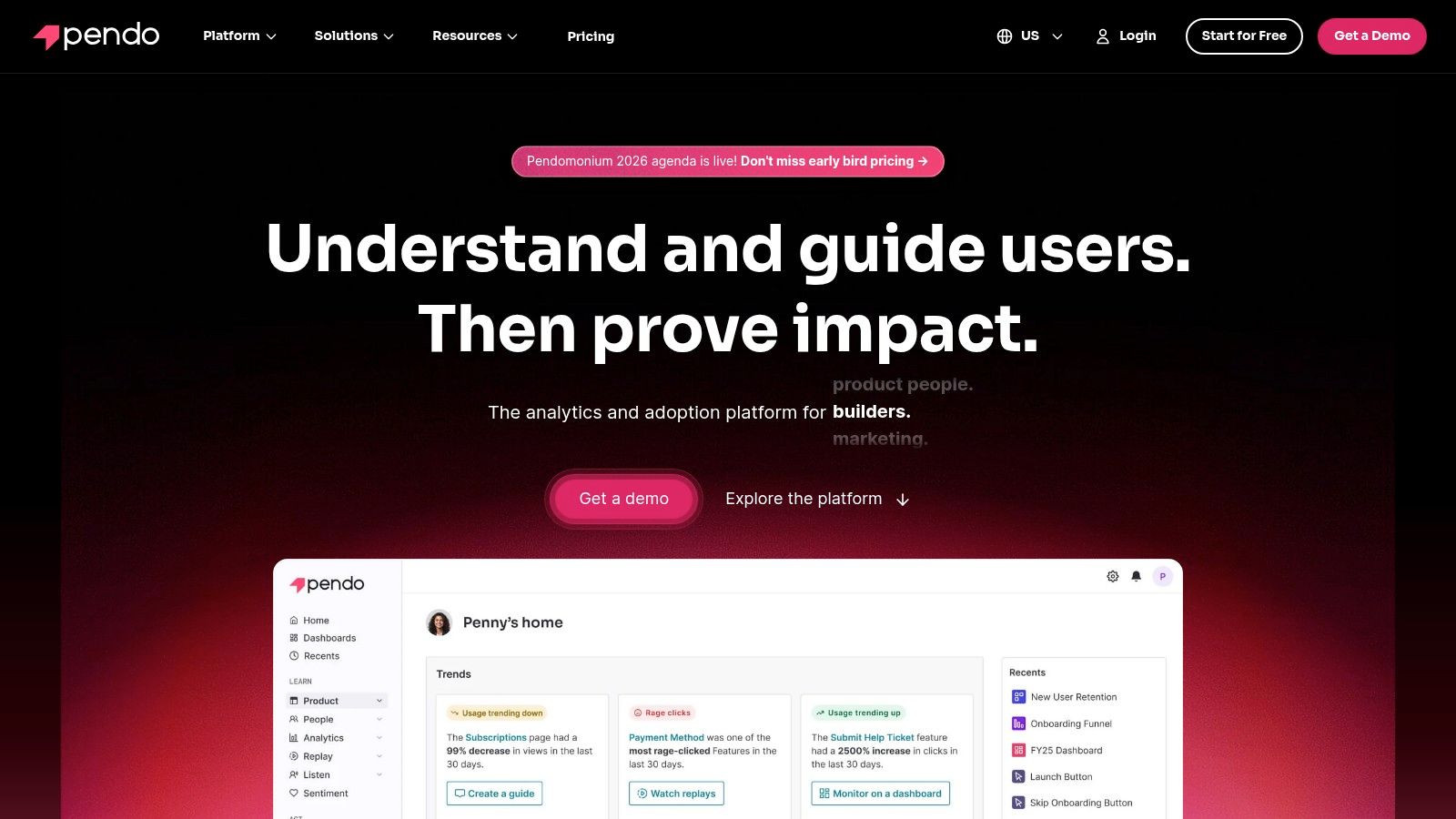
The platform's unique strength lies in its ability to close the loop between measurement and engagement. For instance, after AI surfaces a key drop-off point in a user journey, a product manager can immediately deploy an AI-generated in-app guide to help users navigate the feature. Pendo also offers a free, self-paced "AI for Product Management" course, providing a valuable educational resource for teams looking to standardize their AI fluency. For teams focused heavily on user feedback, you can explore other top-rated customer feedback software to complement Pendo's analytics.
Key Features & Pricing
- AI-Powered Insights: Automatically analyzes product usage data and feedback to surface trends and opportunities.
- In-App Engagement: Deploys user guides, polls, and NPS surveys based on analytics and user segments.
- Free AI Course: Offers a dedicated "AI for Product Management" course to help upskill product teams.
Pendo offers a Free plan to get started, which supports up to 500 monthly active users (MAUs). For larger teams and more advanced features, its core pricing packages are quote-based and typically require engaging with their sales team.
Website: https://www.pendo.io
12 AI Tools for Product Managers — Feature Comparison
| Tool | Core features | UX & Quality (★) | Value & Price (💰) | Target audience (👥) | Unique selling points (✨) |
|---|---|---|---|---|---|
| FeatureBot 🏆 | One-line widget, AI follow-ups, semantic clustering, revenue-weighted signals, full submission context, integrations | ★★★★★ | 💰 Starter $13/mo → Growth $21/mo → Scale $83/mo; Free plan + 60‑day guarantee | 👥 SaaS founders, PMs, CS & engineers | ✨ Revenue-weighted prioritization, weekly AI digests, verbatim voices, AI code gen |
| Productboard | Feedback intake + Spark AI, roadmaps, customer portals | ★★★★☆ | 💰 Per-maker pricing; free Spark credits for trial | 👥 Product managers & roadmap teams | ✨ Spark agent tuned for briefs/PRDs and competitive analysis |
| Atlassian (Jira & Confluence) | Rovo AI (search, chat, agents), indexed quotas, Marketplace AI apps | ★★★★ | 💰 Rovo quotas included in paid cloud tiers; enterprise pricing | 👥 Engineering orgs & large enterprises | ✨ Enterprise governance + rich Marketplace extensibility |
| Notion | Docs, databases, Notion AI (notes, agents, enterprise search) | ★★★★ | 💰 Business tier includes advanced AI; verify current AI pricing | 👥 Cross-functional teams, PMs documenting discovery | ✨ Unified docs+databases with AI agents for drafting & summarization |
| ClickUp | Tasks/docs + Brain/Everything AI add-ons, AI notetaker, automations | ★★★★ | 💰 Competitive base; AI available as paid add-ons with credits | 👥 PMs, ops, engineering teams wanting execution tooling | ✨ Deep task-doc integration and monthly AI super credits |
| Coda | Docs-as-apps, AI blocks & columns, templates, context-aware chat | ★★★★ | 💰 Role-based licensing; confirm AI entitlements | 👥 PMs building structured workflows & templates | ✨ Structured AI outputs (auto-fill columns) and repeatable templates |
| Linear | Issue/project management, AI triage, Linear Insights analytics | ★★★★★ | 💰 Competitive Business tier for Insights; lightweight pricing | 👥 Engineering-led, high-velocity product teams | ✨ Fast UX + triage intelligence for rapid issue lifecycles |
| Dovetail | VOC ingestion, transcripts, theme clustering, semantic search | ★★★★ | 💰 Professional tier affordable; channel ingestion metered | 👥 Research teams & PMs focused on qualitative insights | ✨ Converts interviews/feedback into shareable, clustered insights |
| Mixpanel | Product analytics, AI query builder, funnels, session replay | ★★★★ | 💰 Generous free tier (up to 1M events); event-based pricing | 👥 Growth/product analysts & PMs needing product metrics | ✨ AI-assisted queries w/o SQL and scalable event pricing |
| Amplitude | Conversational analytics, journey analysis, experimentation | ★★★★ | 💰 Enterprise-focused; pricing often sales-led | 👥 Enterprise PMs & data teams validating impact | ✨ Deep behavioral analytics + experimentation features |
| Aha! | Roadmaps, ideas portal, discovery, AI assistant, add-on modules | ★★★★ | 💰 Premium pricing for full-suite features | 👥 Roadmap-heavy PM organizations | ✨ End-to-end product suite with training/certification |
| Pendo | Analytics, in-app guides, NPS, discovery tooling, AI course | ★★★★ | 💰 Free tier up to 500 MAUs; core pricing sales-led | 👥 PMs combining measurement & in-app engagement | ✨ Combines analytics + in-app guides and an AI PM course |
Building Your Future-Proof Product Stack
Navigating the landscape of AI tools for product managers can feel like charting unknown territory. We've explored a wide range of platforms, from feedback-centric solutions like FeatureBot and powerful roadmapping tools like Productboard to analytics giants like Mixpanel and collaborative hubs like Notion and ClickUp. Each tool offers a unique way to augment your capabilities, automate tedious tasks, and unlock deeper insights that were previously out of reach.
The central takeaway is clear: the question is no longer if you should adopt AI, but how and where. Integrating these technologies isn't about replacing the core strategic and empathetic work of a product manager. Instead, it's about building a "centaur" product team, one where human intuition and creativity are amplified by the analytical power and efficiency of artificial intelligence. Your goal is to offload the repetitive, data-heavy lifting so you can focus on what truly matters: understanding your users, collaborating with your team, and building products that solve real problems.
Your Actionable Path Forward
The sheer number of options can be overwhelming, but your next steps are straightforward. Don't aim for a complete overhaul overnight. Instead, identify your team's most significant bottleneck and start there.
- Is user feedback a black hole? Start with a tool like FeatureBot or Dovetail to automate synthesis and identify critical themes.
- Is your roadmap disconnected from strategy? Look at how AI features in Aha! or Productboard can help you prioritize with data-driven confidence.
- Are you drowning in data and struggling for insights? Explore how Mixpanel or Amplitude use AI to surface user behavior patterns you might otherwise miss.
- Is documentation and communication a constant struggle? Leverage the AI assistants in Notion, Coda, or Atlassian Intelligence to streamline writing and knowledge management.
When evaluating these AI tools for product managers, move beyond the feature list. Consider the total cost of ownership, which includes implementation time, team training, and the effort required to integrate the tool into your existing workflows. The most powerful tool is useless if it creates more friction than it removes. Start small, prove the value with a pilot project, and then scale the solution across your organization. This iterative approach mirrors the product development lifecycle itself and ensures a higher chance of successful adoption.
Preparing for What's Next
The pace of AI development is staggering. The tools we discussed today will evolve, and new ones will emerge. Building a future-proof stack means fostering a culture of continuous learning and adaptation within your team. As you plan your long-term strategy, understanding the broader ecosystem is crucial. For instance, looking ahead at the best AI Business Intelligence Tools for 2026 can provide valuable context on how data analytics and product insights will converge even further.
Ultimately, the best AI tool is the one that seamlessly extends your team's capabilities and helps you build better products, faster. By making a strategic, needs-based choice, you are not just buying software; you are investing in a more intelligent, efficient, and user-centric future for your product organization.
Ready to transform your user feedback from a chaotic stream into a clear, prioritized source of truth? FeatureBot uses AI to automatically analyze, tag, and synthesize feedback from Slack, support tickets, and more, giving you the insights you need to build what customers truly want. Start centralizing your feedback and building a data-driven roadmap today with our Free plan.
Ready to capture better feedback?
FeatureBot helps you collect, organize, and prioritize user feedback with AI-powered conversations.
Get Started Free