Customer Feedback Format: A Guide to Actionable SaaS Insights
A customer feedback format is just a fancy way of saying how you ask for and gather insights from the people using your product. Forget those clunky, outdated surveys you're used to seeing. The best format is built right into your product, capturing feedback in the moment, which ultimately gives you better data to make smarter decisions.
Why Your Customer Feedback Format Matters So Much
Let's be real for a minute: most of the ways companies ask for feedback are completely broken. They still lean on long, formal surveys that land in an email inbox days after someone has used the product. Most people just ignore them. The result? Rock-bottom response rates and feedback so generic it tells you almost nothing about what your users actually think or do. This is exactly why picking the right customer feedback format is so critical.
The way you ask for feedback is just as important as the feedback you get back. Think about it—if you want honest advice from a friend, you don't hand them a clipboard and a ten-page questionnaire. You have a conversation. It's the same with your users. A modern, in-app conversational format feels natural, making people far more likely to open up and share what’s really on their minds.
The Shift to Real-Time Insights
The sharpest product teams have already figured this out. They're ditching the old-school methods and moving to real-time, integrated feedback. This whole shift is about one thing: meeting users where they already are—inside your product—and making it dead simple for them to share their thoughts the second they pop into their heads.
This modern approach has some serious upsides:
- Higher Quality Data: When someone gives you feedback right after they've had an experience, it's fresh, accurate, and packed with detail. No more hazy recollections.
- Increased Response Rates: Making it easy and contextual means more people will actually engage. It’s a world away from asking them to stop what they're doing and check their email.
- Better Product Decisions: When you get rich, contextual data, you finally understand the "why" behind what users are asking for. That’s how you build a roadmap that actually moves the needle.
This isn't just a small trend; it's a fundamental change backed by huge market growth. The global customer feedback software market was valued at US$2.38 billion in 2024 and is expected to more than double by 2031. This explosion shows just how seriously businesses are taking modern, structured feedback to fuel their growth. You can dig deeper into these market trends in this detailed report.
The core idea is simple: a better customer feedback format leads to better data. Better data drives smarter product decisions and faster, more sustainable growth.
Comparing the Most Common Feedback Formats
Picking the right way to ask for customer feedback is a lot like choosing the right tool for a job. You wouldn't use a sledgehammer to hang a picture frame, right? In the same way, you shouldn't use a broad loyalty survey when what you really need is a detailed report on a specific bug.
Each feedback format is designed to answer a different kind of question. A Net Promoter Score (NPS) survey is like taking your company's temperature—it gives you a quick, high-level sense of overall customer health. A bug report, on the other hand, is more like a detailed medical diagnosis, giving you the specific, actionable information needed to fix something that's broken. Getting this distinction right is the first step toward collecting insights that actually move your product forward.
Quantitative vs. Qualitative Feedback: The Numbers and The Stories
The biggest split in the world of feedback is between the numbers and the stories.
Quantitative formats are all about the hard data. Think NPS, CSAT, and CES. These tools are fantastic for tracking trends over time, benchmarking your performance against competitors, and getting that 30,000-foot view of customer sentiment. They answer questions like "what" and "how many."
Qualitative formats, like open-text surveys and detailed bug reports, are where you find the why. They capture the rich context behind the numbers—the user stories, the specific pain points, and the brilliant suggestions you’d never think of yourself. A truly effective feedback system needs a healthy mix of both.
If you’re not sure where to start, this decision tree can help you choose a format based on whether you're focused on keeping customers or improving the product itself.
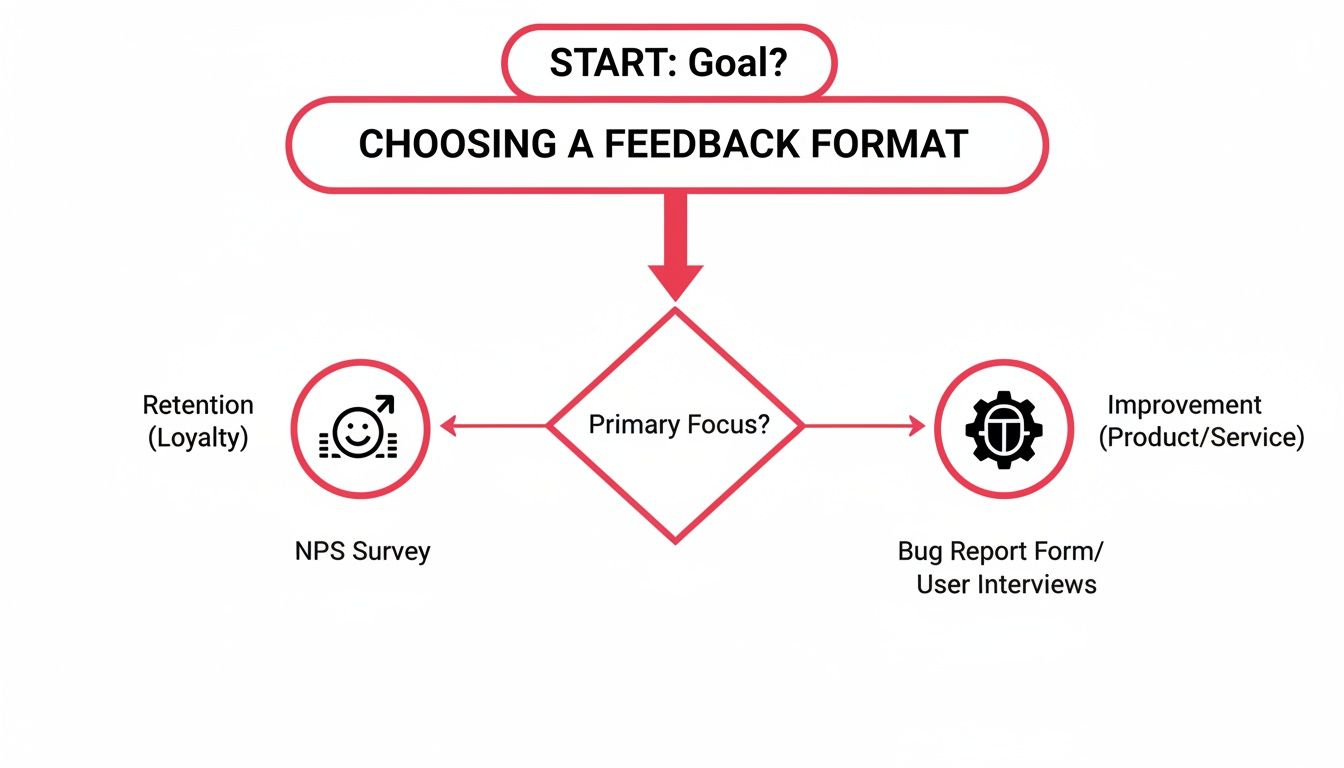
As the chart shows, if your main goal is building long-term loyalty, a metric like NPS is a great place to start. But if you need to fix a broken feature or build a new one, nothing beats the directness of a bug report or a feature request.
A Closer Look at the Key Feedback Formats
Let's dig into the most common formats you'll encounter. We'll break down what each one is good for, its strengths, and where it might fall short.
Net Promoter Score (NPS): This one’s famous for its simplicity. It asks just one question: "On a scale of 0-10, how likely are you to recommend our product to a friend or colleague?" The goal is to measure long-term loyalty and get a sense of future growth potential. It’s best used periodically, maybe once a quarter, to track overall brand health.
Customer Satisfaction (CSAT): CSAT is all about measuring short-term happiness with a specific event. Think of it as a thumbs-up or thumbs-down right after a support chat or after you’ve guided a user through a new feature. The question is usually, "How satisfied were you with your recent experience?" on a 1-5 scale. It’s perfect for getting immediate feedback on individual touchpoints.
Customer Effort Score (CES): This metric gets right to the heart of usability. It asks, "How much effort did you personally have to put forth to handle your request?" We know that low-effort experiences create loyal customers, making CES a powerful tool for finding and eliminating friction in your product.
Bug Reports: This is a highly specific, qualitative format that gives your engineers everything they need to find and crush a technical problem. A good bug report includes clear steps to reproduce the issue, what the user expected to happen, and what actually happened. It’s pure, actionable feedback.
In-App Ratings: These are the simple star ratings you see everywhere. They’re a low-effort way for users to give a quick opinion on a feature or the app as a whole. While they don't provide much detail, they can give you a broad sense of how people are feeling over time.
Open-Text Surveys: Unlike the others, this format is just a blank canvas. It asks an open-ended question like, "What's one thing we could do to improve your experience?" This is where you’ll find gold. It’s the best way to uncover problems you didn't even know you had and hear brilliant ideas straight from your users.
Seeing how these questions are phrased in the real world can make a big difference. Checking out a few customer feedback form templates is a great way to see what an effective survey looks like in practice.
The secret isn’t picking one “best” format. It’s about building a system that blends the big-picture view from your quantitative metrics with the deep, human insights you get from qualitative feedback.
For any SaaS team, knowing https://featurebot.com/blog/how-to-collect-feedback-from-customers is half the battle. The right method can completely change the quality of the insights you get. To make things clearer, the table below breaks down each format to help you pick the right one for any situation.
Customer Feedback Format Comparison
This table offers a side-by-side look at the most common feedback formats, helping you decide which tool to pull out of your toolbox for any given task.
| Feedback Format | Primary Goal | Best Use Case | Pros | Cons |
|---|---|---|---|---|
| NPS | Measure long-term loyalty | Quarterly health checks; benchmarking | Simple, standardized, good predictor of growth | Lacks specific context; can be a vanity metric |
| CSAT | Gauge short-term satisfaction | Immediately after a specific interaction (e.g., support ticket, purchase) | Transactional, immediate, easy to act on | Narrow focus, doesn't measure overall relationship |
| CES | Measure ease of use | After a user completes a key task (e.g., onboarding, finding help docs) | Strong predictor of loyalty, highlights friction points | Less known than NPS/CSAT, context is crucial |
| Bug Reports | Identify & fix technical issues | When a user encounters an error or unexpected behavior | Highly actionable, provides detail for developers | Can be high-effort for users, requires a clear reporting process |
| Open-Text Surveys | Discover unknown issues & ideas | When you need new ideas or want to understand the "why" | Rich, detailed insights; uncovers blind spots | Time-consuming to analyze, unstructured data |
| In-App Ratings | Capture quick sentiment | For getting a general pulse on a feature or the overall app | Low-friction for users, easy to collect at scale | Very low detail, lacks actionable context |
Ultimately, each of these formats has a role to play. The trick is knowing when to use each one to get a complete, 360-degree view of your customer's experience.
Let's Talk: The Shift to Conversational and In-App Feedback
Let’s be honest, traditional feedback forms are starting to feel a bit old-fashioned. The future isn't about sending out detached email surveys days later; it's about engaging with users directly inside your product, right when they have something to say.
Think of it this way: a modern customer feedback format should feel less like an interrogation and more like a helpful chat. When you embed a conversational widget directly into your app, you’re not just collecting data—you're starting a dialogue. This approach is a game-changer for engagement because it feels natural and removes all the friction for the user.
Context is King
One of the biggest headaches with old-school surveys is the total lack of context. A user might leave a low score, but you're left guessing. What were they trying to do? What went wrong? Heck, who even are they? Conversational, in-app feedback fixes this on the spot.
This format automatically grabs a goldmine of crucial data with every piece of feedback submitted. We're talking about details like:
- Browser and OS Data: You immediately know the technical environment where the issue popped up.
- Session Details: See the exact path the user took, including the pages they visited right before leaving feedback.
- Error Logs: Pinpoint specific console errors that give your engineering team the clues they need to solve the problem.
This extra information gives you the whole story. It turns a vague comment like "it's broken" into a detailed, actionable report without making the user do any extra work.
Bringing AI into the Conversation
This is where things get really powerful. Instead of just a static text box, an intelligent widget can ask smart, relevant follow-up questions in real time. If a user suggests a new feature, the AI can gently probe for more detail: "That's an interesting idea! What problem would that solve for you?" This conversational back-and-forth pulls out far richer qualitative data than any static form ever could.
For those looking to dive deeper, this guide to conversational AI chatbots offers some great insights on building effective automated dialogues.
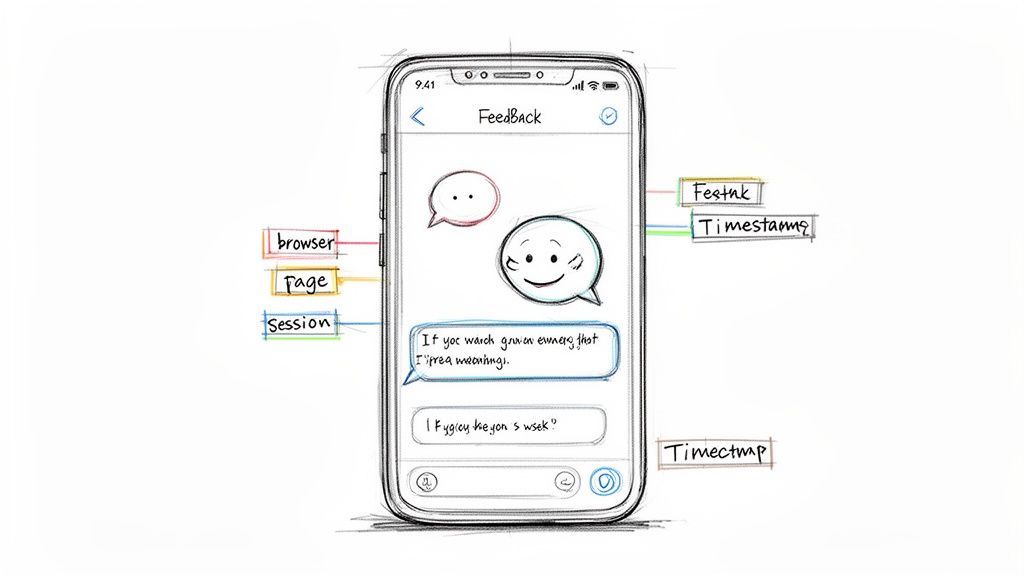
The sketch above really brings this to life, showing how a chat interface can blend a user's comments with the technical context that product teams need.
This isn't just a niche idea; it's a huge trend. In 2024, 61% of customers already said they prefer digital channels like live chat, and 52% are more likely to stick with brands that offer it. By 2026, experts predict these short, in-the-moment prompts will completely take over, finally pushing those long, outdated surveys to the side.
By meeting users where they are and when it matters most, you transform feedback from a chore into a seamless part of the user experience.
Of course, building this kind of modern feedback loop depends on having the right tools. If you're exploring your options, our guide on the best customer feedback tools can point you in the right direction for your SaaS business.
Using AI to Turn Raw Feedback Into Actionable Insights
Collecting customer feedback is one thing, but making sense of it is a whole different beast. Product teams are often drowning in a sea of unstructured comments, bug reports, and random feature ideas. Trying to manually sort through all that raw data isn't just a massive time sink—it's practically impossible to do well once you have more than a handful of customers.
This is where AI steps in as a product team's best friend. Think of it as a brilliant assistant that can read, understand, and categorize thousands of pieces of feedback in the time it takes to grab a coffee. Instead of you spending weeks on manual analysis, AI does the heavy lifting in minutes.
From Manual Mess to Automated Clarity
One of the most practical ways AI helps is through semantic matching. Let's say you get ten requests for "a way to export reports," five for "downloading my data," and another eight for "a CSV button." A human can easily see these are all the same request, but a simple keyword search would treat them as separate things.
Semantic matching is smart enough to understand the meaning behind the words, not just the words themselves. It automatically bundles these duplicate suggestions together, giving you a clean, unified view of what people are actually asking for. This cuts through the noise instantly and reveals the true demand for a feature.
The goal is to move from simply collecting feedback to systematically understanding it. AI makes it possible to spot emerging trends and get concise summaries of what matters most to your users, delivered right to your team.
Prioritizing Feedback with Revenue Weighting
Once you’ve grouped the feedback, the inevitable question comes up: "What do we build next?" A classic mistake is to just count the votes and build whatever gets requested most. But that approach treats a free-trial user and a massive enterprise client as equals, which doesn't make much business sense.
A far more powerful method is weighting feedback by customer revenue (MRR). This completely changes the game, moving prioritization from a simple popularity contest to a strategic model that ties your roadmap directly to business growth.
By connecting every feature request to the MRR of the customer who submitted it, you can finally see which ideas come from your most valuable accounts. A feature requested by three enterprise customers paying you $5,000 per month should absolutely carry more weight than something requested by a hundred users on your free plan.
The Strategic Impact of AI-Driven Insights
This AI-powered approach creates a direct line from what your users need to what your team builds. Instead of guessing, your roadmap is guided by hard data showing what will keep your best customers happy and attract more like them. It’s no surprise that this blend of AI and automation is changing how SaaS teams operate.
In fact, 80% of executives have already seen customer experience improvements from using conversational AI. The companies that are ahead of the curve are reporting a 10-15% reduction in churn and a 30% lift in win rates by putting AI at the core of their customer strategy. You can dig into more of this data with these customer experience statistics and findings.
It all points to one thing: listening to your most valuable customers isn’t just good practice—it’s essential for building a successful, sustainable business.
Building an Integrated Feedback Loop That Works
Collecting customer feedback is just the start. The real magic happens when you actually do something with it. Feedback left to die in a spreadsheet or a dusty inbox is just a missed opportunity. What you're really aiming for is an automated, closed-loop system that funnels those golden nuggets of insight directly into the tools your team lives in every day. This is how raw comments become real, trackable actions.
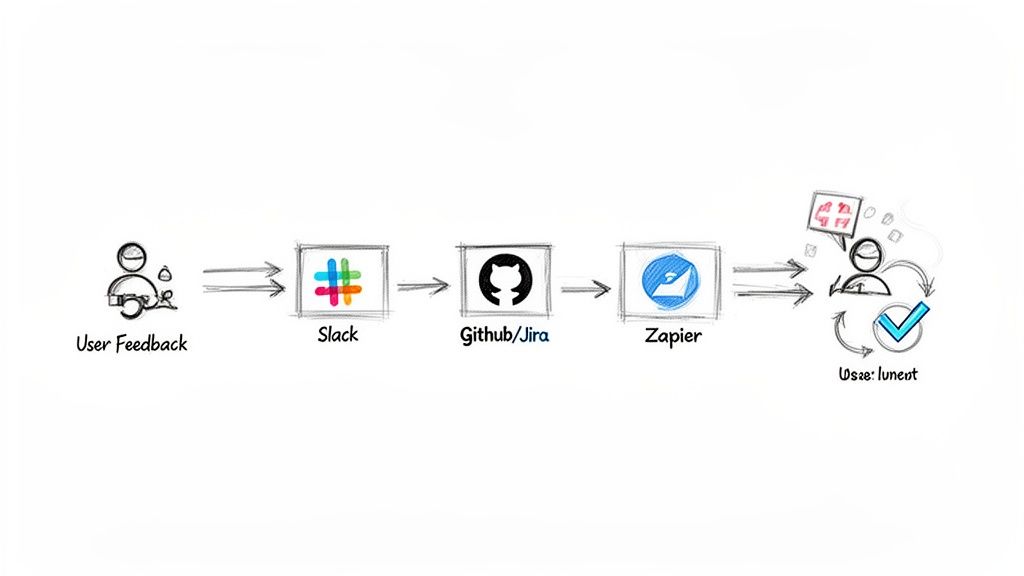
This process, sometimes called "operationalizing feedback," is all about making sure nothing slips through the cracks. It’s about building a reliable workflow so that every piece of feedback gets seen, sorted, and acted on. When you nail this, your whole team stays in sync and focused on what your customers actually want.
Connecting Feedback to Your Daily Workflow
The trick is to connect your feedback collection points directly to your operational tools. Think of it like building a superhighway between your customers and your product, engineering, and success teams. With the right integrations, you can put this entire process on autopilot, making your feedback loop both efficient and incredibly powerful.
Here’s what a smart, integrated workflow looks like in the real world:
Instant Slack Notifications: A new piece of feedback comes in, and boom—an alert pops up in a dedicated Slack channel. This keeps the customer's voice front and center for the whole team, which is huge for building a customer-first culture.
One-Click Issue Creation: A product manager sees the feedback in Slack and, with a single click, turns it into a ticket in Jira or an issue in GitHub. No more copy-pasting. The ticket is instantly created with the user's original comment and all the important context, like their browser info and session details.
Custom Workflows with Zapier: Need to get fancier? Tools like Zapier or webhooks let you build all sorts of custom automations. For example, you could automatically tag users who request a certain feature, creating a ready-made list of people to notify when you eventually ship it.
The Final Step: Closing the Loop
An integrated system isn't just about making your internal process smoother; it's about building genuine relationships with your customers. The loop comes full circle when you finally ship a feature someone asked for. You can reach back out to them and say, "Hey, you asked for this, and we built it." That one small action can turn a casual user into a die-hard fan.
A truly effective customer feedback format is one that doesn’t just collect information but actively drives action. It creates a seamless flow from customer insight to product improvement and back to the customer.
By building these connections, you guarantee that no feedback ever gets lost in the shuffle. If you want a more detailed guide, check out our post on closing the feedback loop—it has concrete steps for building a system that keeps your team aligned and your customers feeling valued. Ultimately, this whole process shows people you're listening, which is one of the best ways to reduce churn and build loyalty that lasts.
Your Top Customer Feedback Questions, Answered
Getting customer feedback right can feel like a moving target. To clear things up, I’ve put together some straightforward answers to the questions I hear most often from SaaS founders and product managers trying to build a feedback system that actually works.
What’s the Best Feedback Format for a Brand New SaaS Product?
When you’re just starting out, skip the standard numerical scores. For a new SaaS, your best bet is a qualitative, in-app conversational widget.
Think about it: at this stage, you don't need a number like an NPS score. You need stories. You need to understand your users' goals, where they get stuck, and what they wish your product could do. A conversational approach lets you dig into the "why" behind their actions, which is pure gold for finding product-market fit.
How Can I Actually Get More Users to Give Feedback?
The secret to getting more feedback is to make it incredibly easy and almost invisible. People are busy. Asking them to fill out an email survey days after they've used your app is a surefire way to get ignored.
Instead, ask them for feedback right inside your product, at the exact moment they might have something to say. A simple, contextual in-app prompt like "Have a suggestion?" is far more effective. A smart widget can then ask a few follow-up questions to get the juicy details without making it feel like a chore. It’s all about respecting their time.
How Do I Prioritize All This Feedback Without Drowning in It?
You need a system. Trying to manually tag and tally every piece of feedback is a recipe for burnout. The modern approach is to use a tool that automates the grunt work. Look for features like AI-powered semantic matching, which groups similar requests together so you can see what’s trending at a glance.
But here’s the most important part: stop just counting votes. The game-changer is weighting feedback against customer revenue (MRR). This simple shift in thinking ensures you’re not just listening to the loudest voices, but to the ones that have the biggest impact on your bottom line.
A common mistake is treating all feedback equally. Prioritizing by MRR ensures your roadmap is driven by what will retain and attract high-value customers, not just by what’s popular.
Can I Try These Feedback Formats Before Committing?
Absolutely. While we don't offer a free trial, we do have a Free plan to get started.
You can set up our conversational feedback widget on your site and start collecting real user insights right away, with no cost or commitment. It’s the perfect way to see how a modern customer feedback format works in practice and prove its value before you even think about upgrading.
Ready to turn user insights into your biggest advantage? With FeatureBot, you can stop guessing and start building a product your customers can't live without. We don't offer a free trial, but you can get started with our Free plan in minutes.
Ready to capture better feedback?
FeatureBot helps you collect, organize, and prioritize user feedback with AI-powered conversations.
Get Started Free