Your Guide to a Customer Feedback Management Platform
Think about all the places your customers talk to you. You've got support tickets, in-app chat messages, social media DMs, emails, and maybe even feedback widgets. It’s a lot to keep track of. A customer feedback management platform is the tool that brings all of this scattered information into one organized hub.
The goal isn't just to collect comments. It's to take that messy, chaotic stream of user feedback and turn it into a clear, actionable blueprint for your product team. It’s about moving past gut feelings and building a roadmap based on what your customers are actually telling you.
Translating Customer Voices into a Product Blueprint
Picture this: your SaaS is a ship, and your customers are the navigators calling out directions. Some are pointing to treasure islands, others are warning you about rocks ahead. The signals come in from every direction—a support email here, a tweet there, a comment on a survey. Without a central system, it's just noise. Messages get lost, important context is missed, and you end up sailing in circles.
This is exactly where a customer feedback management platform steps in. It acts like a central command center for your ship, gathering every signal and translating it into a clear, unified map. It helps you ditch the tangled web of spreadsheets and random notes for a structured process that ensures you’re always listening and responding to what matters most.
From Disorganized Noise to Strategic Signals
Let’s be honest, trying to manage feedback manually is a nightmare. Most product teams are swimming in duplicate requests and are never quite sure what to build next. Big roadmap decisions often come down to guesswork, which leads to wasted engineering time and features that don't quite hit the mark. A dedicated platform is designed to fix this.
A solid feedback management process makes sure that every single customer interaction—good or bad—fuels your product's improvement. It shifts you from constantly putting out fires to proactively building what users need.
Instead of just being a digital suggestion box, a modern platform helps you spot the patterns hiding in the noise. It’s built to answer the questions that drive real product-led growth:
- What are people really asking for? It automatically groups similar pieces of feedback, showing you that 50 seemingly different requests are all pointing to the same core problem.
- Which feedback will move the needle? By connecting feedback to revenue data, it helps you see which requests come from your most valuable customers.
- Why do they want this feature? It captures the context around the request—what page they were on, their user segment—so you understand the why behind the what.
- How do we let them know we listened? It gives you the tools to follow up with users, closing the loop and showing them their input made a difference.
More Than Just a Suggestion Box
Ultimately, this is about turning qualitative chatter into quantitative signals you can act on. It’s the difference between hearing one customer complain about a missing feature and seeing a clear trend that impacts a huge chunk of your user base. In fact, 72% of businesses now see improving the customer experience as their top priority.
By centralizing all your feedback, you create a single source of truth that gets everyone on the same page. Your product, engineering, support, and marketing teams can all rally around the customer, and that alignment is what helps you build products that people stick with.
What To Look For in a Modern Feedback Platform
Let's be honest, a simple digital suggestion box just doesn't cut it anymore. To really get ahead, you need something far more strategic: a customer feedback management platform. The real difference isn't just about collecting comments; it's about having a system that turns all that noise into a clear, actionable product blueprint.
Think of it as an intelligent filter. It takes all the scattered, disorganized feedback from emails, support tickets, and chat logs and transforms it into a prioritized plan that drives real product growth.
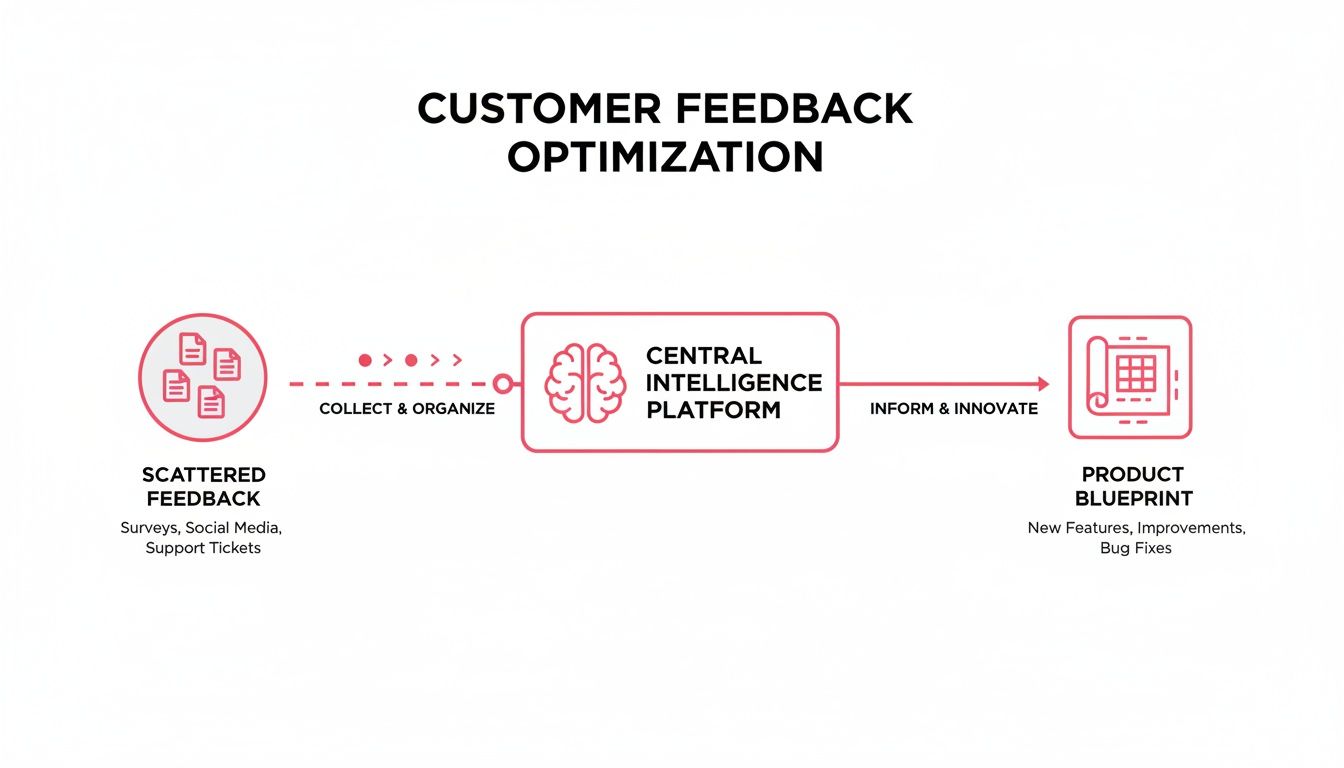
This process is what separates the tools that just collect dust from the ones that build momentum. So, what are the core features that make this happen?
Conversational and Contextual Capture
We’ve all seen them: the static, impersonal feedback forms that feel like a dead end. They rarely get to the why behind a request because, well, they can't ask questions. Modern platforms are changing the game with dynamic, conversational widgets.
Imagine a user hits a snag trying to export a report. Instead of a generic "Leave Feedback" box, an AI-powered widget pops up and asks, "What were you trying to accomplish?" It's a simple change, but it encourages much richer, more detailed responses.
This approach also captures crucial context without the user having to do a thing—like their browser, the page they're on, and their recent actions. This gives your product team the full story from the get-go, cutting out all that frustrating email back-and-forth.
AI-Powered Semantic Clustering
One of the biggest time-sucks for any product manager is manually sorting through feedback to spot trends and group duplicates. It's tedious, mind-numbing work, and it’s easy to miss important insights. This is where AI-powered semantic clustering comes in.
This technology uses natural language processing to understand the meaning behind the words, not just the keywords. It's smart enough to know that "I want to download my data" and "Can you add a CSV export option?" are really the same request.
By automatically grouping similar submissions, the platform instantly reveals emerging themes and popular requests—no manual tagging required. This frees up your product teams to focus on strategy, not admin work.
A PM can log in and see that 15 different pieces of feedback, all phrased differently, have been clustered under "Improve Dashboard Filters." Just like that, they have a clear, data-backed signal on what to investigate next.
Revenue-Based Prioritization
Let's face it, not all feedback is created equal. A feature request from a user on a free plan carries a different weight than one from a high-value enterprise customer. If you're just counting upvotes, you risk building for the loudest voices, not the most valuable ones.
A truly powerful customer feedback management platform connects feedback directly to customer revenue data, like Monthly Recurring Revenue (MRR). This completely changes how you prioritize.
Instead of just seeing "100 users want this," you see "$50,000 in MRR is tied to this request." The conversation shifts from popularity to profitability, ensuring your team’s valuable time is spent on work that actually protects and grows revenue.
AI Summaries and Weekly Digests
Raw feedback is just data; it’s not insight. No one on your team—from engineers to executives—has time to read every single comment that comes in. This is where AI-driven summaries and digests are a lifesaver.
These features automatically analyze all the feedback from a given period (say, a week) and generate a concise, easy-to-read summary. It pulls out the most pressing issues, flags new trends, and can even suggest potential action items.
This means your team gets a clear, actionable report delivered right to them. A mountain of qualitative data gets distilled into a handful of strategic bullet points, ensuring the customer's voice is heard across the company without creating information overload.
Seamless Workflow Integrations
Finally, a feedback platform has to fit into your team's world, not the other way around. The best tools don't force you to adopt a whole new process; they integrate smoothly with the software you already rely on every day.
Think about how these integrations make life easier:
- Slack: New feedback gets posted to a dedicated channel automatically, keeping the whole team in the loop in real-time.
- GitHub/Jira: A validated piece of feedback becomes a development ticket with one click, directly linking the customer request to the engineering task.
- Zapier: You can build custom workflows connecting your feedback platform to hundreds of other apps, automating tasks like updating a CRM or adding users to a follow-up email list.
These connections embed the customer's voice directly into your operations, making feedback a natural part of the daily grind instead of a chore.
To really drive home the difference, let’s look at the old way versus the new way. For years, product teams have been stuck with clunky, manual processes that just don’t scale. Modern platforms directly address these pain points.
Traditional Feedback Methods vs Modern Platform Features
| Challenge | Traditional Method (The Problem) | Modern Platform Feature (The Solution) |
|---|---|---|
| Low-Quality Feedback | Static, impersonal forms result in vague, one-line requests with no context. | Conversational Capture asks clarifying questions and automatically records user context (browser, page, etc.). |
| Manual Analysis | PMs spend hours reading, tagging, and grouping feedback in spreadsheets. | AI Semantic Clustering automatically groups similar feedback by meaning, revealing trends instantly. |
| Biased Prioritization | Decisions are based on "squeaky wheel" upvote counts or gut feelings. | Revenue-Based Prioritization links feedback to MRR, showing the financial impact of each request. |
| Information Overload | Raw feedback floods inboxes and gets lost; key insights are missed. | AI Summaries & Digests provide concise, actionable weekly reports for the whole team. |
| Disconnected Workflows | Feedback lives in a silo, requiring manual copy-pasting into dev tools. | Seamless Integrations push feedback directly into tools like Jira or Slack with a single click. |
As you can see, the shift isn't just about efficiency—it's about moving from a reactive, administrative task to a proactive, strategic function that drives business results.
The Real Payoff: Why Centralizing User Feedback is a Game-Changer
Putting a solid customer feedback management platform in place isn't just about getting organized—it's a strategic move with a real, measurable impact on your bottom line. While the individual features are great, their true power comes from the business results they drive. For any SaaS founder or product leader, pulling all your user feedback into one place is how you unlock sustainable growth and build a product people genuinely love.
It's the difference between being a reactive team just trying to clear tickets and becoming a proactive one that actively creates value. These benefits aren't just fluffy concepts; they hit your most critical business challenges head-on.
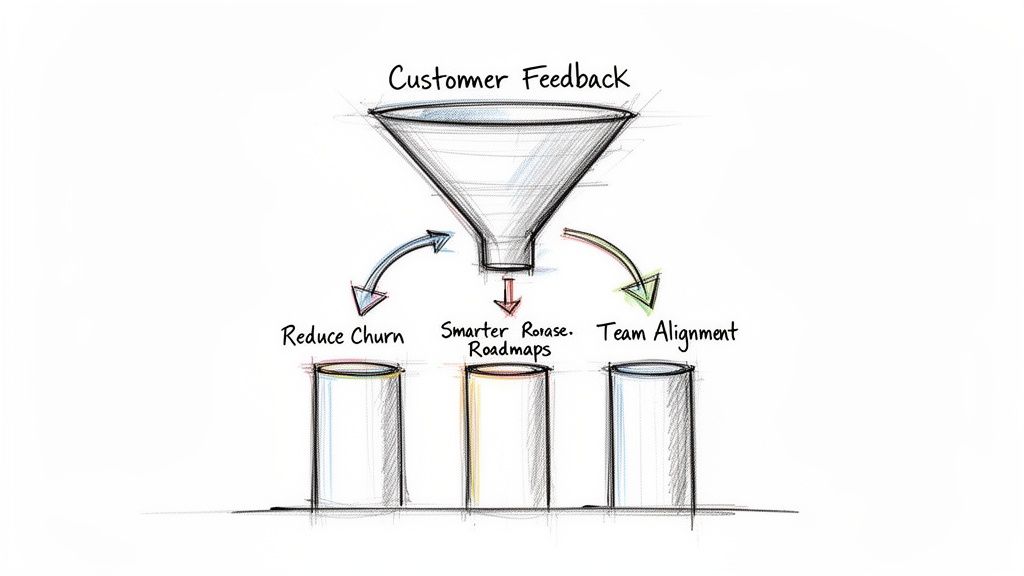
Reduce Customer Churn with Proactive Engagement
Let's be honest: churn is the silent killer of SaaS companies. One of the biggest reasons customers leave is that they feel like they're shouting into the void. Their problems don't get solved, and their ideas seem to disappear. A central feedback system fights this directly by opening up a clear, responsive channel for communication.
When you actively gather, analyze, and—most importantly—act on what users are telling you, they feel heard. The simple act of "closing the loop" by letting a customer know you've shipped the feature they asked for is an incredibly powerful way to keep them around. You can turn a frustrated user into one of your biggest fans.
Think about it: when you show customers that their voice actually shapes your product, you build serious trust and loyalty. It's no surprise that studies show 72% of customers have a more positive view of brands that ask for and respond to their input.
This proactive approach stops feedback from being just a list of complaints and turns it into a powerful retention tool. You can spot at-risk customers by what they're saying, solve their issues before they decide to leave, and prove you're invested in their success.
Build Faster and Smarter Product Roadmaps
Guessing what to build next is an expensive habit. Every single development cycle spent on a feature no one really wanted is a sunk cost of time, money, and your team's energy. A customer feedback management platform takes the guesswork out of the equation and replaces gut feelings with hard data, helping you make smarter roadmap decisions, faster.
By connecting feedback directly to revenue data, you can start prioritizing features based on their actual financial impact. Instead of just building the most-requested feature, you can focus on the improvements that will make your most valuable customers happy.
This data-driven focus makes sure your engineering team is always working on what truly matters.
- Focus on High-Impact Work: Developers get to build features they know are tied to real customer needs and revenue, which is a huge boost for morale and efficiency.
- Validate Ideas Quickly: You can get a sense of the demand for a new feature by analyzing existing feedback before a single line of code is ever written.
- Shorten Development Cycles: When priorities are clear, you waste less time debating what to build next. That means you can ship valuable updates to your customers much faster.
If you want to go deeper on turning raw feedback into a clear strategy, check out our guide on customer feedback analysis. It walks you through a structured process that eliminates ambiguity and makes sure your roadmap is aligned with what the market actually wants.
Enhance Cross-Functional Team Alignment
Silos are where good ideas and agility go to die. When your product, engineering, support, and success teams are all working with different information, the customer experience feels disjointed and broken. A centralized feedback hub becomes the single source of truth that tears down those walls and helps build a genuinely customer-first culture.
Suddenly, everyone across the company can see exactly what customers are saying. A support agent can link a ticket to an existing feature request, a PM can see the revenue tied to a bug fix, and an engineer can understand the why behind the task they're working on. That shared context is priceless.
This isn't just a niche idea; it's part of a massive trend. Companies are pouring money into systems that unify customer data. The Customer Data Platform (CDP) market, for instance, is expected to hit as much as USD 23.98 billion by 2029. This boom shows a clear business priority: creating a unified view of the customer to make smarter, more connected decisions. Centralizing your feedback is a key part of this movement, ensuring every team is rowing in the same direction, with the customer's voice as their guide.
How to Choose the Right Feedback Management Platform
Picking the right feedback management tool can feel like a make-or-break decision for your product. It’s easy to get bogged down comparing endless feature lists, but the reality is much simpler. The best approach is to zero in on a handful of core criteria that actually move the needle for your team and your roadmap.
This isn't about finding the tool that does everything. It's about choosing a system that slides right into your workflow, gives you genuinely useful insights, and can grow with you. Let's walk through the four key areas you should focus on.
Ease of Implementation and Adoption
Let's be honest: the best platform is one your team will actually use. A complicated setup or a steep learning curve is a surefire way to end up with expensive shelf-ware. So, the first question to ask is: how fast can we get this thing live and see our first piece of feedback?
Look for a solution that offers a dead-simple, one-line installation for its feedback widget. You should be up and running in minutes, not days. Just as important is the ability to get started without a huge upfront commitment.
Many modern platforms offer a Free plan to get started. This is a huge advantage—it lets you implement the tool and see real-world value at your own pace, creating a completely risk-free evaluation.
With a permanent free tier, you can prove the platform’s value to your team before you ever have to pull out a credit card.
Quality of Insights Delivered
A feedback platform’s real job is to transform a flood of raw customer comments into clear, actionable signals for your product team. This is where most tools fall short. Just counting upvotes is an old-school method that almost always leads to building the wrong things for the wrong people.
Instead, you need a platform that digs deeper and surfaces truly meaningful insights. Here’s what to look for:
- Revenue-Based Prioritization: Can the tool link a piece of feedback directly to a customer's MRR? Knowing a feature request is tied to $20,000 in monthly revenue is infinitely more powerful than knowing it has 50 votes.
- AI Summaries and Digests: Does the platform use AI to sift through hundreds of comments and deliver a concise weekly report? This can save your product managers hours of manual work and ensures you never miss a critical trend.
- Automatic Context Capture: Does the tool automatically grab the user’s session details, like the URL they were on or any recent browser errors? This context is gold for understanding the why behind the what.
Customer expectations are higher than ever, and handling feedback through unstructured channels like email is just too risky. The global complaint management software market is expected to hit USD 8.286 billion by 2026 for a reason: businesses are investing serious money to systematically handle feedback and protect their revenue. A platform that automatically captures context gives your team the same kind of powerful, enterprise-level insight. You can learn more by checking out the latest research on complaint management software trends.
The User Experience of the Feedback Widget
How you ask for feedback is just as important as what you do with it. A clunky, impersonal widget will only frustrate your users and get you low-quality, one-word replies. The whole point is to make giving feedback feel easy and helpful, not like another chore on their to-do list.
Put yourself in your customer’s shoes and evaluate the front-end experience. Is the widget just a static form, or is it a conversational AI that can ask smart follow-up questions? A conversational approach naturally encourages people to provide richer, more detailed input, which gives your product team so much more to work with.
Integration Capabilities and Workflow Fit
Finally, any tool you choose has to fit into your team's existing workflow. If it lives in a silo, it’s going to be ignored. Make sure the platform you pick integrates seamlessly with the tools your team already lives in every day.
The absolute must-have integrations are:
- Slack: For getting real-time notifications the moment new feedback comes in.
- GitHub or Jira: To turn validated feedback into a development ticket with a single click.
- Zapier: For creating custom automations and connecting to thousands of other apps in your stack.
These integrations are what turn feedback management from a separate, manual task into a smooth, natural part of your product development cycle. If you're weighing your options, our detailed guide on popular feedback platform alternatives can give you more clarity on how different solutions compare.
4 Steps to Implementing Your Feedback System for Maximum Impact
Look, a powerful tool is just a tool. It's only as good as the process you build around it. You can't just install a customer feedback management platform and expect magic. You have to build a system that actively turns customer insights into real-world action. This is about more than just software; it's about embedding a customer-first mindset into your company's DNA.
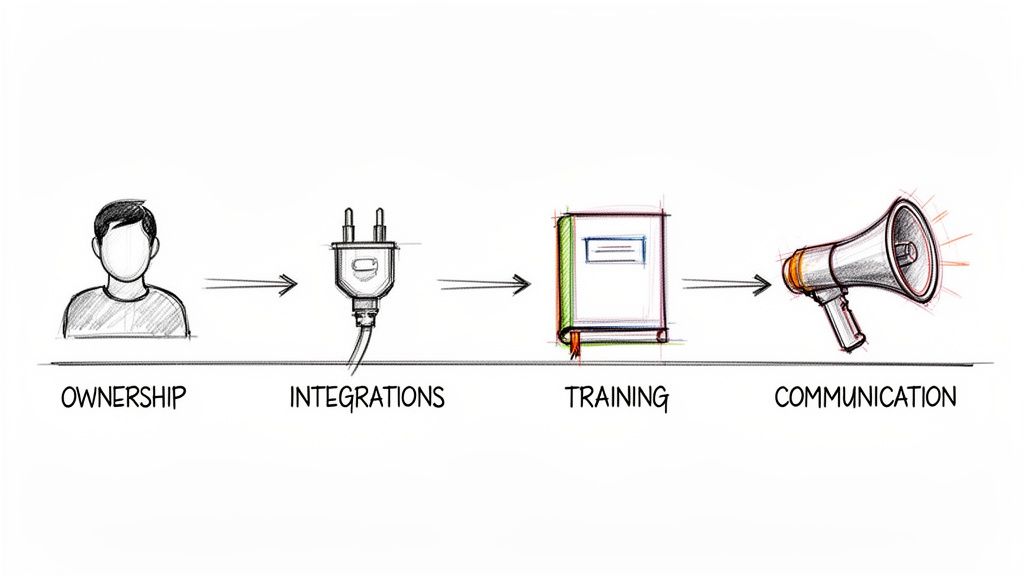
A successful rollout isn't about flipping a switch one afternoon. It's about creating a repeatable, reliable process that ensures feedback is always captured, analyzed, and acted upon. Here’s how you can build that system from the ground up.
1. Define Clear Ownership and Accountability
I’ve seen more feedback initiatives fail from this one mistake than any other: a lack of ownership. When everyone is responsible, it turns out that no one is. To avoid this pitfall, you absolutely must designate a single, clear owner for the entire feedback lifecycle.
This person—usually a product manager or maybe a dedicated customer insights lead—is the quarterback. They’re responsible for:
- Reviewing new feedback consistently, whether that’s daily or weekly.
- Triaging and categorizing everything that comes in to spot trends and weed out duplicates.
- Escalating critical issues to the right teams, like flagging a major bug for engineering or a churn risk for customer success.
- Communicating updates back to the customers who gave you the feedback in the first place.
Without this central point of accountability, I guarantee valuable insights will slip through the cracks. This structure gives every piece of feedback a clear path forward.
2. Configure Key Integrations for a Seamless Workflow
Your feedback platform shouldn't live on an island. Its real power is unlocked when it talks to the tools your team already uses every single day. Integrating it into your existing workflow is non-negotiable for adoption and efficiency.
Start with the essentials:
- Slack: Get a dedicated channel going where all new feedback is posted automatically. This gives everyone in the company visibility and lets teams jump on interesting insights in real time.
- GitHub or Jira: Connect your platform directly to your development tools. This is a game-changer. It means your feedback owner can turn a validated customer request into a development ticket with a single click, automatically linking the original feedback to the engineering task.
These integrations stop feedback from feeling like a chore and make it a natural part of your product development cycle. To dig deeper into this, check out our guide on how to collect customer feedback.
3. Train Your Team to Guide the Conversation
Your customer-facing teams—I'm talking support, success, even sales—are on the front lines. They are your best-kept secret for capturing high-quality feedback. But you have to train them to not just solve problems, but to listen for opportunities.
A customer reporting a bug might also be hinting at a much bigger underlying need. Train your team to listen for what's not being said.
Your team needs to know exactly how to point users to your feedback widget or portal and, more importantly, how to encourage them to share their thoughts. When you do this right, every customer interaction becomes a potential goldmine of product intelligence.
4. Communicate Transparently with Your Users
This is the final, and maybe most important, step: closing the loop. Customers who take the time to share their ideas want to know they were heard. A transparent communication process is absolutely essential for building trust and keeping that feedback coming.
Set up a clear rhythm for sharing updates. Maybe it's a monthly "What's New" blog post, an in-app notification, or even a direct email to the specific users who asked for a feature you just shipped.
When you announce something new, make a point to thank the users whose feedback sparked the idea. This simple act does more than just inform; it turns customers into loyal advocates who know you're a company that actually listens.
Your Product Roadmap Shouldn't Be a Guessing Game
In the crowded world of SaaS, you're constantly looking for an edge. What if I told you the biggest one isn't a secret growth hack or a new marketing channel? It's hiding in plain sight: your customer feedback.
But let's be honest. For most of us, that "feedback" is a chaotic mess of support tickets, Slack messages, and random notes in a spreadsheet. We're reacting, not strategizing. A real customer feedback management platform changes all that. It takes the noise and turns it into a clear signal for growth.
This isn't just about logging feature requests. It's about systematically translating what your users are saying into hard data that informs every decision you make. With a little help from AI, you can finally connect the dots, prioritize with confidence, and build a product people are genuinely excited to pay for. Suddenly, your engineering team isn't just shipping features; they're shipping solutions that directly protect revenue and stop churn in its tracks.
Don't just take my word for it—the market is screaming this from the rooftops. Valued at USD 10.11 billion in 2024, the feedback software space is set to explode to USD 28.04 billion by 2032. Why? Because subscription businesses live and die by retention. Even a tiny dip in churn can massively impact your bottom line. For any startup trying to be product-led, getting this right is no longer optional. You can dig into the numbers yourself in the full report on the feedback management software market.
You Can Start Building a Customer-Led Product Today
Getting started on this path is way more straightforward than it sounds. You don't need a huge budget or a six-month implementation project to begin making smarter, customer-informed decisions. You just need to take the first step.
By putting a system in place to centralize and analyze feedback, you're essentially building a direct bridge from your users' brains to your team's backlog. That alignment is the secret sauce for sustainable, product-led growth.
Modern tools have made this incredibly accessible. Forget about getting locked into pricey annual contracts or racing against a trial clock. Look for a platform that lets you jump in with a Free plan to get started. This way, you can set up a real system, see the value for yourself, and get your team on board without any risk. It’s time to stop guessing and start building what your customers are actually asking for.
Frequently Asked Questions
When SaaS founders and product teams start looking into a dedicated customer feedback management platform, a few common questions always pop up. Let's tackle them head-on to clear things up and show you how these tools can seriously level up your product workflow.
How Is This Different from a Survey Tool or Support Desk?
It's a great question because the lines can seem blurry at first. Think of it this way: survey tools are for asking specific questions you already have in mind, and support desks are fantastic for reacting to problems as they happen.
A true feedback platform, on the other hand, is built for proactive, continuous discovery. It's designed to catch all that spontaneous, "in-the-moment" feedback that users don't think to send to support. It then automatically adds crucial context, like who the user is, their MRR, and what they were doing in the app.
The core job of a feedback platform isn't just to measure satisfaction or put out fires. Its real purpose is to answer the big strategic question: "What should we build next to actually grow the business?"
A feedback platform turns the firehose of customer comments into a prioritized list of revenue-driving opportunities. It's the bridge between customer support conversations and strategic product decisions.
Will Adding a Feedback Widget Annoy Our Users?
We've all been attacked by those obnoxious, full-screen pop-ups. This isn't that. Modern feedback tools use subtle, lightweight widgets that feel more like a helpful chat than a jarring interruption. The goal is to give users an easy, optional way to share an idea right when it strikes them, without getting in their way.
Here’s the thing: when users see that their feedback actually leads to real product improvements, their entire perspective shifts. The widget becomes a valuable, direct line to your team. It sends a powerful message that you're a company that listens and, more importantly, acts on what you hear.
Is Our Team Too Small for a Dedicated Platform?
Honestly, it's often the smallest teams that get the biggest bang for their buck. If you're a small crew, you're probably trying to piece together feedback from Slack DMs, random emails, and scribbled call notes. That manual grind eats up dozens of hours and, worse, lets high-value insights slip through the cracks.
A dedicated tool puts that whole process on autopilot. It saves you an incredible amount of time and makes sure every single idea is captured and organized. It's a low-risk, high-reward investment that helps you operate with the customer-centric focus of a much larger company.
Many modern platforms, for instance, offer a Free plan to get started. This means a small team can set up a professional system and build a customer-led culture from day one, without any upfront cost.
Ready to stop guessing and start building a product your customers will love? FeatureBot is an AI-powered feedback platform designed for product-led teams. Capture rich, contextual feedback, prioritize by revenue impact, and close the loop to reduce churn. Start for free and see the difference today.
Ready to capture better feedback?
FeatureBot helps you collect, organize, and prioritize user feedback with AI-powered conversations.
Get Started Free