Top 12 Customer Insights Platforms for Product-Led Growth in 2026
Building a successful product often feels like navigating a maze without a map. Teams spend countless hours debating features, prioritizing roadmaps, and guessing what customers truly want, need, and value. The cost of getting it wrong is high: wasted engineering cycles, low adoption rates, and a growing disconnect between your product and the market. This is the core problem that customer insights platforms are designed to solve. They centralize, analyze, and activate customer feedback, transforming a chaotic stream of data into a clear, actionable guide for product development.
This guide moves beyond generic descriptions to provide a detailed, side-by-side comparison of the top customer insights platforms available today. We've done the heavy lifting to help you find the perfect tool for your team's specific needs, whether you're an early-stage startup or a scaling enterprise. For product teams looking to drive growth, understanding the range of available tools is key. This includes exploring various Product Led Growth Tools for SaaS that complement a robust insights strategy.
In the following sections, you'll find a thorough analysis of 12 leading solutions, including our own, FeatureBot. For each platform, we break down:
- Core Features: A look at feedback capture, AI-driven analysis, and prioritization capabilities.
- Ideal Use Cases: Who the platform is built for and what problems it solves best.
- Pricing & Plans: A transparent overview of tiers, including free plans where available.
- Pros & Cons: An honest assessment of strengths and limitations based on real-world usage.
We've included screenshots and direct links for every tool, allowing you to quickly evaluate each option. Our goal is to equip you with the information you need to stop guessing and start building a product your customers will love.
1. FeatureBot
Best For: Revenue-driven feedback and rapid feature implementation.
FeatureBot stands out as one of the most powerful and efficient customer insights platforms for product-led teams. It excels at translating raw customer feedback directly into prioritized, actionable engineering tasks. Its core strength lies in its ability to not just collect, but intelligently process and contextualize user input, ensuring that product roadmaps are influenced by genuine business impact, not just vocal minorities.
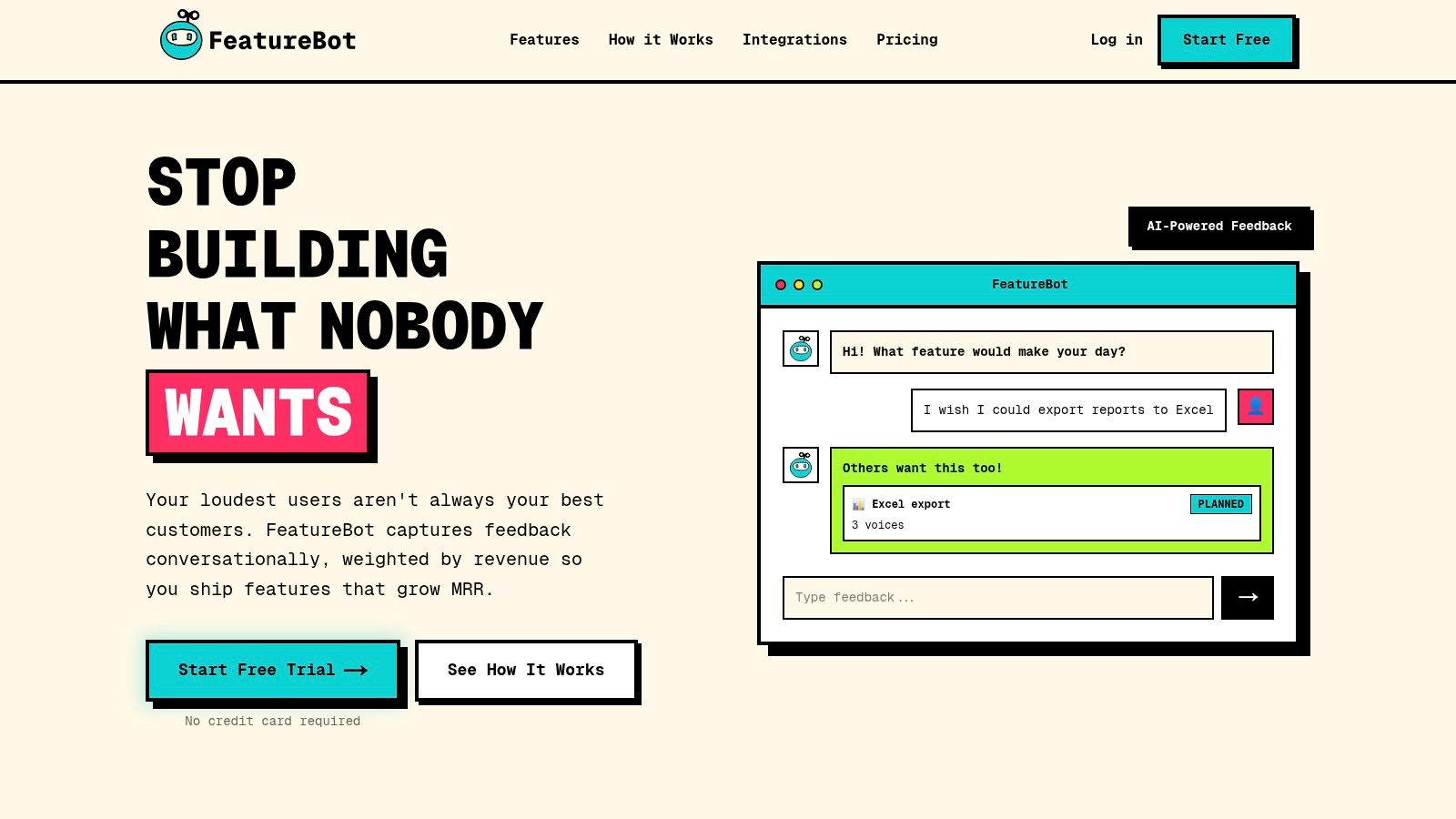
The platform is engineered for speed and precision. A simple widget, installable in minutes, initiates conversational feedback instead of using static forms. The AI asks intelligent follow-up questions to clarify intent and automatically captures crucial session context, such as browser errors, user journey steps, and the specific page a user was on. This eliminates the back-and-forth typically required for debugging, making every submission immediately actionable.
“FeatureBot completely changed how we collect feedback. The AI clustering saves us hours every week… We’ve reduced duplicate requests by 80% and can finally see which features will drive the most revenue.” - JR Johnston, Founder, WP Admin Order Modifier.
Key Features & Differentiators
- Revenue-Weighted Prioritization: This is FeatureBot's killer feature. It connects feedback to customer revenue data (like MRR), allowing teams to prioritize requests from high-value accounts. This ensures that development effort is aligned with financial growth.
- AI-Powered Semantic Clustering: The platform uses AI to automatically group similar feedback, even when phrased differently. This drastically reduces duplicate entries and reveals underlying trends without manual effort.
- Full-Context Capture: Each submission includes a rich payload of technical and user-specific data, providing engineers with everything they need to reproduce issues and understand user intent.
- AI Code Gen & GitHub Integration: A standout capability, AI Code Gen can automatically generate implementation code for a feature request and open a pull request in GitHub. This dramatically accelerates the cycle from feedback to shipping.
Pricing Snapshot
FeatureBot offers a tiered pricing model with a free plan, making it accessible for teams of all sizes.
- Free Plan: Includes 1 team member, 1 workspace, and 25 voices/month to get started.
- Starter: $13/mo (billed annually) for 100 voices/month and basic analytics.
- Growth: $21/mo (billed annually) for 500 voices/month, AI summaries, and branding removal.
- Scale: $83/mo (billed annually) for unlimited members, workspaces, voices, and advanced features like custom domains and priority support.
A 60-day money-back guarantee is also available on paid plans.
Pros & Cons
Pros:
- Revenue-weighted prioritization focuses teams on high-impact work.
- AI-guided conversational widget improves feedback quality and reduces duplicates.
- Full context capture makes feedback instantly actionable for engineers.
- AI Code Gen and deep integrations (Slack, Zapier, GitHub) create a seamless workflow.
- Quick setup and a free starting plan lower the barrier to entry.
Cons:
- The Free and Starter plans have tight limits on monthly voices, which may be quickly outgrown.
- Advanced features like unlimited voices and custom domains are exclusive to the highest-tier Scale plan.
- Compliance details like SOC2 certification are not prominently featured, requiring verification from teams with strict security protocols.
FeatureBot is an exceptional choice for SaaS founders, PMs, and engineering teams who want to build a truly customer-centric product. It provides the tools for not just listening, but for closing the feedback loop by shipping what matters most.
Website: https://featurebot.com
2. Qualtrics (XM Platform)
Qualtrics is an enterprise-grade experience management (XM) platform that provides one of the most comprehensive toolkits for capturing and analyzing customer, employee, and market data. It excels in large organizations requiring robust survey authoring, complex logic, panel management, and stringent governance controls. Unlike more lightweight tools, Qualtrics is built to scale from single research projects to global, multi-departmental Voice of the Customer (VoC) programs.
The platform’s strength lies in its ability to centralize feedback across the entire customer journey, from brand awareness to post-purchase support. Its AI-powered analytics engine, iQ, can automatically surface key themes, statistical trends, and predictive insights from unstructured text and survey data. This makes it a powerful choice for teams looking to build a sophisticated and holistic Voice of the Customer program.
Key Features and Use Cases
- Best For: Enterprise-level CX, market research, and academic studies where data security, advanced survey logic, and scalability are critical.
- Core Capabilities: Advanced survey design, panel management, journey analytics, text and statistical analysis (iQ), and multi-channel feedback collection (web, email, SMS, app).
- Pricing: While a free account with limited features is available, most of the comprehensive CX and EX suites are quote-based and require engaging with their sales team.
- Pros: Unmatched breadth of research methodologies, strong governance and compliance features, and powerful enterprise integrations.
- Cons: The platform can be overly complex and expensive for smaller teams or simple feedback needs. The user interface has a significant learning curve.
Website: https://www.qualtrics.com
3. Medallia
Medallia is a highly regarded enterprise-grade customer experience management platform designed to capture and operationalize feedback signals at scale. It excels in helping large, globally distributed organizations listen to customers across every touchpoint, including web, mobile, contact centers, and in-person interactions. Medallia’s key differentiator is its focus on connecting feedback directly to action, using AI to deliver role-specific insights and alerts from the frontline to the C-suite.
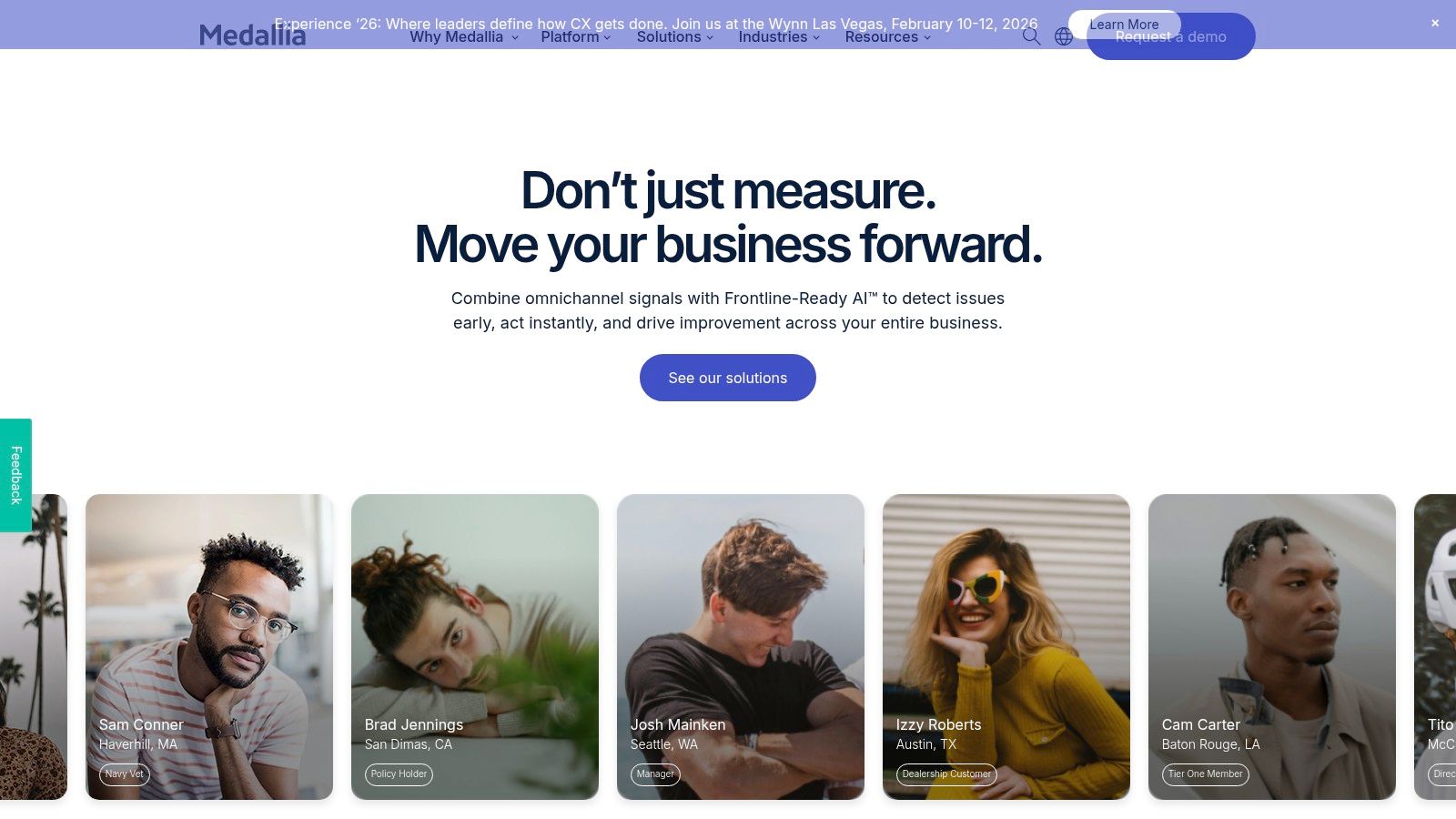
The platform is engineered to not just collect data but to drive organizational change by embedding customer insights into daily workflows. Its AI-driven text analytics, predictive modeling, and action-oriented workflows help teams prioritize improvements and measure their financial impact. This makes it one of the most powerful customer insights platforms for companies committed to building a customer-centric culture and tying experience metrics directly to business outcomes like revenue and retention.
Key Features and Use Cases
- Best For: Large enterprises in retail, hospitality, finance, and telecom that need to manage complex, multi-channel Voice of the Customer (VoC) programs and prove ROI.
- Core Capabilities: Multi-channel signal capture (surveys, social, reviews, speech-to-text), AI-powered text and predictive analytics, role-based dashboards and action workflows, and closed-loop feedback management.
- Pricing: Pricing is not publicly listed and is customized for enterprise needs. Procurement is a sales-led process requiring a formal quote based on usage and modules.
- Pros: Proven scalability and reliability for massive organizations, a strong ecosystem of services and partners, and excellent at framing CX improvements in terms of business ROI.
- Cons: The implementation can be heavy and resource-intensive, making it less suitable for SMBs. The cost and complexity are significant barriers for teams without a dedicated CX budget.
Website: https://www.medallia.com
4. Sprig
Sprig is a product experience insights platform designed to bridge the gap between quantitative behavioral data and qualitative user feedback. It specializes in capturing in-context insights by triggering short, targeted surveys directly within a product experience, ensuring feedback is timely and relevant. Unlike traditional survey tools that rely on email, Sprig focuses on just-in-time feedback to help teams understand the "why" behind user actions as they happen.
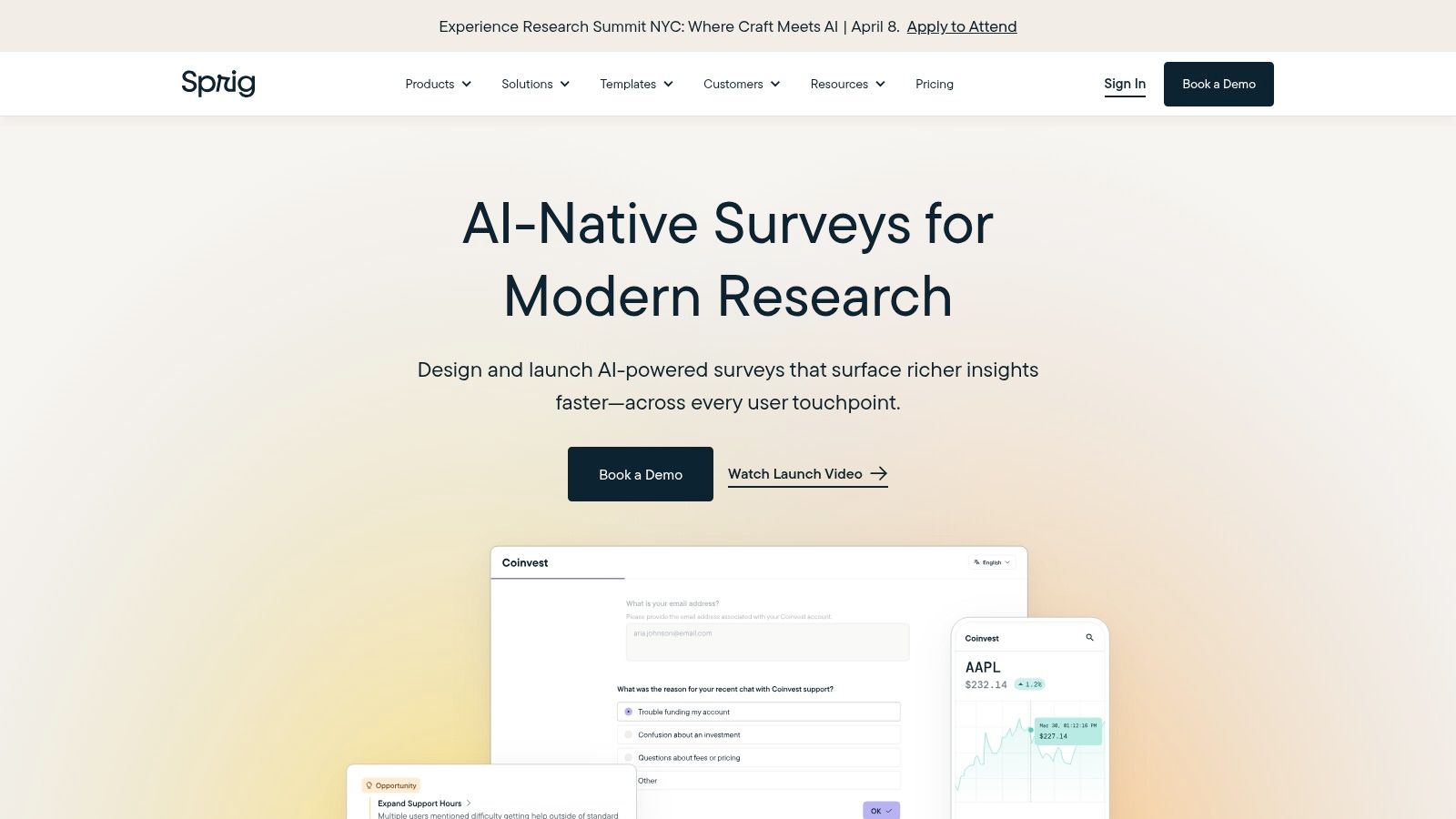
The platform combines in-product surveys with session replays, allowing product managers and UX researchers to connect user-reported feedback directly to their actual behavior. Its AI-powered analysis engine quickly surfaces themes and patterns from open-text responses, significantly reducing manual analysis time. This makes it an excellent choice for agile teams that need to conduct rapid research, validate hypotheses, and iterate on product features quickly, making it one of the most agile customer insights platforms available.
Key Features and Use Cases
- Best For: Product and UX teams needing fast, in-context feedback to inform product development, feature validation, and user onboarding optimization.
- Core Capabilities: In-product (just-in-time) surveys, always-on feedback widgets, session replays, and AI-driven analysis of qualitative data.
- Pricing: A Free plan is available to get started. Paid plans are modular, offered in bundles like Research Core and Digital Experience, and typically require a quote from their sales team.
- Pros: Modern and intuitive user experience enables extremely fast study creation and turnaround. Modular pricing allows teams to start with a specific use case and expand.
- Cons: Pricing is not fully transparent for paid tiers, often requiring a sales conversation. Capturing in-product insights requires an SDK integration, which may involve developer resources.
Website: https://sprig.com
5. Pendo
Pendo is a product experience platform that combines powerful product analytics with in-app user guidance and feedback collection. It’s designed to help digital product teams understand how users engage with their applications and then influence behavior directly within the app. Unlike pure analytics tools, Pendo closes the loop by allowing teams to act on insights immediately through targeted guides, polls, and NPS surveys, without requiring engineering resources.
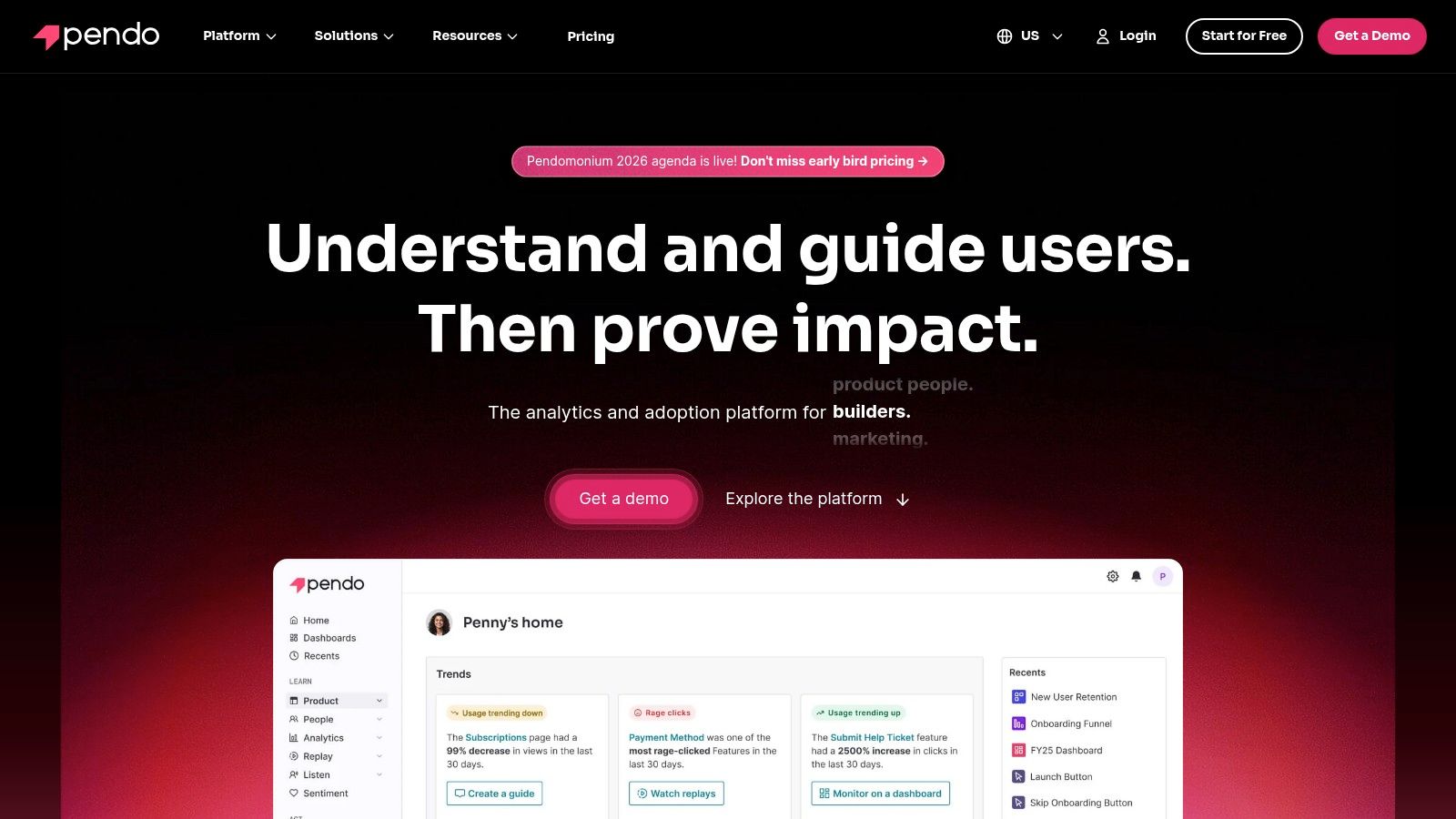
This dual capability makes it one of the more actionable customer insights platforms for product-led growth. Teams can identify where users are dropping off in a workflow and deploy an in-app guide to help them, or segment disengaged users and prompt them for feedback. Its codeless installation and retroactive analytics mean teams can start gathering data on user behavior from day one, even before they know what questions to ask.
Key Features and Use Cases
- Best For: SaaS product teams wanting to combine quantitative product usage analytics with qualitative in-app feedback and user onboarding tools.
- Core Capabilities: Codeless event tracking, user segmentation, feature adoption analytics, in-app guides and polls, NPS surveys, and product roadmapping tools.
- Pricing: Pendo offers a Free plan for up to 500 monthly active users (MAUs). Paid tiers are quote-based and unlock advanced features and higher usage limits.
- Pros: Excellent for combining analytics with in-app engagement, and the free plan allows teams to trial core functionality without a time limit.
- Cons: The Free plan is limited to 500 MAUs and includes Pendo branding. Advanced segmentation and data governance features are locked behind expensive enterprise plans.
Website: https://www.pendo.io
6. Hotjar (now part of Contentsquare)
Hotjar is a leading product experience insights platform that specializes in providing visual, qualitative data about how users interact with a website or app. It combines heatmaps, session recordings, and on-site feedback tools into a single, accessible package. Unlike enterprise-level digital experience analytics platforms, Hotjar is built for fast setup and ease of use, making it a favorite among marketers, UX designers, and product teams who need to quickly understand user behavior without deep technical expertise.
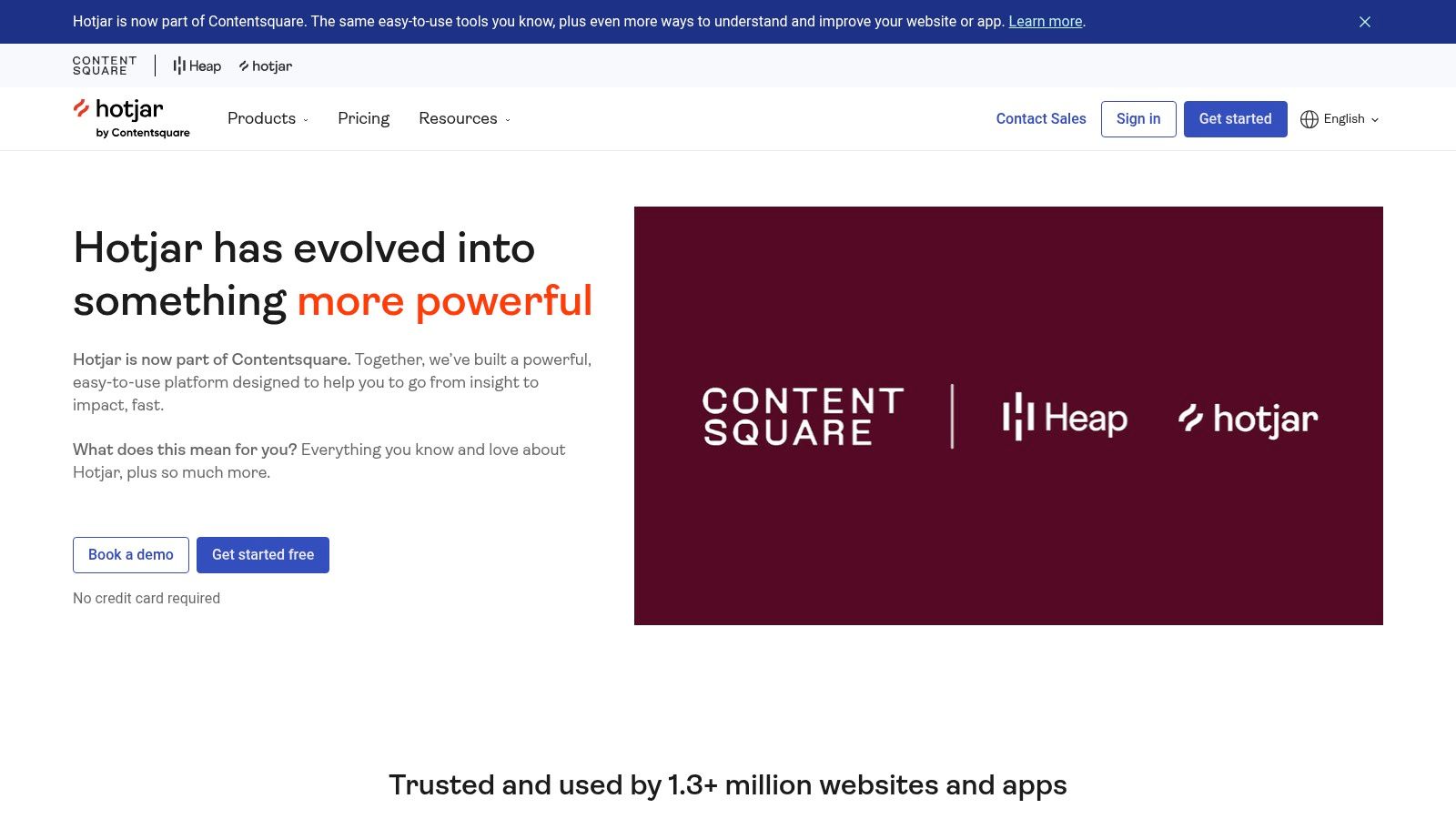
The platform’s core strength is its ability to translate abstract analytics into concrete visual evidence of user friction, engagement, and drop-off points. Session replays with AI summaries allow teams to watch actual user journeys, while heatmaps show where users click, move, and scroll in aggregate. This makes it an invaluable tool for validating design changes, identifying bugs, and gathering contextual feedback directly from users as they experience your product. For teams seeking qualitative customer insights platforms, Hotjar provides a powerful and immediate view into the user experience.
Key Features and Use Cases
- Best For: Product managers, UX designers, and marketers in small to mid-sized businesses who need to quickly diagnose usability issues and gather on-site user feedback.
- Core Capabilities: Unlimited heatmaps, session replays with AI-powered summaries, conversion funnels, on-site surveys, and a user feedback widget.
- Pricing: Offers a free-forever plan with basic features. Paid plans scale based on the number of sessions and start at an accessible price point, with different tiers for its "Observe," "Ask," and "Engage" products.
- Pros: Extremely intuitive with a very fast setup process. Strong visualization tools make user behavior easy for non-analysts to understand and act on.
- Cons: Lacks the deep quantitative analysis of enterprise tools. Session caps and other limits are enforced by plan, which can be restrictive for high-traffic sites.
Website: https://www.hotjar.com
7. FullStory
FullStory is a premier digital experience intelligence (DXI) platform that combines high-fidelity session replay with robust product analytics. It provides a pixel-perfect view of the user's journey, allowing teams to watch real user sessions to understand exactly where they struggle, encounter bugs, or drop off. Unlike traditional analytics tools that only show what happened, FullStory shows why it happened by capturing every click, scroll, and rage click in context.
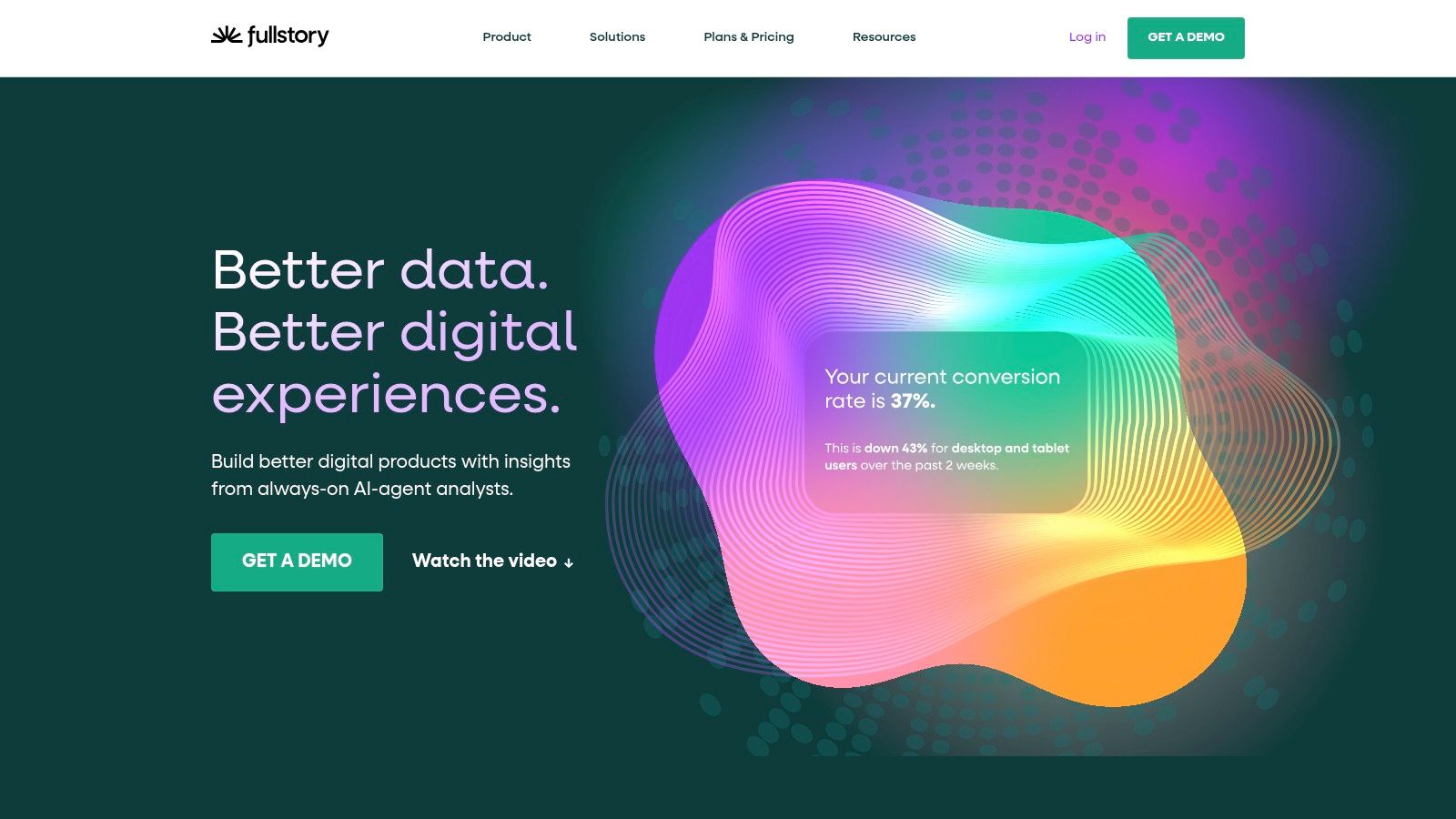
The platform automatically indexes every user interaction, making it searchable without needing to pre-configure events. This makes it one of the most powerful qualitative customer insights platforms for engineering, product, and support teams to collaboratively debug issues, validate product decisions, and empathize with users. Its ability to connect qualitative session replays with quantitative analytics offers a complete picture of the digital experience.
Key Features and Use Cases
- Best For: Product, engineering, and support teams needing to understand user behavior, reproduce bugs, and improve user experience through direct observation.
- Core Capabilities: High-fidelity session replay, behavioral signal indexing (e.g., rage clicks), baseline analytics, developer debugging tools, and user journey funnels.
- Pricing: FullStory offers a generous Free plan with 30,000 sessions per month and up to 10 users. Business and Enterprise tiers are available via custom quotes for advanced features and higher volumes.
- Pros: Exceptional session replay quality and automatic event indexing. The free plan is one of the most feature-rich on the market for startups.
- Cons: Advanced dashboards and analytics are gated behind paid tiers, and enterprise pricing requires engaging with their sales team.
Website: https://www.fullstory.com
8. Amplitude
Amplitude is a leading product analytics platform designed to help teams understand user behavior, optimize product experiences, and drive growth. It moves beyond simple website traffic metrics to provide deep, event-based insights into how customers actually interact with a digital product. Unlike broader CX platforms, Amplitude is hyper-focused on the user journey within an app or website, making it a favorite among product managers and data-driven teams.
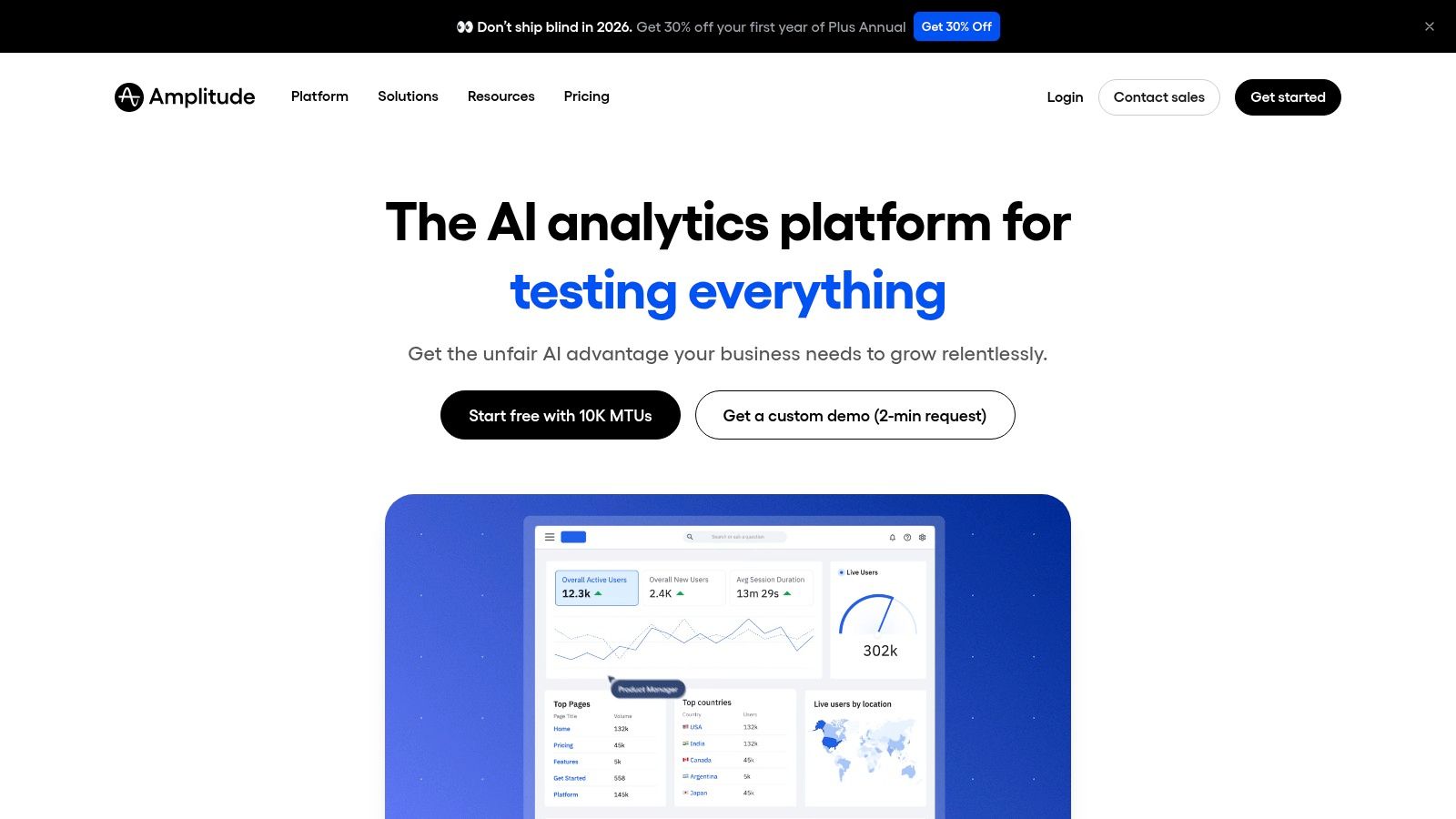
The platform's strength is its ability to connect user actions to business outcomes through powerful cohort analysis, retention charts, and conversion funnels. This makes it one of the most effective customer insights platforms for identifying points of friction and opportunities for engagement. With add-on capabilities like experimentation, session replay, and feature flagging, teams can build a comprehensive product intelligence stack on a single foundation, moving from insight to action quickly.
Key Features and Use Cases
- Best For: Product teams, data analysts, and startups needing to understand user behavior, measure feature adoption, and run A/B tests to optimize their product.
- Core Capabilities: Deep behavioral analytics, cohort and retention analysis, journey mapping, experimentation (A/B testing), session replay, and feature flags.
- Pricing: Offers a generous Free plan for up to 50,000 monthly tracked users (MTUs). Paid plans are quote-based and scale with user volume and feature needs.
- Pros: Transparent and generous free tier for startups, powerful behavioral analytics and segmentation, and scales into a full product intelligence suite.
- Cons: Advanced experimentation and data governance features are typically locked in higher-tier plans. Event and MTU-based pricing models require careful planning to manage costs.
Website: https://amplitude.com
9. Mixpanel
Mixpanel is an event-based product analytics platform that excels at revealing how users interact with a digital product. Rather than focusing on page views, it tracks specific user actions, or events, to build a detailed picture of customer behavior. This developer-friendly approach allows teams to measure feature adoption, analyze conversion funnels, and understand user retention with a high degree of precision, making it one of the most powerful quantitative customer insights platforms available.
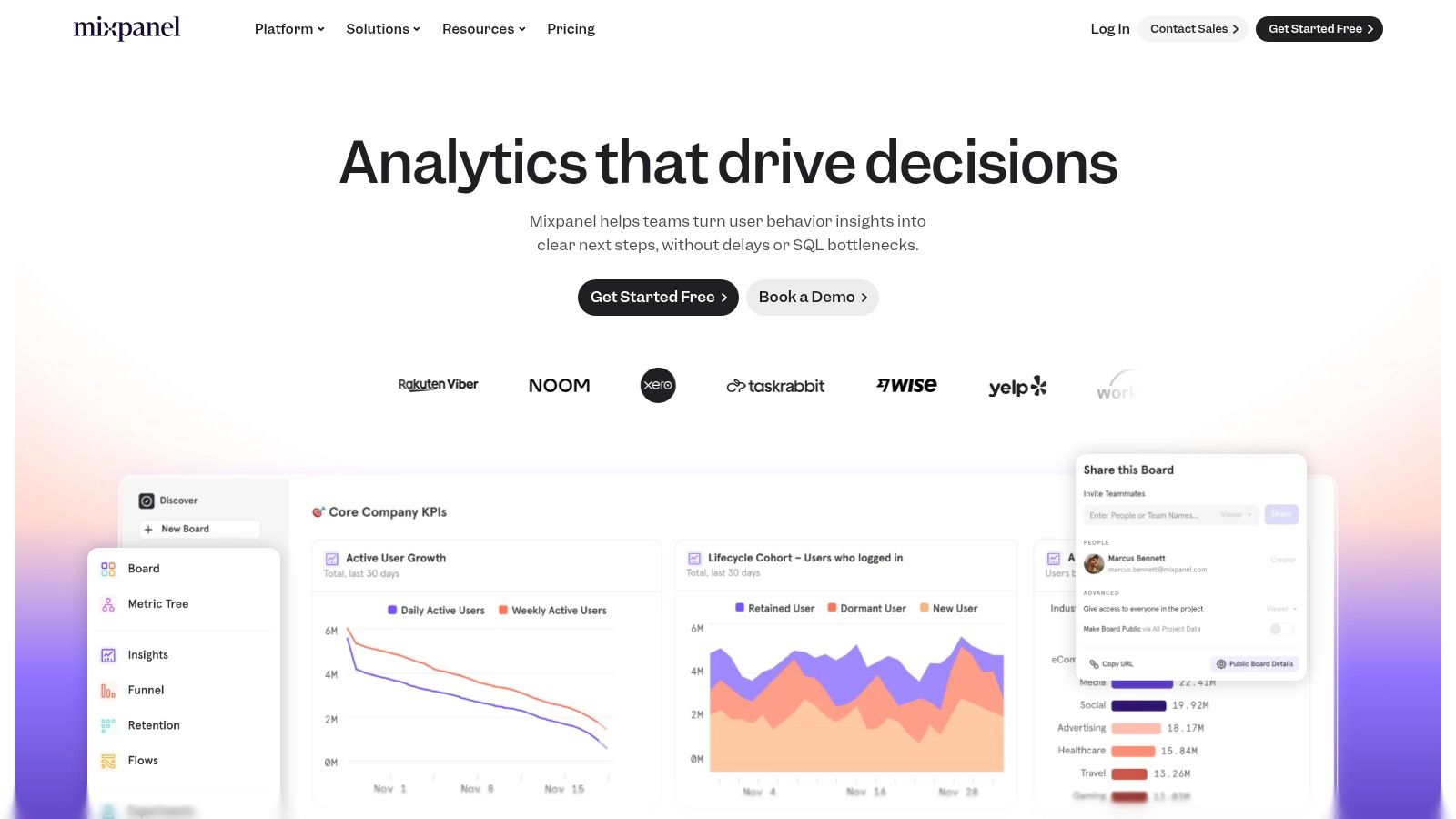
The platform’s strength is its self-serve nature and transparent pricing, which empowers product teams to get started without lengthy sales cycles. By instrumenting key events, you can build sophisticated reports on user flows, cohort behavior, and the impact of new feature launches. This makes it ideal for product-led teams that need to connect product usage data directly to business outcomes and user engagement metrics.
Key Features and Use Cases
- Best For: Product-led SaaS companies, mobile app developers, and data-driven teams needing to understand user behavior through event tracking.
- Core Capabilities: Funnel analysis, retention reports, user flow visualization, cohort analysis, and session replays on paid plans.
- Pricing: Offers a generous Free plan for up to 1 million monthly events. Paid plans are usage-based with transparent pricing, allowing teams to scale as they grow.
- Pros: Highly transparent and scalable usage-based pricing, robust analytics features, and excellent documentation for developers.
- Cons: Requires upfront technical effort for event instrumentation and data planning. Some advanced governance features are limited to Enterprise plans.
Website: https://mixpanel.com
10. SurveyMonkey
SurveyMonkey is one of the most recognized names in the survey software space, offering a highly accessible platform for customer research, Net Promoter Score (NPS) tracking, and market studies. Its primary strength is its simplicity and speed, allowing individuals and teams to design and deploy surveys quickly using an extensive library of templates and an intuitive, AI-assisted builder. It's an excellent choice for straightforward feedback collection without the complexity of enterprise-grade customer insights platforms.
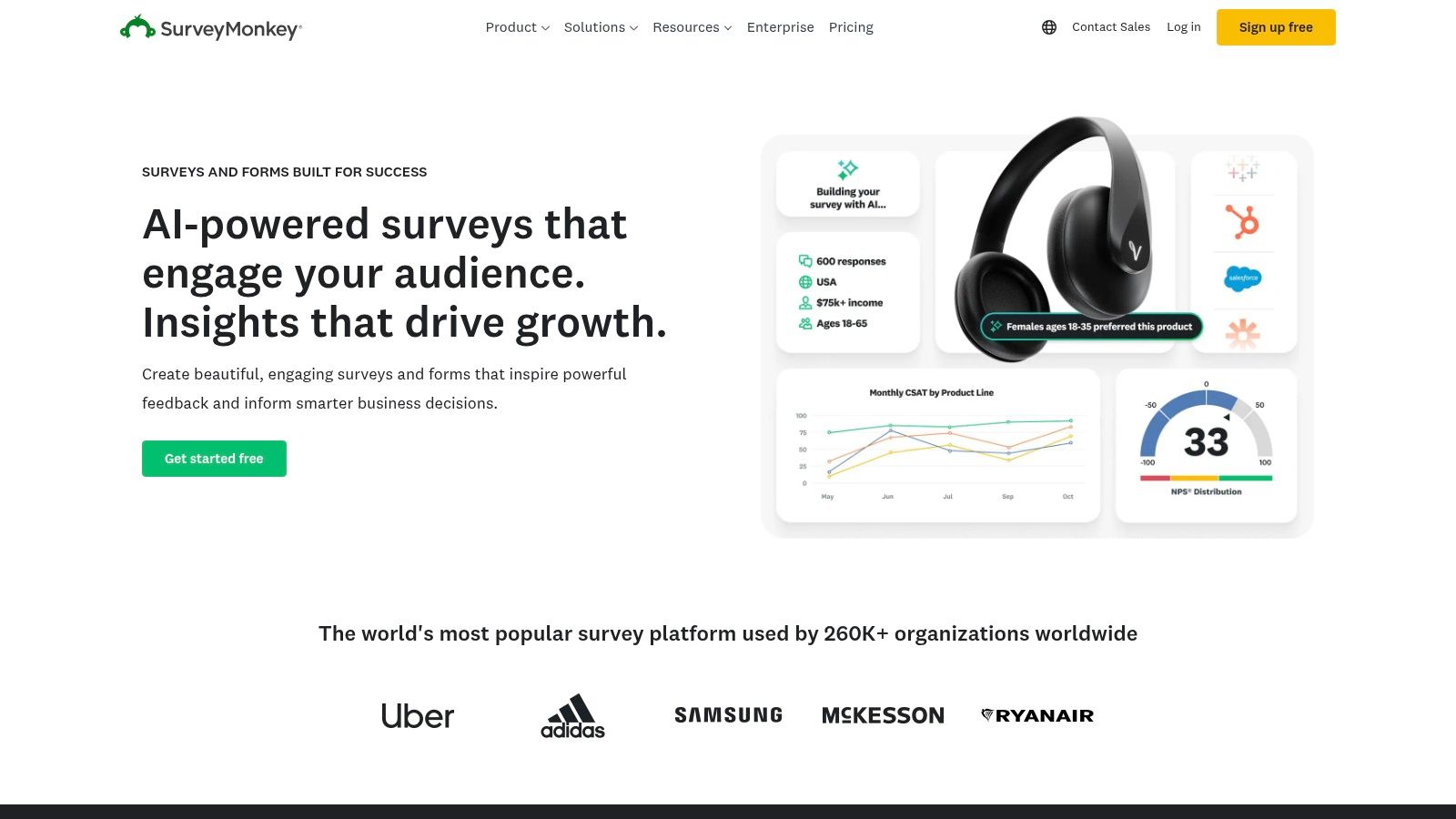
The platform democratizes data collection, making it easy for various departments to gather insights independently. For companies needing to reach specific demographics outside their existing customer base, the optional SurveyMonkey Audience panel provides access to millions of respondents. This makes it a versatile tool for both internal feedback loops and broader market validation, bridging the gap between simple polls and in-depth research projects.
Key Features and Use Cases
- Best For: Teams needing a quick, user-friendly tool for CSAT/NPS surveys, concept testing, and general-purpose market research.
- Core Capabilities: 500+ templates and AI-assisted survey building, multiple collection channels (web, email, QR, SDK), SurveyMonkey Audience panel for targeted respondents, and over 200 integrations (Slack, HubSpot, Teams).
- Pricing: A basic Free plan is available to get started. Paid plans are offered for individuals and teams, with enterprise-level packages providing more advanced features and collaboration tools.
- Pros: Exceptionally easy to launch surveys and scale usage across teams. The large, targetable panel via SurveyMonkey Audience is a significant advantage for market research.
- Cons: Advanced analytics and branding customization are locked behind higher-tier plans. Response overages on certain plans can incur unexpected per-response fees.
Website: https://www.surveymonkey.com
11. UserTesting
UserTesting is a leading human insights platform that allows teams to get video feedback from real people as they interact with products, websites, apps, and prototypes. It shines by connecting companies with a large, diverse global panel of participants for both moderated and unmoderated studies. Unlike traditional survey tools, UserTesting provides the “why” behind user behavior by delivering rich, contextual video clips, making it one of the most powerful customer insights platforms for qualitative feedback.
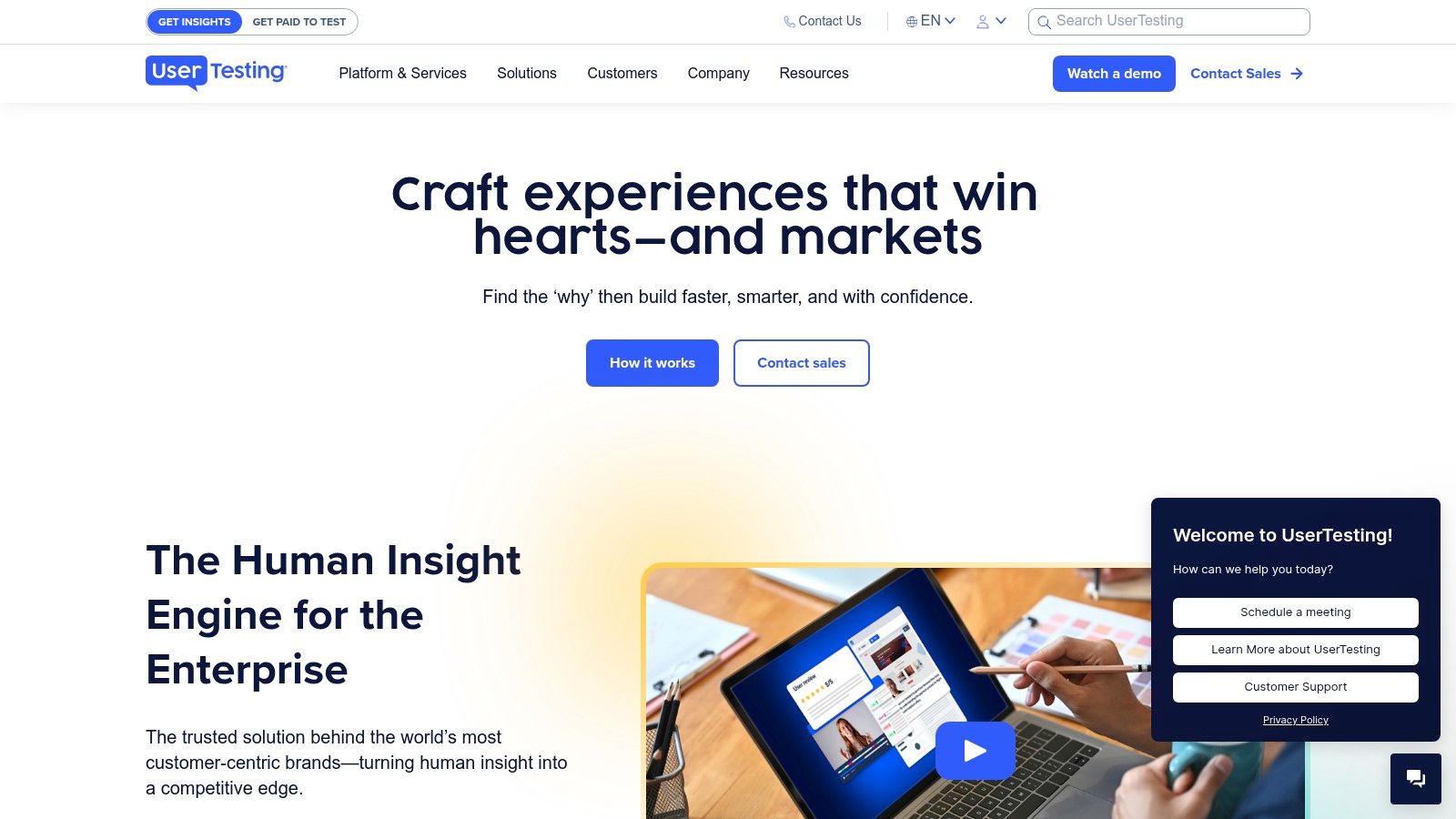
The platform is built for speed, enabling teams to launch a test and receive video feedback in hours. Its AI-powered features help synthesize findings by generating summaries, transcriptions, and sentiment analysis, which streamlines the process of extracting actionable insights. This makes it an invaluable tool for product, marketing, and UX teams that need to validate ideas and identify usability issues quickly, using effective qualitative data analysis techniques to inform their decisions.
Key Features and Use Cases
- Best For: UX research, product validation, and marketing message testing where seeing and hearing from real users is critical for empathy and understanding.
- Core Capabilities: Moderated and unmoderated video testing, access to a large screened participant network, AI-generated summaries and transcriptions, and enterprise-grade security options.
- Pricing: Pricing is customized and quote-based, requiring contact with their sales team. The platform is designed for teams with a consistent testing cadence.
- Pros: Extremely fast access to a targeted global participant panel, scales well beyond product to support marketing and CX research, and delivers powerful video-based evidence.
- Cons: Pricing is higher than basic survey tools and may be prohibitive for teams with infrequent testing needs. The best value is realized through regular, ongoing use.
Website: https://www.usertesting.com
12. G2 (Customer Experience Software category)
While not a customer insights platform itself, G2 is an indispensable software marketplace for discovering, comparing, and validating potential tools. It functions as a meta-resource, offering a comprehensive landscape view of the customer experience and feedback software categories. For teams starting their search, G2 provides a structured way to shortlist vendors based on user reviews, market presence, and specific features before committing to demos or trials.
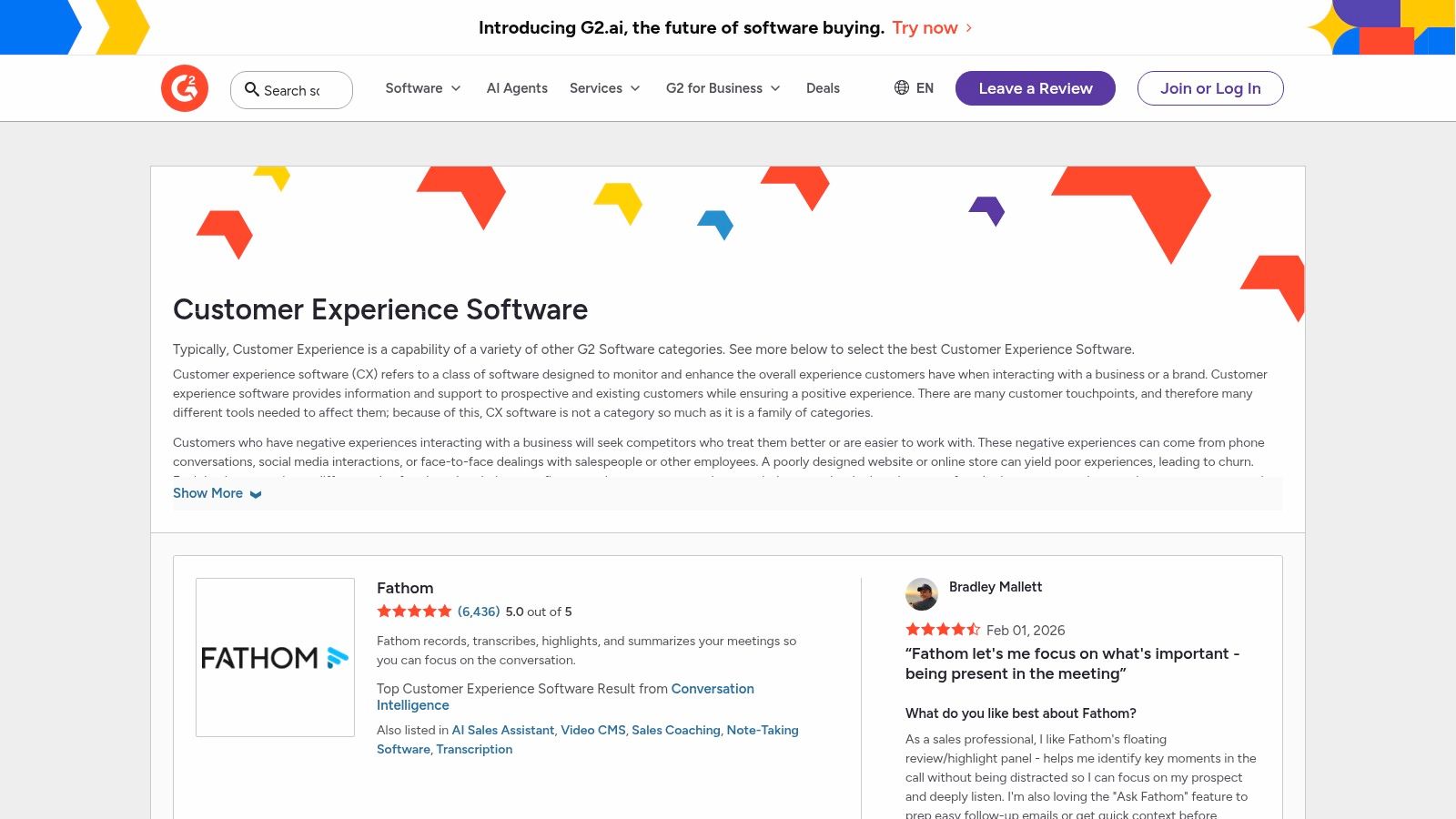
The platform’s real value lies in its crowdsourced reviews and filterable comparison grids. You can quickly see how different customer insights platforms stack up against each other on criteria like ease of use, quality of support, and specific capabilities. This allows teams to validate marketing claims with real-world user feedback, identify rising stars in the market, and ensure they are considering a well-rounded set of options that truly fit their needs and budget.
Key Features and Use Cases
- Best For: Vendor discovery, creating a shortlist of tools, and validating product choices with authentic user reviews before purchasing.
- Core Capabilities: Filterable software categories, side-by-side product comparisons, extensive user reviews and ratings, and market trend reports (Grid Reports).
- Pricing: Free to browse, read reviews, and compare products. Users must visit vendor websites for specific pricing information.
- Pros: Excellent for initial vendor research and competitive analysis. Provides a quick, free way to gauge market sentiment and validate options.
- Cons: Review quality and depth can be inconsistent. Sponsored placements can sometimes influence vendor visibility on category pages.
Website: https://www.g2.com/software/customer-experience
Top 12 Customer Insights Platforms Comparison
| Product | Core features | UX / Quality (★) | Value & Pricing (💰) | Target Audience (👥) | Unique Selling Points (✨) |
|---|---|---|---|---|---|
| FeatureBot 🏆 | AI feedback widget, semantic clustering, full‑context capture, AI digests, integrations | ★★★★ | 💰 Free plan; Starter $13/mo; Growth $21/mo; Scale $83/mo | 👥 Founders, PMs, CSMs, engineers (product‑led SaaS) | ✨ Revenue‑weighted prioritization; AI Code Gen; 2‑min install; conversational follow‑ups |
| Qualtrics (XM) | Surveys, VoC, journey analytics, governance & panels | ★★★★★ | 💰 Sales‑led / quote‑based | 👥 Enterprise CX, research teams | ✨ Broad methodologies; enterprise governance & compliance |
| Medallia | Multi‑channel VoC, AI analytics, role‑based reporting, ROI framing | ★★★★ | 💰 Sales‑led / enterprise pricing | 👥 Large, distributed orgs (CX ops, execs) | ✨ Multi‑channel capture; services ecosystem; ROI focus |
| Sprig | In‑product surveys, session replays, heatmaps, AI insights | ★★★★ | 💰 Modular bundles / quote-based | 👥 Product & UX teams needing fast studies | ✨ Just‑in‑time research; modular bundle approach |
| Pendo | Product analytics, in‑app guides, NPS, segmentation | ★★★★ | 💰 Free tier (capped); paid tiers sales‑led | 👥 Product teams wanting analytics + in‑app messaging | ✨ Combines analytics with guides; free trial tier |
| Hotjar (Contentsquare) | Heatmaps, session replays, funnels, surveys, AI summaries | ★★★★ | 💰 Accessible pricing; session caps per plan | 👥 UX researchers, marketing, small teams | ✨ Fast setup; strong visual tools for non‑analysts |
| FullStory | Session replay, behavioral signals, product analytics | ★★★★ | 💰 Free plan available; enterprise quoted | 👥 Startups & product teams needing replays | ✨ High‑quality replays; event indexing; generous free tier |
| Amplitude | Product analytics, experimentation, feature flags, replay | ★★★★ | 💰 Free Starter (50k MTUs); transparent pricing | 👥 Data‑driven product teams | ✨ Transparent billing; deep behavioral analytics + experimentation |
| Mixpanel | Event analytics: funnels, retention, cohorts, replay | ★★★★ | 💰 Free tier (1M events); usage‑based pricing | 👥 Developer‑friendly analytics teams | ✨ Usage‑based billing; mature docs & self‑serve setup |
| SurveyMonkey | Surveys, 500+ templates, Audience panel, integrations | ★★★ | 💰 Tiered plans; response overages possible | 👥 Researchers, CS, marketing teams | ✨ Large template library; paid Audience panel |
| UserTesting | Moderated/unmoderated tests, video feedback, AI summaries | ★★★★ | 💰 Sales‑led; typically higher cost | 👥 UX researchers, product & marketing teams | ✨ Large screened panel; video insights; enterprise security |
| G2 (CX category) | Review grids, buyer guides, award lists, vendor comparisons | ★★★ | 💰 Free to use; vendor‑paid placements | 👥 Buyers researching CX & feedback tools | ✨ Crowd‑sourced reviews, rankings, buyer resources |
Turn Insights Into Impact: Your Next Steps
Navigating the expansive landscape of customer insights platforms can feel overwhelming, but the journey from raw data to actionable product strategy is more achievable than ever. We've explored a dozen powerful tools, from the all-in-one enterprise suites like Qualtrics and Medallia to the targeted, agile solutions like FeatureBot and Sprig. Each platform offers a unique lens through which to view your customer's world, whether through quantitative analytics, qualitative feedback, or direct user observation.
The core takeaway is clear: listening to your customers is no longer a passive activity. Modern platforms empower you to proactively gather, centralize, and analyze feedback from disparate sources, transforming a chaotic stream of information into a prioritized roadmap. The distinction between a good product and a great one often lies in the ability to consistently close the loop between user feedback and product development.
Making Your Decision: A Final Checklist
Choosing the right tool isn't about finding the one with the most features; it's about finding the one that best fits your team's workflow, maturity, and specific goals. As you make your final decision, revisit these critical questions:
- Problem to Solve: What is the most significant gap in your current understanding of your customers? Are you struggling with feedback chaos (like FeatureBot solves), session replays (Hotjar, FullStory), or broad market sentiment (Qualtrics)?
- Team & Workflow: Who will own this platform? A product manager in a startup needs a tool that integrates seamlessly with Slack and GitHub, while a dedicated research team might require the robust panel management of UserTesting.
- Data & Integration: Does the platform connect with your existing tech stack? The value of these tools multiplies when they can pull data from and push insights into the systems your team already lives in, like your CRM, analytics platform, and project management tools.
- Scalability & Cost: What does the growth path look like? Consider not just the entry-level price but also the total cost of ownership as your user base and feedback volume grow. Can the platform support you from a small startup to a scale-up?
From Implementation to Impact
Once you've selected a platform, successful implementation is paramount. Start small with a specific, high-impact project. For instance, you could focus on understanding the "why" behind a key drop-off point in your onboarding flow. This targeted approach demonstrates value quickly and builds momentum for broader adoption across the organization.
Remember that the ultimate goal of any customer insights platform is to drive meaningful business outcomes. These tools provide the necessary data to understand user friction points and identify opportunities for improvement. For example, analyzing session recordings and in-app survey responses can reveal precisely why users are abandoning their carts, giving you the specific insights needed to learn how to increase website conversion rate and boost revenue. The key is to connect every insight to a potential action and, ultimately, a measurable result.
The path to becoming a truly customer-centric organization is a continuous journey of listening, learning, and iterating. By arming your team with the right customer insights platform, you're not just buying software; you're investing in a system that places the voice of the customer at the very heart of every decision you make. This commitment is the foundation of sustainable growth and lasting product success.
Ready to stop guessing and start building what your customers truly want? FeatureBot centralizes your user feedback from every channel into one organized workspace, using AI to surface the most critical insights so you can build a better product, faster. Get started with our Free plan today and turn customer feedback into your competitive advantage.
Ready to capture better feedback?
FeatureBot helps you collect, organize, and prioritize user feedback with AI-powered conversations.
Get Started Free