What Is the Voice of the Customer A Guide to Driving Growth
Let's be honest, we all think we know what our customers want. But guessing is a risky way to build a product. Voice of the Customer (VoC) is the process of getting out of your own head and into your customers' by systematically listening to what they're actually saying, thinking, and feeling about your product.
It’s about tuning into their needs, their frustrations, and even their brilliant ideas to steer your product in the right direction.
What Is the Voice of the Customer?
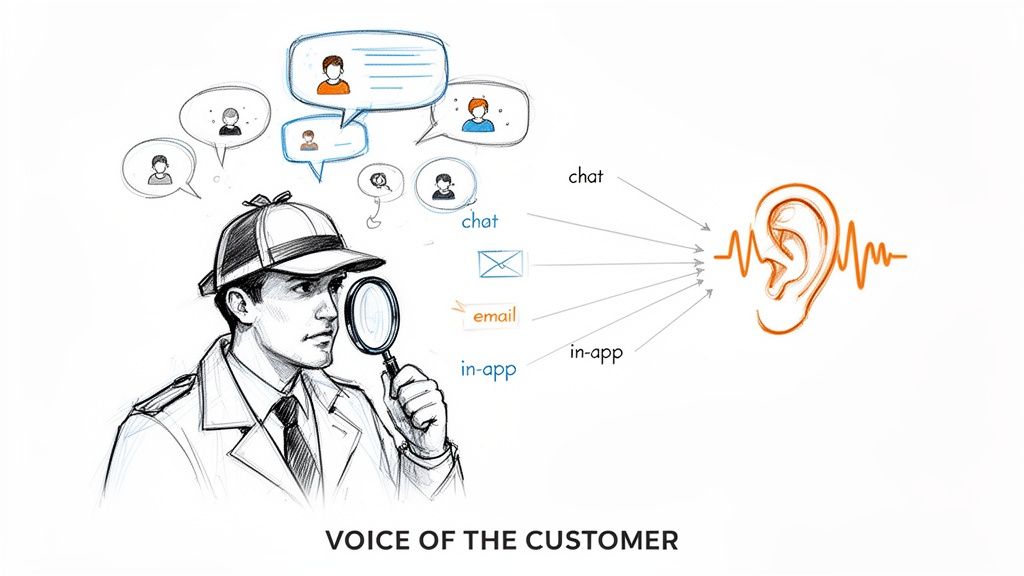
Think of yourself as a detective trying to solve the puzzle of what users truly need. You wouldn't just look at one clue and call it a day. You'd gather all the evidence you could find—from interviews and surveys to support tickets and social media chatter. That’s the heart of understanding the Voice of the Customer.
A formal VoC program is the system you build to make sure none of that evidence gets lost. It's how you bring all that feedback together so every team, from product to marketing, is on the same page about what customers are asking for. For instance, you can get way ahead of the curve by using AI chat logs to improve product feedback loops to spot trends before they become major issues.
This shifts your team's mindset from building what you assume customers want to building what they've told you they need. It’s a game-changer.
The Core Pillars of a VoC Program
A really solid VoC program isn't some mystical, complex thing. It’s a straightforward framework built on three key stages. It’s designed to do more than just collect feedback; it turns that raw data into real-world product improvements that customers love.
This structured process ensures customer feedback doesn't just die in a spreadsheet. Instead, it becomes the fuel for your product's growth. To start off on the right foot, it’s worth exploring different methods to gather customer feedback effectively.
This table breaks down the three fundamental stages, giving you a clear roadmap for how a VoC program actually works.
The Three Pillars of a Voice of the Customer Program
| Pillar | Description | Key Activities |
|---|---|---|
| Capture | Gathering direct, indirect, and inferred feedback from all customer touchpoints. | Surveys, in-app feedback widgets, user interviews, social media listening. |
| Analyze | Processing raw feedback to identify patterns, themes, and sentiment. | Semantic clustering, sentiment analysis, root cause analysis. |
| Act | Using insights to prioritize roadmap items, make product changes, and communicate back to customers. | Prioritization frameworks, closing the feedback loop, feature development. |
Mastering these three pillars—Capture, Analyze, and Act—is the key to making sure your customers feel heard and your product evolves in a way that genuinely meets their needs.
Why VoC Is the Engine of Product-Led Growth
In a product-led growth (PLG) world, your product is your best salesperson. It’s the primary way you acquire, convert, and keep customers. For that to actually work, the product experience has to be so seamless and valuable that people just get it on their own, upgrade without a sales call, and tell their friends.
This is where the Voice of the Customer (VoC) becomes your secret weapon.
Instead of throwing money at long sales cycles or flashy marketing campaigns, PLG companies win by building something that basically sells itself. A great VoC program gives you a direct line to your users, showing you exactly what you need to build to remove friction, prioritize features that matter, and stop guessing what customers actually need.
It’s the difference between flying blind and having a crystal-clear navigation system for your roadmap.
How VoC Directly Impacts Key PLG Metrics
A solid PLG strategy lives and dies by a few core metrics. VoC isn't just a nice-to-have feedback channel; it's a powerful lever you can pull to directly improve the numbers that drive sustainable growth.
- Activation: VoC insights pinpoint the exact moment a new user gets confused or stuck. Fix those specific hurdles in your onboarding, and you’ll help far more people experience that "aha!" moment where your product's value clicks for them.
- Adoption: When you listen to what customers are trying to accomplish, you stop building features that look good on paper and start building tools they actually use. This deepens engagement and makes your product an indispensable part of their daily routine.
- Retention: People stick with companies that listen. According to Zendesk, 81% of shoppers who have a good customer experience are more likely to buy again. VoC is your mechanism for creating those positive experiences that keep customers around.
- Expansion: By tuning into the needs of your power users, you can spot opportunities for new premium features or even entirely new products. This is how you drive more revenue from the customers who already love what you do.
A strong Voice of the Customer program is the difference between building a product you think users want and a product they can't imagine their workflow without. It closes the dangerous gap between your team's assumptions and what people actually need.
This isn't just a niche idea anymore; it's a massive business priority. The market for VoC tools is exploding as more companies realize its power. In 2024, the VoC customer analytics market hit USD 1.69 billion, and it's on track to reach USD 4.68 billion by 2030. This growth isn't just a trend; it's a fundamental shift in how businesses operate. You can learn more about the growth of the Voice of the Customer market and what’s driving it.
Shifting from Passive Feedback to Proactive Growth
Too many companies treat VoC like a dusty old suggestion box that someone checks once a quarter. In a PLG company, that’s a recipe for failure. VoC has to be an active, always-on feedback loop that feeds directly into every single product decision.
When you make this shift, you can do some amazing things:
- Spot At-Risk Customers Early: By tracking feedback, you can catch signs of frustration or confusion and step in to help before a small problem turns into a lost customer.
- Find Your "Super Users": VoC is the best way to identify your most passionate customers. These are the people who will give you incredible testimonials, join your beta programs, and become your biggest cheerleaders.
- Build a True Community: When people see their feedback actually lead to product improvements, it builds incredible trust and loyalty. They stop being just "users" and start acting like partners in your product's journey.
Ultimately, a deep understanding of what the voice of the customer is and how to act on it is the fuel for any successful PLG engine. It makes sure every feature you ship, every bug you squash, and every update you release moves the needle on what really matters: creating a product people are happy to pay for and can't stop talking about.
How to Capture Meaningful Customer Feedback
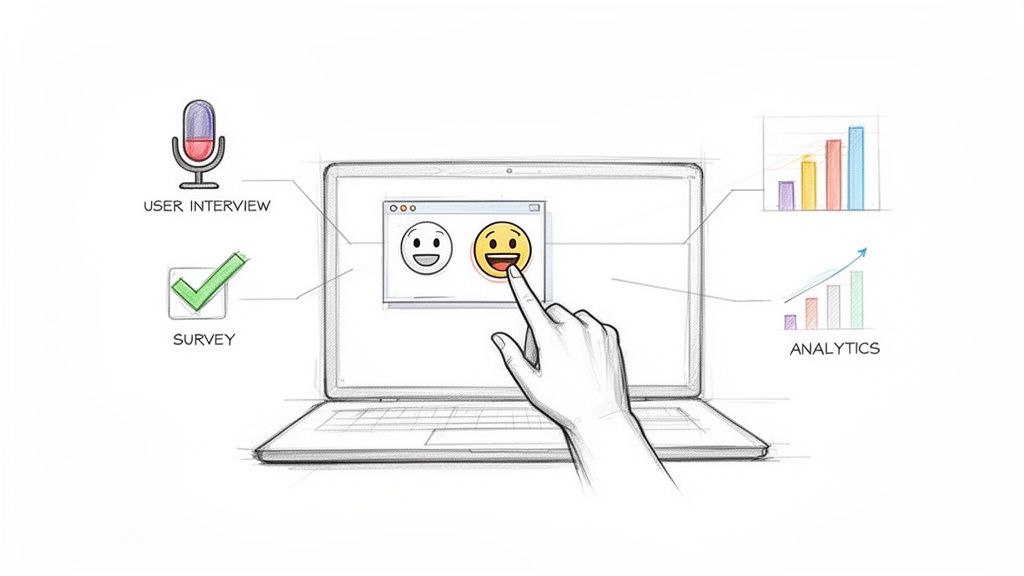
Hearing what your customers have to say all starts with one simple act: listening. But great listening isn’t passive. It’s not about just waiting for feedback to trickle in. It's about building an active system that proactively gathers insights from every single corner of the customer journey.
The goal here is to meet customers exactly where they are. You want to make it dead simple for them to share their thoughts, whether they're feeling a moment of delight or a flash of frustration. This means blending different methods to capture not just what they’re saying, but the crucial context of why they’re saying it.
This is a far cry from the old-school annual survey. Instead, you're building an always-on listening engine that combines the depth of qualitative feedback with the scale of quantitative data to paint a vivid, complete picture of your customers' reality.
Balancing Qualitative and Quantitative Feedback
To truly get what your customers are telling you, you need to collect two different kinds of data. Think of them as two halves of the same story. If you only listen to one, you're guaranteed to get a skewed, incomplete picture.
Qualitative feedback is all about the "why." It's the rich, human stuff you get from one-on-one user interviews, focus groups, or open-ended survey questions. This is where you find the emotion, the specific stories, and the detailed context that raw numbers can never give you.
On the other hand, quantitative feedback delivers the "what" and "how many." This is the data from your Net Promoter Score (NPS) surveys, Customer Satisfaction (CSAT) scores, and simple in-app ratings. It’s measurable, making it perfect for spotting trends, tracking sentiment over time, and understanding just how widespread a problem really is.
The most powerful VoC programs don’t choose between qualitative and quantitative data; they masterfully weave them together. A low CSAT score tells you there's a problem, but a user interview reveals the specific frustration causing it.
This blended approach is the foundation for making confident, evidence-based decisions instead of just guessing what your users want.
Modern Methods for Capturing VoC Data
The days of relying on a simple "Contact Us" form are long gone. Today's best product teams use a whole toolkit of methods to gather feedback without ever getting in the user's way.
In-App Contextual Widgets: These are the small, non-intrusive prompts inside your app that let users give feedback right on a specific feature or page. The real magic is the context—the feedback is automatically tagged with the user's session data, browser, and exactly where they were in your product.
User Interviews and Focus Groups: Nothing beats a real conversation. While they take more time, interviews let you dive deep into a user’s workflow, uncover pain points they might not even realize they have, and ask crucial follow-up questions to get to the heart of the matter.
Targeted Surveys: Forget about blasting your entire user base with a 20-question survey. Modern tools can trigger short, hyper-relevant surveys based on user behavior. For example, you can pop up a quick question right after someone uses a new feature for the very first time.
Social Media and Community Listening: Your customers are already talking about you on places like Twitter, Reddit, and industry forums. Tapping into these channels gives you raw, unfiltered feedback and often serves as an early warning system for emerging issues.
So, how do you decide which method to use? The table below breaks down some of the most common approaches to help you pick the right tool for the job.
Choosing Your VoC Data Collection Method
| Method | Type | Best For | Potential Drawback |
|---|---|---|---|
| User Interviews | Qualitative | Gaining deep, contextual understanding of user problems and motivations. | Time-consuming and not easily scalable. |
| In-App Feedback Widgets | Both | Capturing specific, contextual feedback in real-time without interrupting workflow. | Can generate high volumes of unstructured data that needs analysis. |
| NPS/CSAT Surveys | Quantitative | Measuring overall loyalty and satisfaction at key touchpoints. | Lacks the "why" without an open-ended follow-up question. |
| Community Forums | Both | Sourcing ideas and identifying common issues from your most engaged users. | Can be dominated by a vocal minority, potentially skewing perceptions. |
In the end, a strong VoC strategy doesn't rely on a single method. It uses a smart mix of these techniques. By building a comprehensive listening system, you create a safety net that ensures no valuable customer insight ever slips through the cracks, setting you up for powerful analysis and decisive action.
Translating Raw Feedback into Actionable Insights
Capturing customer feedback is a massive win, but it's only the first step. A mountain of raw comments, suggestions, and complaints is just data—noisy, chaotic, and ultimately useless until you have a system to make sense of it all. This is where analysis comes in, transforming that raw material into real, actionable insights.
The whole point isn't just to collect feedback; it's to find the signal in the noise. Think of it like trying to assemble a thousand-piece jigsaw puzzle without the picture on the box. That’s what staring at a wall of raw customer comments feels like.
This critical phase is where you turn a jumbled stream of customer voices into a clear, prioritized product roadmap that actually drives business growth.
From Manual Tagging to Automated Insights
In the early days, most teams start with a simple spreadsheet. They manually copy and paste feedback from emails, support tickets, and chat logs, then try to categorize everything with tags. And for a handful of comments, that works just fine. But it breaks down with shocking speed.
The process is painfully slow, riddled with human error, and completely impossible to scale. As your feedback volume grows, that once-helpful spreadsheet becomes an unmanageable beast, and valuable insights get buried forever. It's like trying to bail out a speedboat with a teaspoon—you're working hard but falling further and further behind.
This is exactly why modern product teams are moving toward smarter, AI-driven approaches. Instead of relying on someone to manually tag every comment, these systems can automatically identify and group related feedback using semantic analysis.
The true power of modern VoC analysis is its ability to instantly quantify feedback. You can immediately see that 15% of your high-value customers are struggling with the same integration issue, transforming a collection of anecdotes into a hard data point that demands attention.
Connecting Feedback to Business Impact
Let’s be honest: not all feedback is created equal. A feature request from a single user on a free plan doesn't carry the same weight as a critical bug report from a dozen enterprise customers. A crucial step in any successful VoC program is a robust Voice of Customer analysis, which turns that raw data into strategic direction.
To prioritize effectively, you have to connect feedback to tangible business metrics. The most powerful way to do this is by linking customer comments directly to revenue data, especially Monthly Recurring Revenue (MRR).
This approach lets you answer the questions that really matter:
- How much MRR is tied to the customers asking for this specific feature?
- Which bugs are impacting our highest-paying accounts the most?
- Are we at risk of churn if we don't address this specific pain point?
By quantifying feedback with revenue, your product team can finally move beyond prioritizing the loudest or most popular requests. Instead, they can focus on the changes that will have the biggest positive impact on the business, protecting revenue and driving growth. This data-driven method makes roadmap decisions objective and defensible. For a deeper dive, you can explore various qualitative data analysis techniques that help structure this process.
Transforming Analysis into a Prioritized Roadmap
Once your feedback is categorized and quantified, the final step is turning it into a clear set of priorities. This is where insights become actions. The analysis should feed directly into your product development workflow, creating a straight line from a customer's need to a shipped feature.
A well-executed analysis process delivers several key outputs that truly empower your team:
- Themed Clusters: Instead of 100 individual comments about "slow loading times," you get one clean, themed cluster representing that issue, complete with all associated user conversations and revenue data.
- Sentiment Trends: You can track whether customer sentiment around a particular topic is getting better or worse over time, giving you an early warning system for potential problems.
- Revenue-Weighted Priorities: You get a clear, stack-ranked list of issues and feature requests, ordered not just by volume but by their direct impact on your bottom line.
This structured approach removes the guesswork from product management. It ensures your team is always working on the most important problems for your most valuable customers. You stop reacting to the most recent complaint and start proactively building a product that solves the problems that matter most—turning your VoC program into a powerful engine for strategic growth.
Building Your VoC Program From the Ground Up
The ultimate goal is to turn a mountain of customer feedback into a clear, prioritized product roadmap. But how do you actually build a system that does this over and over again? A successful Voice of the Customer (VoC) program isn’t about finding one magic tool; it's about creating a repeatable process that weaves customer listening into the fabric of your company.
It’s all about moving from a chaotic, ad-hoc approach to a structured system that consistently captures, analyzes, and, most importantly, acts on what your customers are telling you. This framework is what ensures the voice of the customer doesn't just get heard—it gets results.
Define Your VoC Program Goals
Before you even think about tools or start drafting a survey, you have to know what you’re trying to accomplish. Without clear goals, your VoC program will just be a noisy echo chamber, full of data but empty of real signal. Your objectives will steer every single decision that follows.
So, start by asking: what does success actually look like for us? Are you trying to:
- Reduce Churn? Then you'll need to focus on identifying at-risk customers and prioritizing fixes for their biggest frustrations.
- Increase Activation? Your goal should be to pinpoint where new users get stuck and then smooth out those rough spots in the onboarding flow.
- Drive Expansion Revenue? You'll want to uncover what your power users value most to inspire new premium features they’d happily pay for.
Setting a specific, measurable goal—like "cut churn by 5% in the next six months by solving the top three issues reported by our at-risk accounts"—gives your program the direction and purpose it needs to succeed.
Choose Your Tools and Integrations
Once you know your destination, you can pick the right vehicle to get you there. Your VoC toolkit should make it dead simple to capture feedback, make sense of it, and push those insights right into your team’s daily workflow. A smart setup usually involves a central hub that plays nicely with the tools your team already lives in.
For example, an integration with Slack can ping your product team about urgent feedback the moment it comes in. Connecting your VoC platform to Jira or GitHub can turn a validated customer insight into a development ticket in one click, bridging the gap between listening and doing.
This simple flow chart shows how feedback moves from collection to prioritization, forming the backbone of your program.
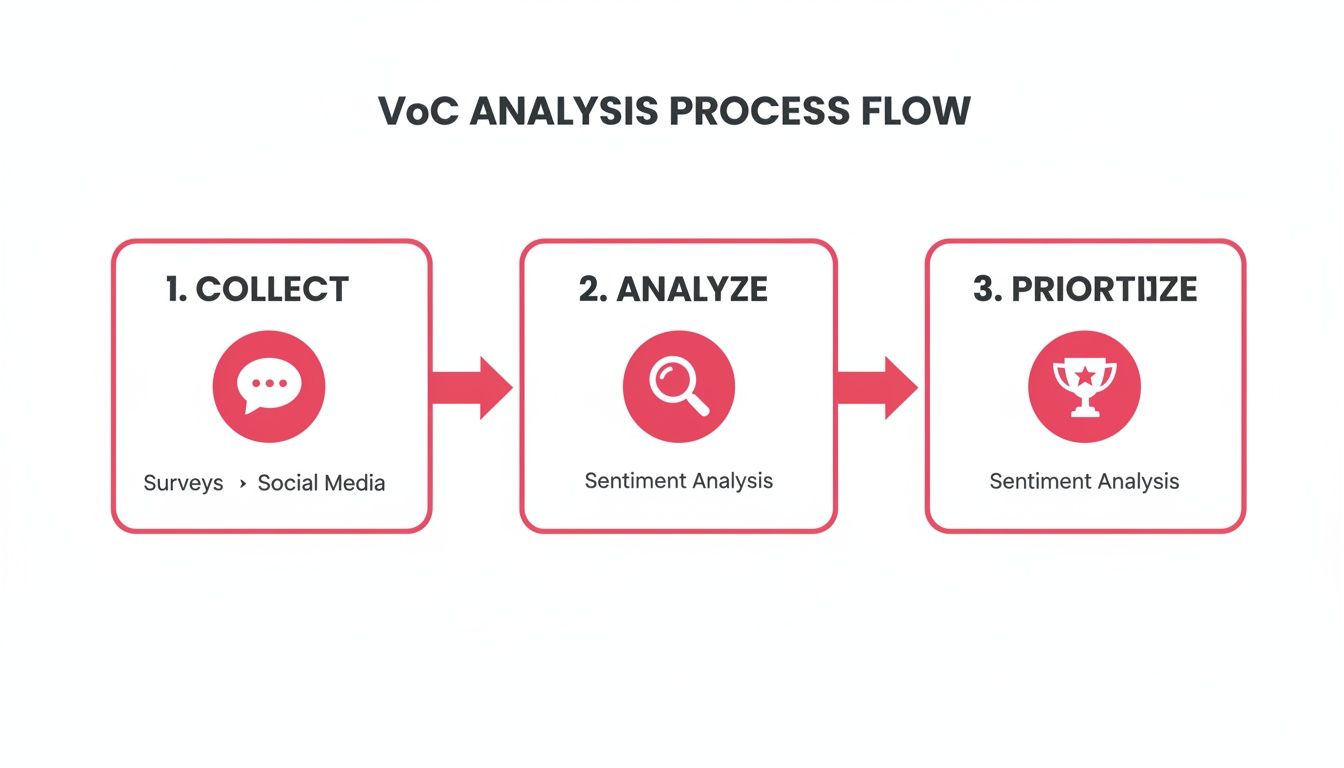
The visual really boils it down to the essentials: gathering the feedback, understanding it, and then ranking it by impact.
Prioritize and Take Action
With a steady stream of feedback coming in, the real work begins: deciding what to do first. As we've covered, weighting feedback by revenue is a game-changer here. It helps you shift from simply building the most-requested features to building the features your most valuable customers desperately need.
Taking action also requires a clear handoff. Once an insight is validated, the product team needs the full story. They should be able to see who asked, what they said, and how much their account is worth to make truly informed roadmap decisions.
Close the Feedback Loop
This last step is easily the most important, yet it’s the one most companies skip. Closing the feedback loop simply means letting customers know when you've shipped a feature or fixed a bug they told you about. It’s the ultimate proof that you’re not just collecting feedback for show—you’re actually listening.
Closing the loop is one of the most powerful retention tactics you have. It transforms a simple transaction into a partnership, making customers feel heard, valued, and genuinely invested in your product’s journey.
This one small act builds incredible customer loyalty. And the financial impact is real. Businesses that master this see up to 20-30% higher retention rates, drawing a straight line from VoC efforts to revenue growth. The entire VoC software market is booming because companies are waking up to this reality. If you want to dig into the numbers, you can explore more data on how VoC software impacts retention.
How FeatureBot Automates Your VoC Strategy
Running a Voice of the Customer program sounds great in theory, but the reality can be a whole lot of manual work. Capturing, sifting through, and actually acting on feedback often feels like a full-time job. This is where modern tools come in—they handle the heavy lifting, turning VoC from a one-off project into an always-on engine for product growth.
FeatureBot is designed to do exactly this. It plugs right into your product with a simple, conversational widget that prompts users for their thoughts right when they have them. It feels natural, not like some clunky, tacked-on survey.
From Raw Feedback to Revenue-Driven Decisions
Collecting feedback is just the start. The real magic is in making sense of it all, and this is where FeatureBot puts things on autopilot.
Its AI gets to work immediately, using semantic clustering to group similar ideas. No more manually tagging feedback in spreadsheets or trying to guess which duplicate request came first. It automatically surfaces the big themes everyone is talking about.
But it goes deeper than that. FeatureBot connects each piece of feedback to the business data that matters, like customer MRR. This allows you to stop prioritizing based on who yells the loudest and start focusing on the changes that will retain your most valuable customers. It’s about making sure your development time directly protects your bottom line.
A great VoC tool doesn't just show you what customers are saying; it shows you which voices matter most to your revenue. It turns a noisy feedback channel into a clear, revenue-weighted roadmap.
Closing the Loop with Confidence
A VoC program isn't finished until you let customers know you heard them. FeatureBot makes this final, crucial step easy.
You can automatically notify users when a feature they requested is shipped or a bug they reported gets fixed. This small act proves you're listening and is one of the most powerful ways to build a loyal following. We don't offer a free trial but we do have a Free plan to get started.
To see how all these pieces come together, check out our guide on choosing the right customer feedback management platform for your team.
Common Questions About Voice of the Customer
Whenever teams start digging into the voice of the customer, the same practical questions tend to pop up. It's totally normal. Building a great VoC program is all about working through these early questions and getting clear on the fundamentals. Let's tackle some of the most common ones.
Think of this as a quick-start guide to clear up any confusion and get you moving in the right direction from the get-go.
How Is VoC Different from NPS or CSAT Surveys?
This is a great question, and the distinction is super important. Think of scores like NPS (Net Promoter Score) or CSAT (Customer Satisfaction) as the "what." They give you a number—a snapshot in time that tells you what customers think about you. Are they happy? Are they loyal? These metrics are fantastic for benchmarking and watching trends.
But the Voice of the Customer is the "why" behind that number. It's not a single survey, but a continuous process of gathering the rich, messy, human details of your customers' experiences. An NPS score might tell you there's a fire, but your VoC program is what finds the smoke and tells you exactly where the fire is, what's fueling it, and how to put it out.
How Can I Start a VoC Program with a Small Team?
You absolutely don't need a huge team or a six-figure budget to get started. Honestly, the most important thing is to just start. Start small, but be consistent.
Begin with the channels you already have. Are your support reps hearing the same complaints over and over? That's VoC. Could you set up a simple automated email asking for feedback after a user signs up? That's VoC, too. The trick is to create a simple, repeatable habit of collecting and actually looking at the feedback, even if it’s just for an hour every Friday.
A great way to begin is with a tool built for teams that don't have a ton of resources. We don't offer a free trial but we do have a Free plan to get started. It lets you plug in a powerful feedback widget and analysis system without spending a dime, so you can start proving the value of VoC right away.
How Do I Measure the ROI of My VoC Program?
Measuring the return on investment (ROI) isn't as fuzzy as you might think. It’s all about connecting the dots—drawing a straight line from a piece of customer feedback to a real business outcome. When you listen and then act, the results show up in your core metrics.
Here are a few concrete examples:
- Activation Rate: You hear from new users that your onboarding is confusing. You use that feedback to simplify the first three steps. The direct result? You can measure the lift in your user activation rate.
- Customer Retention: Several of your biggest customers ask for a specific integration. You build it. When they renew their contracts, you can directly attribute retaining that chunk of MRR to your VoC efforts.
- Reduced Churn: Your VoC system flags a recurring bug that's frustrating a group of at-risk users. You fix it before they cancel. You just directly prevented churn and saved revenue.
Ready to stop guessing and start building what your customers actually want? With FeatureBot, you can launch a powerful VoC program in minutes. Capture contextual feedback, automatically analyze insights with AI, and prioritize your roadmap based on real business impact. Learn more at FeatureBot.
Ready to capture better feedback?
FeatureBot helps you collect, organize, and prioritize user feedback with AI-powered conversations.
Get Started Free