10 Powerful Methods of Prioritization for Product Teams in 2026
In the world of product development, the difference between success and failure often comes down to one thing: prioritization. With limited resources and endless possibilities, deciding what to build next is the most critical decision you'll make. But how do you move from a chaotic backlog of user requests, stakeholder demands, and brilliant ideas to a clear, actionable roadmap? The answer lies in adopting structured methods of prioritization.
These frameworks replace guesswork with data, gut feelings with clear criteria, and endless debates with decisive action. To truly stop guessing and start prioritizing effectively, it's crucial to begin with well-structured discussions. A key step in this process involves learning how to create a focused agenda, as detailed in an article on crafting a board meeting agenda that actually drives action, which ensures every conversation leads to a tangible outcome.
This guide will walk you through 10 proven methods, providing a comprehensive toolkit for any product team aiming to build what truly matters. We'll explore everything from quick visual matrices to complex scoring models, helping you find the perfect approach to turn feedback into features that drive growth and customer loyalty. Whether you're a startup founder on our Free plan or a seasoned product manager, you will learn how to:
- Objectively evaluate features, bugs, and technical debt.
- Align your team and stakeholders around a shared set of goals.
- Communicate your roadmap with confidence and clarity.
- Select the right framework for any scenario, from early-stage validation to mature product optimization.
Get ready to transform your product planning from a subjective art into a strategic science.
1. MoSCoW Method
The MoSCoW method is a powerful prioritization framework used to categorize features, tasks, or requirements. Developed by Dai Clegg for the Dynamic Systems Development Method (DSDM), it helps teams reach a common understanding of what truly matters for a specific release or sprint. This technique is one of the most straightforward methods of prioritization, focusing on delivering the most immediate value first.
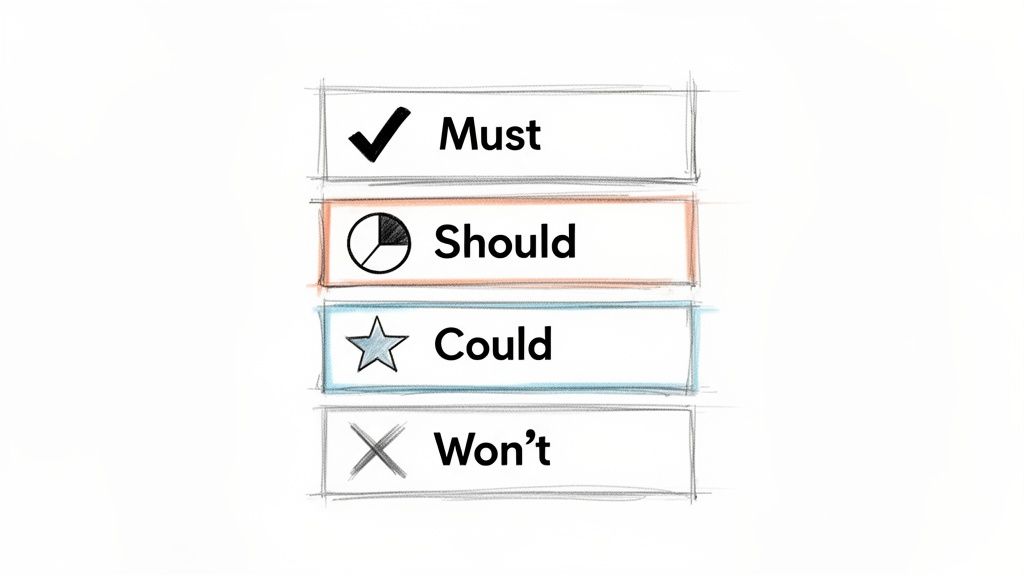
It segments items into four distinct categories:
- Must Have: Non-negotiable, critical requirements. The product or release is considered a failure without them. These are the absolute minimum for a viable solution.
- Should Have: Important but not vital. These requirements are significant but can be deferred to a later release without catastrophic impact. The product will still work, but it will be less valuable.
- Could Have: Desirable but not necessary. These are nice-to-have features that will only be included if time and resources permit. They have a small impact if left out.
- Won't Have (this time): Items that are explicitly out of scope for the current timeframe. Acknowledging these helps manage expectations and prevents scope creep.
When to Use the MoSCoW Method
This framework excels in scenarios requiring clear, consensus-driven scope management. It's ideal for Agile teams planning a sprint, SaaS companies defining quarterly roadmaps, or startups scoping a Minimum Viable Product (MVP). By forcing stakeholders to agree on what is truly a "Must Have," it clarifies priorities and aligns the entire team.
Actionable Tips for Implementation
To get the most out of MoSCoW, involve a cross-functional team including product, engineering, and customer success. This ensures all perspectives inform the categorization.
- Set a Hard Cap: To prevent everything from becoming a "Must Have," allocate a strict budget for them, such as 60% of your team's effort for the release.
- Integrate Customer Data: Use feedback from platforms like FeatureBot to validate your assumptions. For instance, a "Could Have" feature might become a "Should Have" if it's consistently requested by high-MRR customers.
- Document Your Rationale: Record why an item was placed in a specific category. This context is invaluable when priorities are questioned or revisited later.
- Iterate Regularly: Priorities change. Revisit your MoSCoW board at the start of each new cycle to ensure it still reflects current business goals and user needs.
2. RICE Scoring Model
The RICE scoring model is a quantitative prioritization framework designed by Intercom to remove gut feelings from product roadmapping. It helps teams evaluate competing ideas in a consistent, data-informed way by scoring each initiative against four distinct factors. This method is one of the most effective methods of prioritization for product teams needing to justify their decisions with clear, objective data.
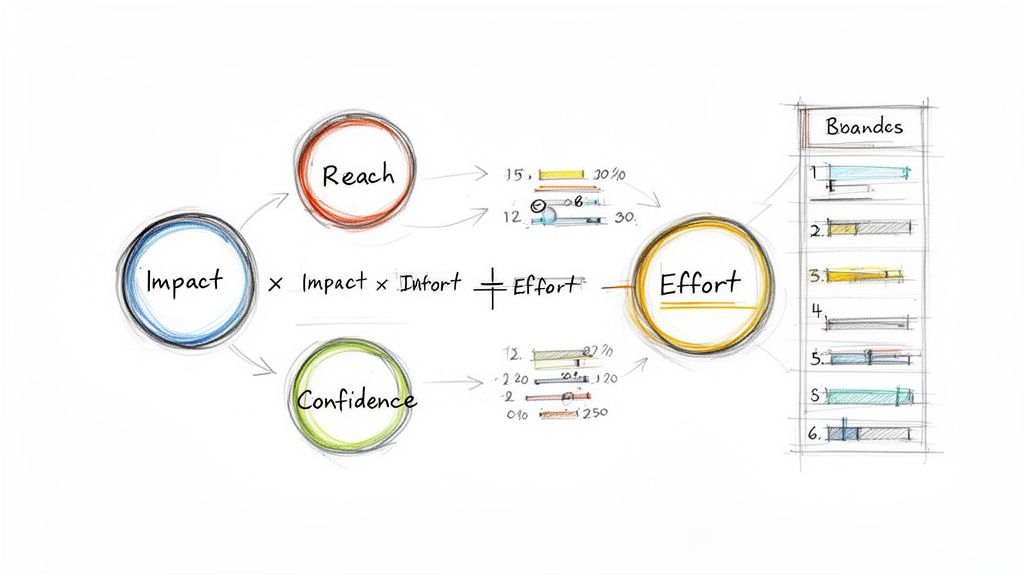
It calculates a final score using this formula: (Reach x Impact x Confidence) / Effort.
- Reach: How many people will this initiative affect within a specific time period? (e.g., customers per quarter).
- Impact: How much will this initiative impact individual users? This is often measured on a scale from massive (3x) to minimal (0.25x).
- Confidence: How confident are you in your estimates for reach, impact, and effort? This is expressed as a percentage (e.g., 100% for high confidence, 50% for low).
- Effort: How much time will this require from your product, design, and engineering teams? This is estimated in "person-months."
When to Use the RICE Scoring Model
RICE is exceptionally useful for established product teams managing a continuous stream of ideas from various sources, such as customer feedback, internal stakeholders, and market analysis. It’s ideal for SaaS companies like Dropbox or Slack that need to objectively compare vastly different initiatives, from minor UI tweaks to major new features. The framework forces a data-driven conversation about potential value versus required resources.
Actionable Tips for Implementation
Successful RICE implementation depends on clear definitions and collaborative input. It's one of several essential product management frameworks that benefit from team alignment.
- Define Your Scales: Before you start, create a clear rubric for what each score means (e.g., what constitutes a "massive" 3x impact vs. a "high" 2x impact).
- Weight 'Reach' with MRR: Use data from a platform like FeatureBot to inform your Reach score. A feature requested by five enterprise clients should score higher than one requested by twenty users on a Free plan.
- Score Collaboratively: Involve representatives from engineering, design, and marketing in the scoring process to get accurate effort estimates and diverse perspectives on impact.
- Document Assumptions: For each confidence score, briefly note why you chose that percentage. This transparency is crucial for future reviews and discussions.
- Re-evaluate Periodically: RICE scores are not permanent. Revisit your prioritized list quarterly or when new data emerges to ensure it still aligns with your strategic goals.
3. Kano Model
The Kano Model is a customer-centric prioritization framework that connects product features to user satisfaction. Developed by Japanese professor Noriaki Kano, this model helps teams understand which features will satisfy, delight, or simply meet the basic expectations of their customers. It recognizes that not all features have an equal impact on customer loyalty.
It classifies features into five categories, with three being central to prioritization:
- Basic Features (Must-Haves): Expected by customers. Their absence causes dissatisfaction, but their presence is taken for granted and does not increase satisfaction. Think of a login system for a SaaS tool.
- Performance Features (Satisfiers): The more you provide, the more satisfied customers become. These are features where performance directly correlates with satisfaction, such as faster processing speeds or more storage.
- Excitement Features (Delighters): Unexpected and pleasant surprises. Their absence doesn't cause dissatisfaction, but their presence creates delight and can be a major competitive differentiator. Slack's emoji reactions were an early example.
When to Use the Kano Model
This model is exceptionally useful when you need to move beyond functional requirements and prioritize based on emotional impact and customer loyalty. It's ideal for mature products looking for a competitive edge, teams defining a new product experience, or companies trying to balance bug fixes (maintaining Basic Features) with innovation (creating Delighters). For instance, a SaaS company could use it to decide whether to improve core feature performance or build a novel, delightful integration.
Actionable Tips for Implementation
To apply the Kano Model effectively, you must gather direct customer feedback, as internal assumptions are often wrong.
- Survey Customers: Use the specific Kano questionnaire format, asking users how they feel if a feature is present and if it's absent. This dual-question approach is key to accurate categorization. For deeper insights, you can review different user research methodologies to complement your surveys.
- Balance Your Roadmap: A robust roadmap should contain a mix of all three feature types. Neglecting Basic Features leads to churn, while ignoring Delighters leads to stagnation.
- Analyze Feedback Themes: Use tools like FeatureBot to cluster user feedback and identify which themes correspond to Basic, Performance, or Excitement needs. This can reveal hidden Delighters in your backlog.
- Re-evaluate Regularly: Customer expectations evolve. Yesterday’s Delighter is today’s Basic Feature. Re-run your Kano analysis annually or quarterly to stay aligned with the market.
4. Value vs. Effort Matrix (2x2 Matrix)
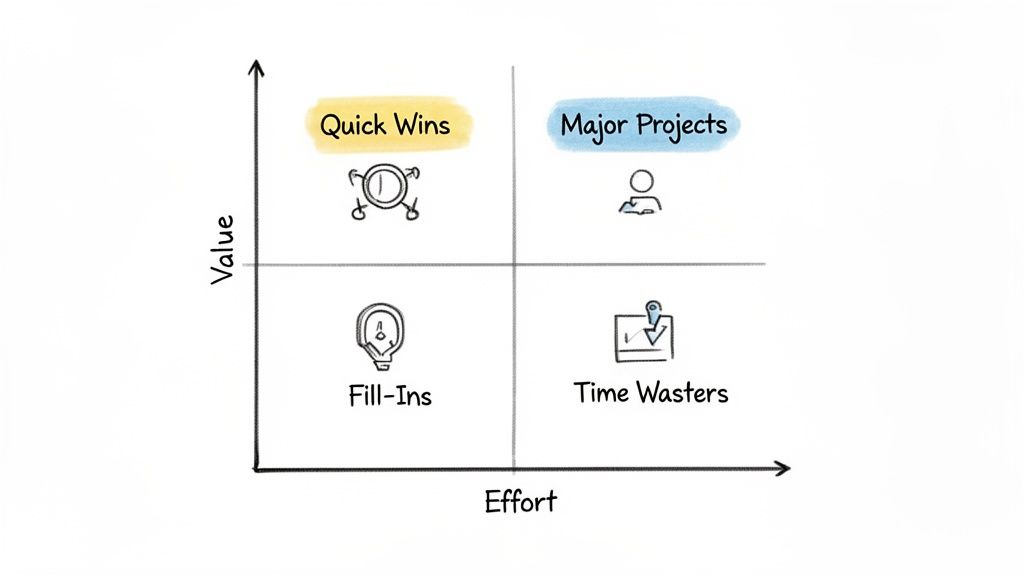
The Value vs. Effort Matrix is a simple yet effective prioritization framework used to visually map initiatives based on their potential return and the resources required to complete them. This 2x2 grid plots tasks on two axes: Business Value (or Customer Impact) on the vertical Y-axis and Implementation Effort on the horizontal X-axis. This method provides immediate clarity, making it one of the most accessible methods of prioritization for quick decision-making.
It segments items into four distinct quadrants:
- Quick Wins (High Value, Low Effort): Top priorities. These tasks deliver significant value with minimal investment and are great for building momentum.
- Major Projects (High Value, High Effort): Strategic initiatives. These require substantial resources but promise significant long-term returns. They need careful planning.
- Fill-Ins (Low Value, Low Effort): Optional tasks. These can be done when there are gaps in the schedule but shouldn't distract from more valuable work.
- Time Wasters (Low Value, High Effort): Items to avoid. These consume significant resources for little to no gain and should be deprioritized or eliminated.
When to Use the Value vs. Effort Matrix
This framework is perfect for teams that need a fast, visual way to compare a diverse set of tasks without complex scoring. It’s ideal for early-stage startups planning initial feature sets, marketing teams prioritizing campaigns, or engineering leads deciding which technical debt to tackle alongside new features. Its simplicity facilitates quick alignment and discussion among stakeholders.
Actionable Tips for Implementation
To maximize the matrix's effectiveness, ensure your definitions of "value" and "effort" are clear and consistent across the team.
- Define 'Value' Objectively: Before plotting, agree on what value means. Is it direct revenue impact, user satisfaction, or churn reduction? Use data to inform this dimension.
- Involve Engineering in Effort Estimates: To ensure effort scores are realistic, collaborate closely with the development team. Their buy-in is critical for accurate planning.
- Integrate Customer Revenue Data: Use a tool like FeatureBot to inform your "value" score. Weighting feedback by customer MRR can turn a subjective guess into an objective data point. You can get started with a Free plan.
- Start with Quick Wins: Prioritize completing tasks in the Quick Wins quadrant first to build team morale and deliver immediate value to users. This creates a positive feedback loop for the team.
- Update the Matrix Regularly: This is not a one-time exercise. Revisit and update your matrix monthly or quarterly to reflect new information and shifting business priorities. Learn how to prioritize your product backlog with this and other frameworks.
5. Priority Poker (Planning Poker)
Priority Poker, often called Planning Poker, is a gamified, consensus-driven technique for estimating effort and prioritizing tasks. Popularized within Agile frameworks like Scrum, it uses a group-based approach to mitigate cognitive biases, like anchoring, where the first opinion shared heavily influences subsequent ones. It ensures every voice is heard equally before a collective decision is made.
The process involves team members using numbered cards to vote simultaneously on an item's value or effort. This prevents individuals from being swayed by others' opinions. The steps are simple:
- Present an Item: A facilitator introduces a feature or task from the backlog.
- Discuss Briefly: The team discusses the item to ensure everyone has a shared understanding.
- Vote Privately: Each member selects a card representing their estimate or priority level and places it face down.
- Reveal and Discuss: Everyone reveals their cards at the same time. If estimates vary significantly, the members with the highest and lowest votes explain their reasoning.
- Re-Vote: The process is repeated until the team reaches a consensus.
When to Use Priority Poker
This collaborative method is highly effective for Agile teams during sprint planning, backlog grooming, or feature prioritization sessions. It shines when you need to leverage the collective wisdom of a cross-functional team, including developers, designers, and product managers. It's also an excellent tool for distributed teams, as digital poker apps can easily facilitate remote participation, ensuring alignment across different locations.
Actionable Tips for Implementation
To maximize the effectiveness of Priority Poker as one of your core methods of prioritization, a structured approach is key.
- Use Digital Tools: For remote teams, platforms like Miro, Trello, or dedicated planning poker apps can replicate the in-person experience seamlessly.
- Arm with Customer Data: Before the session, prepare cards or notes with actual customer feedback. For instance, you can pull feature requests directly from a tool like FeatureBot to give context to the discussion.
- Facilitate Discussion: When votes differ widely, have the highest and lowest voters explain their rationale. This dialogue is where the real value lies, often uncovering hidden complexities or assumptions.
- Set Time Limits: Keep the momentum going by time-boxing the discussion for each item. This prevents analysis paralysis and keeps the session focused and productive.
- Document Outcomes: Record the final priority or estimate and, more importantly, the key points from the discussion. This context is invaluable for future reference.
6. Weighted Scoring Model
The Weighted Scoring Model is a highly adaptable and quantitative prioritization technique used to evaluate competing initiatives. This method removes much of the subjectivity from decision-making by scoring each potential project or feature against a set of predefined, business-relevant criteria. It provides a transparent, data-driven foundation for building a product roadmap.
The process involves several key steps:
- Define Criteria: First, your team identifies the key drivers of value. These could include strategic alignment, revenue impact, customer satisfaction, and implementation effort.
- Assign Weights: Not all criteria are equally important. The team assigns a percentage weight to each criterion, ensuring the total adds up to 100%. For example, strategic alignment might be weighted at 30%, while effort is at 20%.
- Score Initiatives: Each initiative is then scored against every criterion, typically on a scale of 1-5 or 1-100.
- Calculate Total Score: The final priority score for each initiative is calculated by multiplying its score in each criterion by the criterion's weight and summing the results. The items with the highest scores are prioritized.
When to Use the Weighted Scoring Model
This model is exceptionally useful for organizations needing a systematic and objective way to compare diverse types of initiatives. It's ideal for enterprise product teams balancing needs from different customer segments, SaaS companies prioritizing features based on revenue and user requests, or startups weighing growth-focused features against technical debt. It brings clarity when you have multiple stakeholders with conflicting priorities.
Actionable Tips for Implementation
The strength of this model lies in its customization and transparency. A well-defined model can transform prioritization from a debate into a calculation.
- Limit Your Criteria: Start with 5-7 core criteria to avoid overcomplicating the model. Too many variables can make scoring unwieldy and dilute the focus.
- Align Weights with Strategy: Your weights should directly reflect your current business goals. If churn reduction is your top priority, give a higher weight to criteria like "customer satisfaction" or "retention impact."
- Leverage Customer Data: Use quantitative data from tools like FeatureBot as an input. The revenue weighting from customer requests can serve as a powerful, pre-calculated "revenue impact" criterion.
- Document and Socialize: Make the scoring criteria and their definitions public within your organization. This transparency builds trust and helps all stakeholders understand how decisions are made.
- Revisit Weights Quarterly: Business strategies evolve. Review and adjust your criteria weights at least once a quarter to ensure your prioritization framework remains aligned with your most important objectives.
7. Impact Mapping
Impact Mapping is a strategic planning and prioritization technique that visually connects business objectives with desired outcomes and the features required to achieve them. Developed by Gojko Adzic, it flips traditional product planning on its head. Instead of starting with a list of features, it begins with a clear business goal and works backward to identify the most effective path to success.
This method organizes thinking around four key questions:
- Why? What is the business goal we are trying to achieve? This is the central objective.
- Who? Who are the actors (users, stakeholders) that can influence the outcome?
- How? How should these actors' behaviors change to help us achieve the goal? These are the desired impacts.
- What? What can we build or do to support the required impacts? These are the deliverables or features.
When to Use Impact Mapping
Impact Mapping is highly effective for teams looking to ensure their product development efforts are directly tied to tangible business results. It’s ideal for startups validating that new features serve customer acquisition goals, enterprise teams aligning product investments with company strategy, or product managers defining roadmaps for new market entry. It prevents building features that don't contribute to the bottom line.
Actionable Tips for Implementation
To maximize the effectiveness of Impact Mapping, facilitate a collaborative session with a diverse group of stakeholders. This ensures all perspectives contribute to a robust, goal-oriented plan.
- Define a SMART Goal: Start with a goal that is Specific, Measurable, Achievable, Relevant, and Time-bound. A vague goal like "increase user engagement" is less effective than "increase daily active users by 15% in Q3."
- Use Customer Insights: Validate your assumptions about behavior change with real user feedback. Use data from customer feedback tools to confirm which features are most likely to drive the desired impacts.
- Prioritize Deliverables Ruthlessly: Once you have a map, focus on the deliverables that offer the most direct path to the desired impact. Be prepared to cut features that don't clearly map back to a specific behavioral change and the primary goal.
- Revisit and Adapt: An impact map is a living document. Revisit it regularly, especially when business goals shift or market conditions change, to ensure your product roadmap remains aligned with your strategy.
8. Opportunity Scoring (Net Promoter Score-based)
Opportunity Scoring is a customer-centric prioritization method used to identify features that offer the greatest potential for improving user satisfaction. Popularized within the Jobs to Be Done framework by Tony Ulwick, it pinpoints the gap between how important a feature is to a customer and how satisfied they currently are with it. This technique is one of the more data-driven methods of prioritization, focusing on areas where improvements will deliver the most customer value.
The core of the model lies in a simple calculation based on customer survey data:
- Importance: Customers rate how important a specific outcome or feature is to them on a scale (e.g., 1-10).
- Satisfaction: Customers then rate their current satisfaction level with that same outcome or feature.
- Opportunity Score: Calculated by combining these two metrics, often using a formula like
Importance + (Importance - Satisfaction). Features with high importance and low satisfaction yield the highest scores, signaling a significant opportunity.
When to Use Opportunity Scoring
This framework is exceptionally powerful for product teams focused on retention and customer-led growth. It’s ideal for SaaS companies analyzing NPS feedback to find improvement areas, mature products looking to reduce churn, or enterprise vendors prioritizing features based on feedback from a customer advisory board. By quantifying customer pain points, it moves prioritization from internal guesswork to a process driven by user needs.
Actionable Tips for Implementation
To implement Opportunity Scoring effectively, consistent and well-structured customer feedback is essential. This ensures your data is reliable and your priorities are aligned with real-world user sentiment.
- Conduct Regular Surveys: Ask customers to rate both the importance of and satisfaction with key features on a quarterly basis to track trends.
- Validate Importance: Use data from a tool like FeatureBot to identify frequently requested features. This qualitative data can validate the quantitative importance ratings from your surveys and ensure you're asking about the right things.
- Segment Your Data: Analyze scores separately for different customer segments, such as high-MRR customers or new users, to identify which opportunities matter most to your key personas.
- Target Quick Wins: Focus on features with the highest opportunity scores (high importance, low satisfaction). These are your biggest pain points and offer the most impactful improvements.
- Share Findings: Communicate the opportunity scores back to key customers or your user community. This builds transparency and manages their expectations about your roadmap.
9. Threshold Gate Prioritization
Threshold Gate Prioritization is a filtering-based framework that establishes minimum criteria, or "gates," that initiatives must pass to even be considered for development. Instead of ranking every idea against each other from the start, this method acts as a bouncer, quickly eliminating initiatives that don't meet foundational business requirements. It’s one of the most efficient methods of prioritization for teams overwhelmed with a high volume of requests.
The process involves setting predefined conditions. Items that fail to meet these thresholds are set aside, allowing the team to focus its energy on a pre-qualified list. Common gates include:
- Strategic Alignment: The initiative must directly support a current company OKR.
- Minimum Customer Demand: It must be requested by a certain number of users or specific high-value accounts.
- Revenue Impact: The feature must have a projected minimum impact on MRR or expansion revenue.
- Feasibility Check: It must be achievable within the team's current technical capabilities and resource constraints.
When to Use Threshold Gate Prioritization
This approach is highly effective for product organizations that need to manage a large, unfiltered backlog. It’s perfect for enterprise product teams filtering low-revenue requests, startups ensuring every feature aligns with their core strategy, or support teams deciding which bugs warrant immediate engineering attention. By weeding out non-starters early, it saves significant time and effort that would otherwise be spent on detailed scoring.
Actionable Tips for Implementation
To implement this method effectively, gates must be clear, objective, and aligned with your business strategy.
- Make Gates Transparent: Clearly document and share your gate criteria with all stakeholders. This builds trust and helps everyone understand why certain ideas are not pursued.
- Use Multiple Gates: Filter initiatives progressively. An idea might first pass a strategic fit gate, then a customer demand gate, and finally a feasibility gate.
- Set Revenue-Based Thresholds: Leverage customer data to create powerful gates. For example, use a platform like FeatureBot to automatically filter requests, only considering those from customers contributing a combined $5,000 in MRR.
- Review Thresholds Quarterly: Business needs change. Re-evaluate your gates every quarter to ensure they still align with your evolving goals and market conditions.
- Combine with Other Methods: Use Threshold Gate Prioritization as a first-pass filter. For the items that pass, apply a more granular method like Weighted Scoring or RICE to determine the final development order.
10. Jobs to Be Done (JTBD) Framework
The Jobs to Be Done (JTBD) framework is a powerful theory that reframes product development from building features to solving customer problems. Popularized by Clayton Christensen, it posits that customers "hire" products to get a specific "job" done. This approach shifts the focus from what customers are asking for to why they need it, leading to more impactful and innovative solutions. This is one of the most customer-centric methods of prioritization.
Instead of focusing on a product's attributes, JTBD prioritizes based on the customer's core needs and the outcomes they seek. A classic example is people not buying a drill because they want a drill, but because they want a quarter-inch hole. This lens helps teams understand the real motivation behind a purchase. For instance, Slack was hired for the job of "reducing internal email clutter," not just to be another chat app.
When to Use the JTBD Framework
JTBD is invaluable when you need to understand the fundamental drivers of customer behavior, especially for new product innovation or market discovery. It's perfect for early-stage startups trying to find product-market fit or established companies looking to unlock new growth by solving a core customer struggle more effectively than competitors. It helps teams escape the "feature factory" mindset and build things that truly matter.
Actionable Tips for Implementation
To apply JTBD effectively, your team must become deeply empathetic to the customer's context and struggles.
- Conduct Job-Focused Interviews: Don't ask customers what features they want. Instead, ask about the circumstances and frustrations that led them to seek a new solution.
- Identify Underlying Jobs: Use customer feedback tools to look for patterns in feature requests. A user asking for more filters might actually be trying to do the job of "finding critical information quickly."
- Prioritize Job Improvements: Focus your roadmap on features that make the core job faster, easier, or more successful for the customer. Eliminate anything that doesn't serve a key job.
- Map the Customer's Journey: Understand the entire process a customer goes through to get their job done. This reveals pain points and opportunities where your product can provide the most value.
10 Prioritization Methods — Side-by-Side Comparison
| Method | 🔄 Implementation complexity | ⚡ Resource requirements | 📊 Expected outcomes | 💡 Ideal use cases | ⭐ Key advantages |
|---|---|---|---|---|---|
| MoSCoW Method | Low — simple four-tier classification | Low — meetings and stakeholder alignment | Clear categorical priorities; reduces scope creep | Agile teams, sprint planning, backlog trimming | Easy to explain; forces trade-offs |
| RICE Scoring Model | Medium — requires scoring rules and calibration | Medium — data on reach/impact and effort estimates | Quantitative ranked list for defensible choices | Data-rich product teams evaluating many initiatives | Data-driven comparisons; accounts for effort |
| Kano Model | Medium — needs customer surveys and analysis | High — user research to categorize features | Understands drivers of customer satisfaction; identifies delighters | Retention/UX prioritization; product differentiation | Reveals must-haves vs delighters; reduces wasted effort |
| Value vs. Effort Matrix | Low — visual 2×2 plotting | Low — quick estimates from product/engineering | Fast identification of quick wins and risky investments | Early-stage planning, quick roadmapping, tactical sprints | Highly visual; highlights immediate wins |
| Priority Poker (Planning Poker) | Low–Medium — facilitation and voting rounds | Medium — team time and facilitator | Consensus-based prioritization; surfaced disagreements | Sprint planning with small cross-functional teams | Reduces groupthink; increases buy-in |
| Weighted Scoring Model | Medium–High — define criteria and weights | Medium — cross-functional input and setup time | Customizable numeric rankings aligned to strategy | Enterprise prioritization, multi-objective decisions | Nuanced, transparent, and defensible rankings |
| Impact Mapping | Medium–High — guided facilitation and mapping | High — stakeholder workshops and alignment work | Features directly tied to business outcomes and goals | Strategic roadmaps, new market entry, goal-driven planning | Connects work to strategy; prevents unnecessary features |
| Opportunity Scoring (NPS-based) | Medium — requires systematic surveys | Medium–High — ongoing customer research | Prioritizes features that close satisfaction gaps; aids retention | Mature products focused on churn reduction and NPS | Grounded in customer importance; targets high-impact fixes |
| Threshold Gate Prioritization | Low — set and apply gates to filter items | Low — initial criteria definition, then efficient | Rapid elimination of non-viable items; smaller shortlist | Large backlogs, portfolio management, intake triage | Fast, defensible filtering; saves prioritization time |
| Jobs to Be Done (JTBD) Framework | High — deep interviews and synthesis | High — qualitative research and analysis | Outcome-focused roadmap; fewer irrelevant features | Product differentiation, innovation, job-oriented design | Reveals true customer motivations; guides strategic innovation |
Turn Your Prioritization Method into a System
You've explored ten powerful methods of prioritization, from the straightforward MoSCoW method and Value vs. Effort matrix to more complex frameworks like RICE Scoring and Impact Mapping. The journey doesn't end with choosing a single framework off a list. The real, sustainable advantage comes from operationalizing your chosen approach, transforming it from a one-off exercise into a continuous, data-driven system that powers your product development lifecycle.
The most effective product teams recognize that no single method is a silver bullet. The true art lies in building a flexible toolkit and knowing which tool to use for which job. You might use a quick Value vs. Effort matrix for initial bug triage, lean on the Kano Model during user research to uncover delighters, and then apply a rigorous Weighted Scoring model for your quarterly roadmap planning. The goal is to create a multi-layered system that provides clarity at every altitude, from high-level strategic bets to granular sprint-level decisions.
From Framework to Flywheel: Building Your System
Turning theory into practice requires more than just a spreadsheet. It involves creating a repeatable process that integrates directly into your team's existing workflows and, most importantly, is fueled by a constant stream of high-quality customer insights. Without this connection, even the most sophisticated scoring model operates in a vacuum, leading to precise calculations about the wrong problems.
Here are the essential steps to build your prioritization flywheel:
- Standardize Your Inputs: Your prioritization output is only as good as its input. Create a single, unified channel for all feedback, whether it comes from Slack, customer support tickets, or sales calls. This ensures no insight is lost and provides a complete picture of user needs.
- Enrich Feedback with Context: A feature request like "add dark mode" is a starting point, not a complete story. Your system must capture the why behind the what. Attach user roles, MRR data, and direct quotes to every piece of feedback. This context is what separates a guess from an informed decision.
- Establish a Triage Cadence: Not all feedback requires a full RICE score. Implement a regular triage process (daily or weekly) to quickly categorize incoming items. Is it a bug, a small improvement, or a major feature idea? This initial sort keeps your backlog clean and actionable.
- Document and Communicate Decisions: Prioritization is as much about communication as it is about calculation. When you decide to build (or not build) something, clearly document the rationale behind the decision. Share these outcomes transparently with stakeholders to build trust and alignment across the organization.
As you work to turn your chosen prioritization method into a robust and reliable system, adopting a structured approach, akin to a systematic literature review methodology, becomes essential. This means defining your criteria, systematically gathering and evaluating your inputs (customer feedback), and synthesizing them into a clear, defensible roadmap.
The Ultimate Goal: A Data-Informed Roadmap
Mastering these methods of prioritization is about more than just organizing a backlog. It's about instilling a culture of customer-centricity and evidence-based decision-making. When your team has a clear, transparent, and repeatable system, you eliminate the guesswork and politics that often derail product strategy. You stop building features based on the loudest voice in the room and start shipping solutions that demonstrably solve customer problems and drive business growth.
The frameworks covered in this article are your tools, but the system you build around them is your machine. By connecting a steady flow of user feedback, enriched with revenue and contextual data, directly into a flexible prioritization model, you create a powerful engine for growth. This transforms prioritization from a dreaded quarterly chore into an energizing, continuous process that ensures you are always working on what truly matters most.
Ready to turn chaotic feedback into a clear, prioritized roadmap? FeatureBot centralizes user feedback from tools like Slack, enriches it with customer data, and uses AI to surface the most impactful insights, helping you implement any prioritization method with confidence. Get started on our Free plan and build a product your customers will love.
Ready to capture better feedback?
FeatureBot helps you collect, organize, and prioritize user feedback with AI-powered conversations.
Get Started Free