A Practical Guide to Technical Feasibility Assessment
A technical feasibility assessment is the moment of truth for any new project idea. It's a deep dive into your team's existing technology, skills, and resources to answer one deceptively simple question before you burn through your budget: Can we actually pull this off?
Why You Can't Afford to Skip a Technical Feasibility Assessment
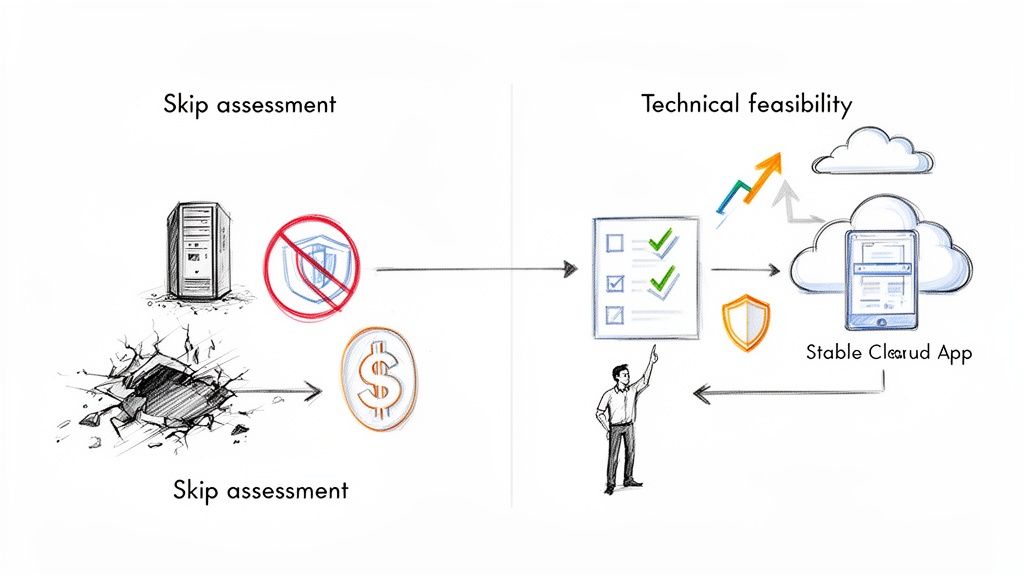
Diving into a development cycle without a solid grasp of the technical hurdles is a recipe for disaster. It's like trying to build a skyscraper without surveying the ground it's supposed to stand on. A technical feasibility assessment is your engineering blueprint—it’s how you spot and manage risk before you’ve written a single line of code.
Think about it. Your team spends six months building a feature everyone is excited about, only to find out it's completely incompatible with your core architecture. Or worse, the infrastructure costs to support it are high enough to sink your entire budget. These aren't just what-if scenarios; this is the reality for teams that skip this crucial step.
Sidestep Expensive Development Pitfalls
The whole point of this assessment is to stop guessing and start making evidence-based decisions. It's about getting your team to ask the hard questions upfront so you can be sure a project is just as practical from an engineering standpoint as it is desirable from a business one.
This is where you unearth all the hidden complexities that would otherwise blow up your timeline and budget later. That "simple" third-party API integration might look great on paper, but an assessment could reveal crippling rate limits or authentication nightmares that make the whole feature a non-starter. You want to find that out now, not months down the road.
A well-executed feasibility study is your insurance policy against wasted effort. It gives you the hard data you need to either move forward with confidence or wisely hit the brakes.
Connect What Customers Want with What You Can Realistically Build
Great products are built on user feedback, but what customers ask for often comes without any technical context. They want a new feature, but they have no idea what it will take to actually build it. This is where combining feedback tools with a solid feasibility process really shines.
Tools like FeatureBot are fantastic for capturing and organizing what users are asking for. It helps you see which feature requests have the most momentum by weighting feedback against customer revenue, so you know you're focusing on what really matters. The technical feasibility assessment then takes that raw feedback and grounds it in reality. It forces you to answer questions like:
- Architectural Fit: Can we build this with our current tech stack, or are we looking at a massive overhaul?
- Team Skills: Do we have the right people with the right expertise to build and maintain this thing long-term?
- Scalability: If this feature takes off, can our current infrastructure actually handle the load?
Before jumping into a big new project, it’s also smart to look at the bigger picture with a comprehensive AI readiness assessment. This helps confirm the strategic fit—the 'why'—before you get lost in the 'how'. By making this kind of structured analysis a regular part of your process, you turn ambitious ideas into solid, shippable product improvements.
Assembling Your Technical Feasibility Dream Team
A technical feasibility assessment is never a solo mission. You can't just toss a project idea to a single engineer and expect to get the full picture. It's a team sport, and winning requires a mix of perspectives to spot the risks and opportunities you’d otherwise miss.
When you get the right people in the room, the entire exercise shifts. It stops being a simple technical checkbox and becomes a critical strategic conversation about the future of your product.
The Core Players and Their Unique Perspectives
Building out this team isn't about filling seats with generic titles. It's about bringing together specific expertise to get a true 360-degree view of the project, from the foundational architecture to the bottom-line budget.
Here’s who you need at the table:
- Engineering Lead: Think of this person as the architectural guardian. They’re focused on the deep technical questions. Will this fit into our existing tech stack? Can it scale? Are we about to create a mountain of technical debt we’ll regret later?
- Product Manager: The PM is the voice of the customer and the business. They’re constantly asking, “Does this actually solve a painful problem for our users?” and, just as importantly, “Is this the most valuable problem we could be solving right now?”
- DevOps/Infrastructure Specialist: This is your reality check. This person grounds the entire conversation in the practicalities of deployment, maintenance, and infrastructure costs. They’ll tell you if your current setup can handle the new load or if you need to budget for new investments.
- Finance/Business Analyst: This is the stakeholder that’s too often overlooked. They provide the economic guardrails, analyzing the project's cost versus its potential benefit to ensure the investment of time and money actually makes sense.
This kind of collaborative risk management is becoming standard practice. In fact, the global market for feasibility studies is projected to climb from $5.4 billion in North America in 2024 to an incredible $12.6 billion by 2033. This growth is all about organizations trying to get smarter about their big bets. You can explore the full market research on feasibility study trends to see how this is playing out.
Defining Roles for a Smoother Process
When everyone knows exactly what they’re supposed to do, the whole assessment runs much more smoothly. The table below breaks down who’s responsible for what and the kind of critical questions each person should be asking from the very start.
Key Roles in a Technical Feasibility Assessment
This table breaks down the essential team members, their core responsibilities, and the critical questions each should address during the assessment process.
| Role | Primary Responsibility | Key Questions to Ask |
|---|---|---|
| Engineering Lead | Evaluates architectural fit, scalability, and technical risks. | Does this align with our long-term tech vision? What are the potential performance bottlenecks? |
| Product Manager | Champions user needs and validates business alignment. | How does this feature address validated customer pain points? What is the expected impact on our key metrics? |
| DevOps Specialist | Assesses infrastructure needs, deployment complexity, and ongoing maintenance. | Can our current infrastructure support this? What are the estimated operational and cloud costs? |
| Finance Analyst | Analyzes project costs versus potential return on investment (ROI). | What is the total estimated cost to build and maintain this? Does the projected revenue justify the expense? |
The real strength of an assessment comes from the healthy tension created between these different roles. The engineer's pragmatism balances the product manager's ambition, while the finance analyst ensures the entire effort is actually sustainable.
This process highlights exactly why having a single source of truth for customer feedback is so crucial.
When your team is pulling from scattered support tickets, random Slack messages, and anecdotal notes, you're almost guaranteed to have misalignment. A platform like FeatureBot centralizes that feedback, enriching it with user context and revenue data. This means when the PM presents a user need, the entire team is looking at the same validated data, leading to far more productive discussions and better, more accurate decisions. To learn more about gathering structured input, check out our guide on building powerful customer advisory boards.
The Core Components of a Thorough Assessment
With your dream team in place, it’s time to get down to the brass tacks of the feasibility assessment. This isn't about opinions or gut feelings; it’s about gathering cold, hard evidence. We need to dissect the project across five critical pillars to see if it’s genuinely viable or just a good idea on paper.
Breaking the assessment down this way forces you to cover all your bases, from the foundational architecture all the way to the final price tag. Asking the tough questions in each of these areas is what separates a wildly successful project from a costly and painful failure.
This process flow shows how a truly comprehensive assessment is a team sport, demanding technical, operational, and financial input to make a sound decision.
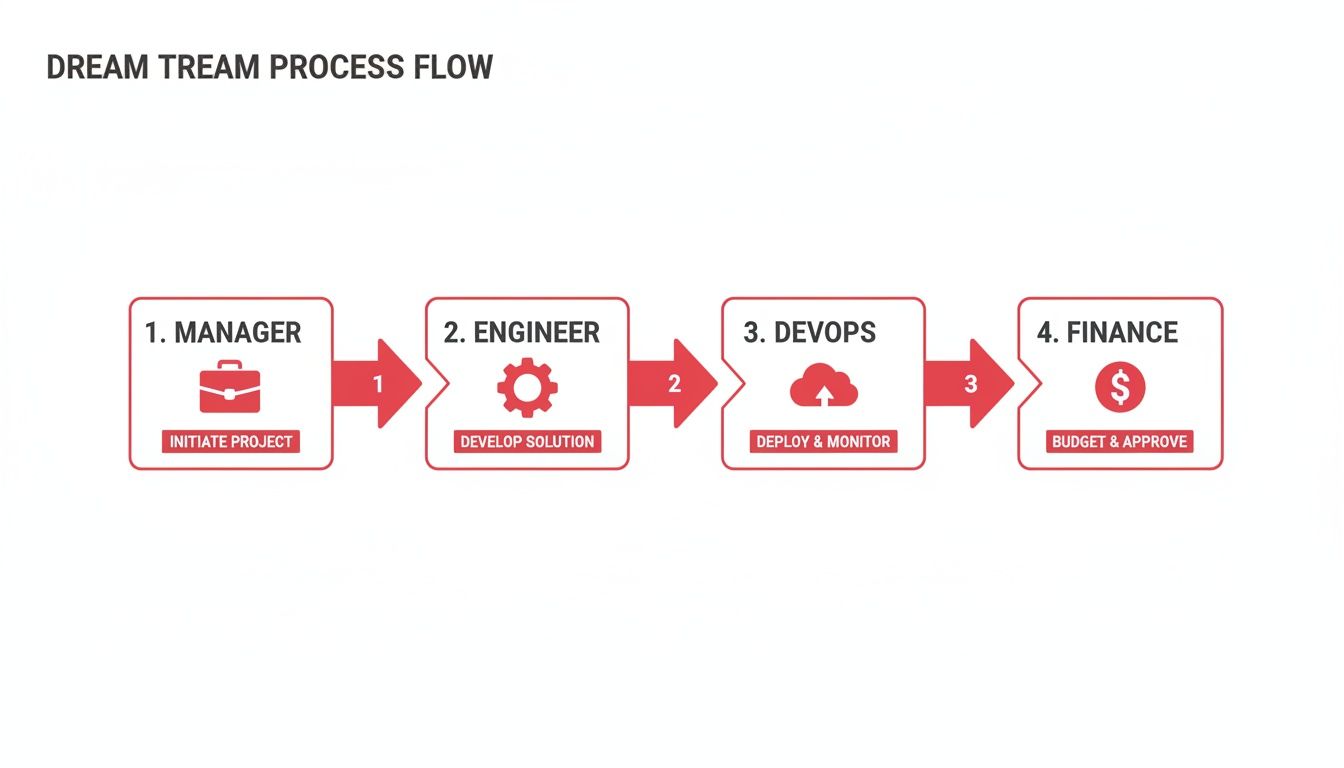
Each stakeholder brings a different piece of the puzzle to the table. Let's look at what evidence you need to collect.
Architectural Alignment
The first question you have to answer is deceptively simple: Does this actually fit with what we already have? If you try to force a new feature into an architecture that isn't built for it, you're signing up for a future of maintenance nightmares and crippling technical debt. It's the classic square-peg-in-a-round-hole problem.
To do this right, your engineering team needs to produce concrete artifacts. A quick whiteboard session just won't cut it. I expect to see:
- Sequence Diagrams: These are essential. They map out how different services and components will talk to each other, instantly highlighting potential bottlenecks or ridiculously complex communication paths.
- Data Flow Models: Where is the new data going to live? How is it accessed, stored, and kept safe? A clear data model is non-negotiable to prevent creating data silos or messing with your core database integrity.
- Tech Stack Compatibility Review: Take a hard look at the required languages, frameworks, and libraries. If this project requires a technology no one on your team has touched before, that’s a massive red flag. It has direct implications for your timeline, your budget, and potentially your hiring plan.
Dependencies and Integrations
Let’s be honest, modern software is never built in a silo. Your project will almost certainly lean on other internal services or third-party APIs. I’ve seen more projects go off the rails by underestimating the complexity of these connections than for almost any other reason.
A proper dependency assessment goes way beyond the "happy path." Your team needs to dig into:
- API Stability and Documentation: Is the third-party API well-documented and known for being reliable? Vague or outdated docs can easily add weeks of frustrating, exploratory coding to your schedule.
- Rate Limits and Throttling: What happens if you succeed beyond your wildest dreams? You absolutely must know if the APIs you rely on can handle a massive spike in traffic. Hitting an unexpected rate limit can bring your entire service to a screeching halt.
- Authentication and Security: How are you connecting to these external systems? Complex or poorly designed authentication methods can introduce a surprising amount of development overhead.
Performance and Scalability
"Will it work?" is a starting point, but the real question is, "Will it work at scale?" A feature that runs smoothly for ten beta testers but crumbles under the weight of a thousand real users is a failure waiting to happen.
This requires your team to think ahead and even be a little pessimistic. They need to quantify the expected load and stress-test their assumptions. Get specific numbers for:
- The number of concurrent users the system must be able to support without breaking a sweat.
- The expected data volume it will handle, like gigabytes per day.
- Clear response time targets—for example, all critical actions must complete in under 500ms.
A great rule of thumb I've always used is to plan for 10x your current user load. This simple exercise forces you to build a system that can grow with the business instead of one that holds it back.
Security and Compliance
In this day and age, security can't be bolted on at the end; it has to be baked in from the start. Introducing a new feature is like adding a new door to your house—you have to make sure it has a solid lock. Your assessment must include a proactive security review to catch vulnerabilities before a single line of code gets written.
Your security checklist needs to cover:
- Data Sensitivity: Is this feature handling Personally Identifiable Information (PII) or other sensitive data? If the answer is yes, you're immediately looking at stricter compliance rules like GDPR or CCPA.
- Authentication and Authorization: Who gets to use this, and how do you prove they are who they say they are?
- Dependency Vulnerabilities: Are you pulling in any third-party libraries that come with their own known security flaws?
Cost Analysis
At the end of the day, every technical choice has a price tag. A feature could be beautifully architected, massively scalable, and totally secure, but if it costs a fortune to build and operate, it’s still a no-go. A key part of any good assessment involves mastering software development cost estimation to put together a realistic budget.
Don't just look at developer salaries. You need to calculate the Total Cost of Ownership (TCO), which is the real, all-in number. Make sure you account for:
- Build Costs: The one-time hit for design, development, and testing.
- Run Costs: The ongoing monthly bills for cloud services, API subscriptions, and infrastructure.
- Maintenance Costs: The long-term, often-forgotten costs of fixing bugs, applying updates, and just generally keeping the lights on.
Developing a Practical Scoring Framework
An assessment without a clear conclusion is just a pile of data. To get real value from your technical feasibility assessment, you need a way to translate all those qualitative findings into a clear, objective score. This is where a practical scoring framework comes in—it turns complex analysis into a straightforward go/no-go signal that leadership can actually use.
The point isn't to build some rigid, overly engineered system. You just need a simple, effective tool that helps your team weigh different factors and compare potential projects on an even playing field. It brings much-needed structure to what can easily become a messy, opinion-driven debate.
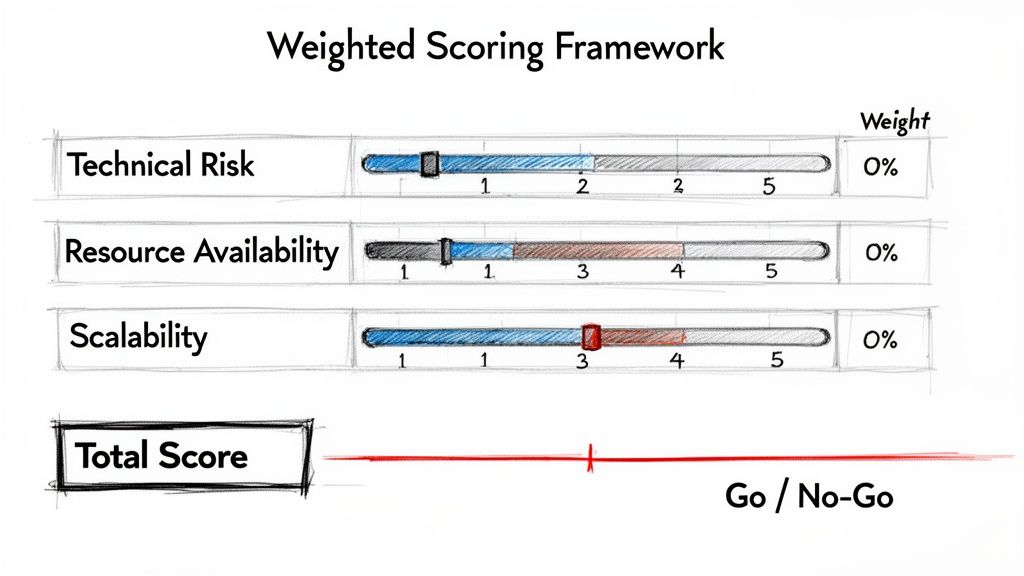
Ultimately, this method strips away ambiguity and gives you a data-backed foundation for your final recommendation.
Introducing a Weighted Scoring Model
Let's be honest: not all criteria are created equal. If you're building a fintech app, security is probably ten times more important than the initial development cost. For a new social media feature, on the other hand, scalability might be your number one concern. A weighted scoring model lets you build these unique business priorities right into your evaluation.
It’s pretty straightforward. You just assign a "weight" to each assessment category based on how critical it is to the project's success. This ensures the final score genuinely reflects what matters most.
A simple way to get started is to:
- Define Your Core Criteria: Start by listing your main evaluation categories. These often line up with the evidence you’ve already gathered, like Technical Risk, Resource Availability, Scalability, and Architectural Fit.
- Assign Weights: Distribute a total of 100 percentage points across those criteria. For example, security might get a heavy 40% weight, while cost gets a lighter 10%.
- Score Each Criterion: Grade each category on a simple 1-to-5 scale. Let 1 represent high risk or a terrible fit, and 5 represent low risk or a perfect match.
- Calculate the Final Score: Just multiply each category's score by its weight, then add them all up. This gives you a final, weighted feasibility score.
Suddenly, you have a single, defensible number to guide your decision.
Creating a Reusable Scoring Template
To keep things consistent and save time on future assessments, it’s a great idea to build a reusable template.
Here’s a basic structure you can adapt in a spreadsheet or your project management tool:
| Assessment Category | Weight (%) | Score (1-5) | Weighted Score (Weight x Score) | Notes & Justification |
|---|---|---|---|---|
| Technical Risk | 30% | 3 | 0.9 | Moderate risk due to reliance on a new third-party API. |
| Resource Availability | 25% | 4 | 1.0 | Senior engineer is available, but junior staff needs training. |
| Scalability | 25% | 5 | 1.25 | Built on our core serverless architecture; scales easily. |
| Cost Analysis | 20% | 2 | 0.4 | Higher than average cloud costs are projected for this feature. |
| Total Score | 100% | 3.55 |
This kind of structured approach makes it easy to spot a project's strengths and weaknesses at a glance. You can learn more about organizing initiatives like this in our guide on how to prioritize your product backlog.
A scoring framework transforms the assessment from a subjective discussion into an objective evaluation. It forces the team to justify their ratings with evidence, leading to more rigorous analysis and better decisions.
Real-World Example Comparing Two Features
Let's put this into practice. Imagine a SaaS company has two hot feature requests pulled from their feedback tool. The first is an AI-powered analytics dashboard ("AI Dashboard"), and the second is a simple integration with popular accounting software ("Accounting Sync"). Using the framework, they can compare them objectively.
Feature A: AI Dashboard
- Technical Risk (40%): Score 2. Requires machine learning models the team has never built. Weighted Score: 0.8
- Resource Availability (30%): Score 2. They'd need to hire a data scientist. Weighted Score: 0.6
- Scalability (30%): Score 3. The potential processing load on the infrastructure is high. Weighted Score: 0.9
- Final Score: 2.3 (High Risk / Low Feasibility)
Feature B: Accounting Sync
- Technical Risk (40%): Score 5. The partner has a well-documented, stable API. Weighted Score: 2.0
- Resource Availability (30%): Score 4. A mid-level engineer can handle it solo. Weighted Score: 1.2
- Scalability (30%): Score 5. The API is built to handle high volume. Weighted Score: 1.5
- Final Score: 4.7 (Low Risk / High Feasibility)
The scoring makes the choice pretty clear. While the AI Dashboard sounds exciting, the Accounting Sync is far more feasible right now. The same logic applies to massive infrastructure projects, just on a much bigger scale. For instance, rigorous feasibility assessments were essential for the boom in renewable energy. Solar energy capacity shot up from 0.3 TWh in 1989 to 1,033 TWh in 2021—an incredible increase of over 3,400 times, a path paved by solid technical planning.
From Assessment to Actionable Product Decisions
Getting through the scoring framework is a huge step, but a technical feasibility assessment isn't really done until you can tell a compelling story with the data. The final, critical part of the process is turning all those raw findings into a clear, actionable recommendation for the people who make the final call. This is where your detailed analysis becomes the backbone of strategic product planning.
The idea is to get out of the weeds of the spreadsheet and present a tight summary that respects everyone's time, especially executives. They don’t need a line-by-line breakdown of your calculations; they need the bottom line. Your final deliverable should be a confident report that clearly states the recommendation, flags the biggest risks, and lays out a realistic, high-level timeline.
Crafting a Compelling Executive Summary
You have to make your final report easy to scan. I always aim for a one-page brief an executive can digest in five minutes and walk away with everything they need to know.
This summary is your chance to weave all the evidence you’ve gathered into a coherent narrative. It has to state your team's recommendation plainly and, just as importantly, explain the "why" behind it.
A solid summary usually contains:
- The Recommendation: A direct "go," "no-go," or "proceed with caution" verdict. No waffling.
- Key Findings: A few quick bullet points that cover the best and worst-scoring parts of your assessment.
- Top Risks: The 2-3 biggest hurdles or unknowns that could sink the project, along with some thoughts on how to handle them.
- Estimated Timeline & Resources: A rough projection of the time and people you’d need if the project gets the green light.
Blending Technical Data with Business Context
Here’s where a technical assessment gets its real power: when you start layering in business context. A feature might score a 3.5 on technical feasibility—decent, but not exactly a slam dunk. Standing alone, that number might not get it prioritized.
But what if that same feature is the single most requested item from your top five highest-paying customers?
This is where integrating customer feedback becomes a game-changer. Using a tool like FeatureBot lets you see not just what users want, but the actual business impact behind those requests. By weighting feedback by customer revenue (MRR), you can instantly see which features will move the needle.
A feature with moderate technical complexity but overwhelming demand from high-MRR customers is often a much smarter bet than a technically simple feature that only a handful of free-tier users have requested.
This approach marries objective engineering analysis with crucial business intelligence. It’s how you ensure your roadmap decisions are both technically sound and financially smart. We dig into more strategies for this in our guide to the best product roadmap tools.
Making the Final Go/No-Go Decision
At the end of the day, the decision comes down to balancing technical reality with market opportunity. There's a reason the global market for research and analysis services is projected to hit $94.4 billion by 2025. Companies are desperate to lean on data-driven assessments before they commit serious resources. It’s just common sense: you have to validate an idea before you build it. You can discover more insights about effective feasibility analysis on Metheus.co.
When you present your findings clearly—backed up by both technical scores and hard customer revenue data—you give leadership the confidence to make the right choice. You’ve done the heavy lifting to replace guesswork with evidence, paving the way for smarter, more profitable product decisions that everyone can get behind.
Frequently Asked Questions
When you're first diving into technical feasibility assessments, it's natural to have a few questions. Let's tackle some of the most common ones that product managers, founders, and engineers run into.
How Long Should a Technical Feasibility Assessment Take?
Honestly, it depends almost entirely on the project's complexity. A small tweak to an existing feature might only take a day or two of focused effort. On the other hand, if you're looking at a massive architectural shift, you could be talking about several weeks of deep, analytical work.
The most important thing is to avoid "analysis paralysis" by setting a firm deadline. For a typical new feature in a SaaS product, aiming for a 1-2 week timeframe is a great starting point. This forces the team to focus on the biggest risks and stops the assessment from turning into a research project with no end in sight.
Remember, the goal isn't to have a perfect, exhaustive plan. It’s to gather just enough information to confidently decide whether to move forward.
What's the Difference Between Technical and Economic Feasibility?
This is a great question because they're two sides of the same coin, and you absolutely need both. They answer fundamentally different questions.
- Technical Feasibility asks, "Can we actually build this?" It's all about the nuts and bolts—the code, the architecture, your team's skills, and the systems you have in place.
- Economic Feasibility asks, "Should we build this?" This is the business side of the equation, looking at development costs, ongoing maintenance, and the potential return on investment (ROI).
You can have a project that's a brilliant technical concept but a complete financial disaster. Imagine your team could build an incredible new feature for $500,000, but it's only projected to bring in $50,000 in new revenue. Technically feasible? Yes. A smart business decision? Not at all.
What Are the Most Common Pitfalls to Avoid?
I've seen plenty of these assessments go off the rails over the years. Here are the most common traps teams fall into:
- Scope Creep: The assessment itself starts to grow, with the team getting lost exploring every tiny technical rabbit hole. You have to set clear boundaries from day one.
- Confirmation Bias: This is a huge one. It happens when you’re only looking for evidence that proves what you already want to be true. My advice? Assign someone the official role of "devil's advocate" to challenge assumptions and keep everyone honest.
- Ignoring Non-Functional Requirements: It's easy to get hyper-focused on cool features and completely forget about security, performance, and scalability. These "invisible" factors are often what make or break a project down the line.
- Poor Stakeholder Communication: If you don't have the right people in the room from the beginning, you're basing your assessment on flawed assumptions. If DevOps isn't involved, for example, your infrastructure cost estimates could be wildly inaccurate.
The single biggest mistake is treating the assessment as a formality to green-light a decision that's already been made. A real assessment has to have the power to stop a project dead in its tracks.
How Can I Run an Assessment with a Small Engineering Team?
When you have a small team, you can't afford to waste time. Efficiency is everything. The key is to be absolutely ruthless about prioritizing what you investigate. Focus only on the assumptions that carry the highest risk.
Forget about creating exhaustive, 50-page documents. Instead, rely on quick, collaborative methods. Whiteboarding sessions to map out a proposed architecture are fantastic for this. You’d be amazed how a 30-minute chat with a senior engineer can uncover more show-stopping problems than a week of writing reports.
Often, your best bet is to build a small, highly targeted proof-of-concept (POC). Find the single gnarliest, most difficult technical part of the project and just try to build that. This hands-on approach gives you real answers and cuts right through all the theoretical debates.
A FeatureBot Free plan can help you get started by automatically organizing user feedback. This lets even a small team quickly see the context and revenue impact behind each request, making your feasibility assessments much faster and more data-driven.
Ready to capture better feedback?
FeatureBot helps you collect, organize, and prioritize user feedback with AI-powered conversations.
Get Started Free