A Guide to Building High-Impact Customer Advisory Boards
A customer advisory board (or CAB) is a hand-picked group of your most strategic customers. You meet with them regularly to get their unvarnished opinions on your company’s direction, product roadmap, and overall market strategy. Think of it as less of a focus group and more of a high-level, formal dialogue that pressure-tests your vision and uncovers insights you can't get anywhere else.
Why a Customer Advisory Board Is a Secret Weapon for Growth
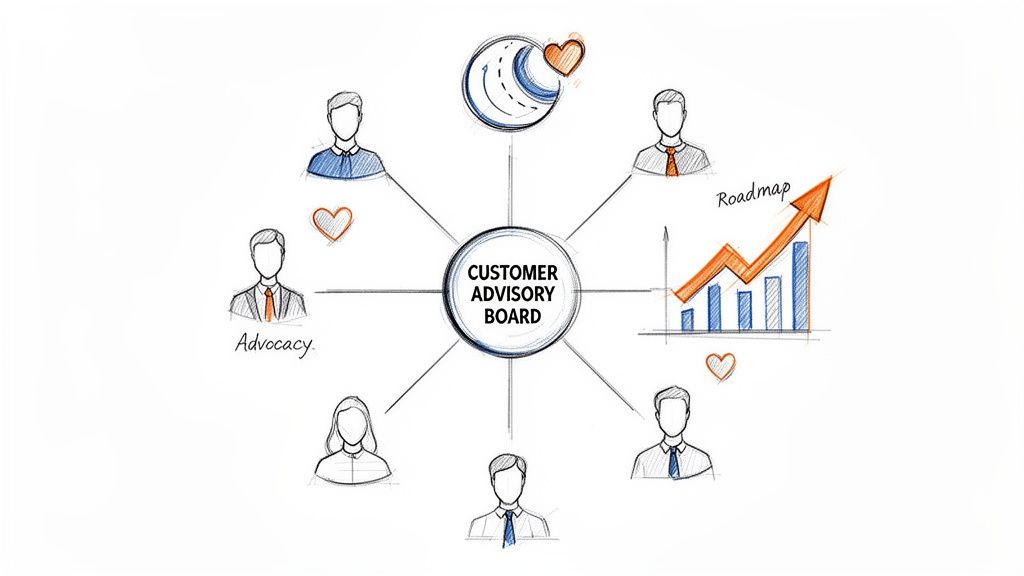
Let’s be real. In a crowded SaaS market, a Customer Advisory Board isn't just another feedback channel—it’s a powerful tool for growth. It helps you cut through the noise of a thousand user suggestions and creates a dedicated space for deep, honest conversations with the people whose opinions matter most.
I’ve seen top product teams use CABs to get a raw, unfiltered look at their biggest challenges and opportunities. They stop guessing. Instead, they get direct validation on their roadmap and start spotting market trends before they become obvious to everyone else.
More Than Feedback, It's a Partnership
The real magic of a CAB is how it fundamentally changes the customer relationship. Members stop being just users and become genuine advocates who are invested in seeing you win. This partnership pays off in a few huge ways:
- Roadmap Validation: Get critical feedback on major features and strategic pivots before you pour months of engineering time into them.
- Market Intelligence: Discover industry-specific pain points and opportunities your team would probably miss on its own.
- Customer Advocacy: Create a core group of champions who will send new business your way and provide killer testimonials.
Getting this alignment right is crucial. For any SaaS business serious about figuring out how to reduce customer churn, a CAB is an indispensable tool for staying ahead of their customers' needs.
A well-run CAB provides the qualitative 'why' that perfectly complements the quantitative 'what' from your feedback tools. It’s the human story behind the data—the context you need to make game-changing decisions that drive both product innovation and loyalty.
Putting Qualitative and Quantitative Insights Together
Your feedback management platform gives you a constant stream of valuable data—feature requests, bug reports, and user comments. That’s the "what." A CAB delivers the essential "why" behind all those data points.
For instance, you might see a sudden spike in requests for a specific integration. On the surface, it seems simple enough. But a CAB discussion might reveal the real driver is a new compliance requirement sweeping their industry. That deeper context lets you build a far more strategic solution, not just a tactical one.
When you pair these deep insights with retention efforts, you'll see a direct impact on increasing customer lifetime value. At the end of the day, a CAB isn't just another meeting on the calendar; it’s a high-impact initiative that ensures you’re building what truly matters.
Laying the Groundwork: Your CAB Blueprint
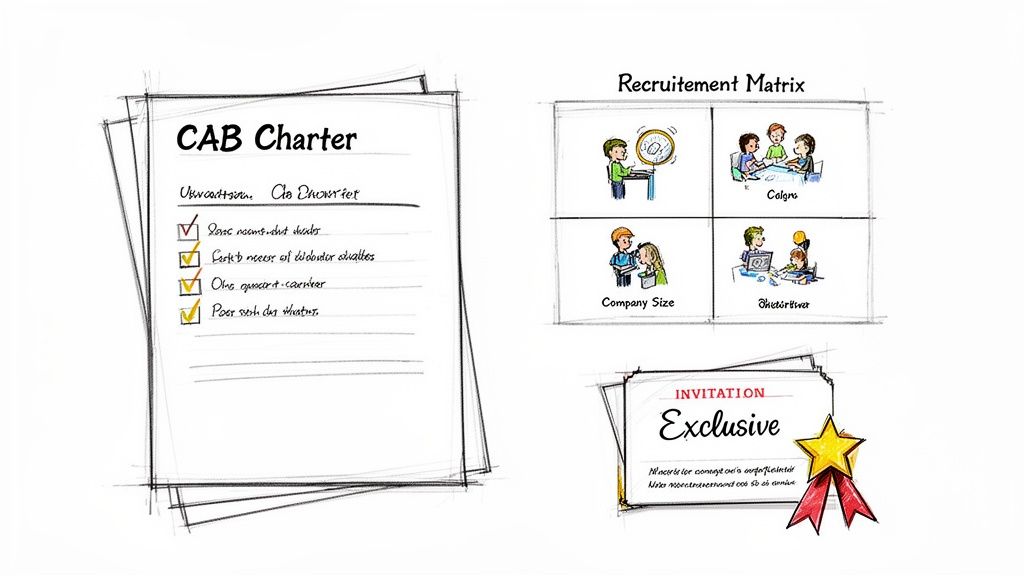
Before you even think about sending out invitations, you need a solid game plan. A successful customer advisory board isn't just a good idea; it's a strategic initiative built on a thoughtful foundation. The first, most crucial piece of that foundation is a formal CAB charter.
Think of the charter as the constitution for your CAB. It spells out the board’s mission, scope, and goals, making sure everyone—from your CEO down to the members themselves—is on the same page about why this group exists.
Defining Your Charter and Mission
Your charter needs to answer a few make-or-break questions that will steer every decision you make from here on out. Get your internal stakeholders in a room and hammer out the specifics.
- What’s our primary mission? Are we trying to validate a new product for an adjacent market? Are we trying to get ahead of a major industry shift? A clear mission is the difference between a strategic council and an unfocused complaint forum.
- What decisions will this board actually influence? Be explicit about the scope. Members need to feel their input will shape big-picture decisions—think pricing models or major platform architecture—not just minor bug fixes.
- What’s in it for them? Your ideal members are busy executives. The invitation needs to be a can't-miss opportunity, centered on genuine strategic influence, exclusive access to your leadership team, and networking with other top-tier peers.
Nailing this upfront work pays off. The Customer Advisory Board Benchmark Survey found that companies with well-run customer advisory boards see 24% higher revenues than those without. That’s the power of replacing guesswork with real customer insight.
Crafting the Ideal Member Profile
Once your mission is locked in, you can start building a profile for your ideal CAB member. The goal here is a balanced, dynamic board, not an echo chamber filled with your happiest customers. Diversity of thought is your most valuable asset.
Don't just invite your biggest logos or your friendliest contacts. The most valuable insights often come from customers who challenge your assumptions and represent different segments of your target market.
To get this right, you need a methodical approach. I’ve found that using a simple matrix is the best way to map out recruitment targets, spot gaps, and ensure you’re getting a representative mix of perspectives.
Here’s a look at how you can structure a segmentation matrix to keep your recruitment process on track. It helps you deliberately seek out the right blend of customers instead of just grabbing the first ones who say yes.
Customer Advisory Board Member Segmentation Matrix
| Segment Criteria | Ideal Profile (Example Mid-Market) | Ideal Profile (Example Enterprise) | Recruitment Target (Name/Company) |
|---|---|---|---|
| Company Size | 500-1,000 employees; high-growth trajectory | Fortune 500; established industry leader | |
| Industry | SaaS / Technology | Financial Services / Healthcare | |
| User Persona | VP of Operations (Strategic Buyer) | Director of Product (Power User) | |
| Product Maturity | New customer (<1 year); innovative adopter | Tenured customer (>3 years); deep product knowledge | |
| Geography | North America | EMEA |
By filling this out, you can quickly see if you’re too heavy on one type of customer. Strive for a healthy balance across these key criteria:
- Company Size: A good mix of mid-market and enterprise voices.
- Industry: Representation from your key verticals to understand different use cases.
- User Persona: Both the strategic decision-maker and the hands-on power user.
- Product Maturity: New, enthusiastic clients alongside tenured customers who have seen your product evolve.
This structured approach is a cornerstone of improving customer communication and turning your CAB into a true strategic asset. When you finally extend that invitation, you can do it with confidence, emphasizing the exclusivity and the unique opportunity to shape the future of a tool they depend on every day.
Facilitating High-Impact CAB Meetings
A customer advisory board is only as valuable as the meetings you run. The real magic isn't just getting smart people in a room; it's about engineering an experience that sparks genuine, strategic conversations. You want to get way beyond a stale product demo and dig into the real-world challenges and future opportunities your customers are wrestling with.
Too many companies make the mistake of treating their CAB as a captive audience for a sales pitch or an endless product update. Honestly, that’s the quickest way to kill engagement. These leaders are giving you their most valuable asset—their time—and they expect a collaborative workshop, not a one-way presentation.
Designing an Agenda That Sparks Real Talk
The best CAB meetings feel less like a stuffy board meeting and more like a high-level workshop among peers. Your agenda needs to mirror that vibe, dedicating the vast majority of your time to facilitated, open-ended discussion. Ditch the back-to-back PowerPoints from your internal teams.
Here’s a simple structure I’ve seen work wonders:
- Industry & Market Discussion (40%): Kick things off with the big picture. Ask broad questions about the market itself. What’s keeping them up at night? Where are they spotting untapped opportunities? This gets everyone talking about their world first, which is far more engaging than starting with your product.
- Strategic Deep Dive (40%): This is where you bring your own challenges to the table. Frame a core strategic problem or a major roadmap theme you're grappling with. Present it as a puzzle you need their help to solve together, not just a feature list for them to critique.
- Product Vision Feedback (15%): Toward the end, give them a high-level glimpse of your future direction and see how they react. The key here is to focus on the vision and the why, not get bogged down in a detailed feature walkthrough.
- Wrap-Up & Commitments (5%): Quickly summarize the big takeaways and, most importantly, be crystal clear about how you'll follow up.
Getting that candid feedback hinges on asking the right questions. We've put together a guide on crafting effective UX research interview questions that has some great principles for framing prompts that pull out deep, honest insights instead of just surface-level answers.
Finding the Right Rhythm for Your Meetings
You also need to find a cadence that keeps members hooked without burning them out. In the last few years, a lot of successful programs have moved to a hybrid model. It's the best of both worlds: the convenience of virtual meetings blended with the depth you can only get from an in-person session. This approach makes it easier to scale, cuts down on travel costs, and keeps the momentum going.
A popular format is running three or four 90-minute virtual sessions a year, with some of the top-tier programs meeting quarterly. For a deeper dive into the numbers, you can read the full research about CAB benchmarks.
The facilitator's #1 job is to create psychological safety. Members have to feel confident that they can share tough, even critical, feedback without it blowing back on them or hurting their relationship with your company. This trust is everything.
Practical Facilitation Techniques
A brilliant agenda can fall flat without a skilled facilitator steering the ship. This person—whether it’s an internal leader or a third-party pro—is responsible for keeping the conversation focused, balanced, and productive.
Here are a few go-to techniques:
- Balance the Voices: Be on the lookout for members who are dominating the conversation and actively invite quieter folks to chime in. A simple, "Jane, we haven't heard your take on this yet—what are you seeing from your perspective?" can completely rebalance the room.
- Use a 'Parking Lot': When a discussion veers into a topic that's super tactical or only relevant to one person, acknowledge it and put it in a "parking lot." This shows you value their point and will follow up offline, but it keeps the meeting from getting derailed.
- Send a Pre-Read: A week before the meeting, send out a concise, one-page document. It should set the stage by outlining the key discussion topics and the big strategic questions you’ll be exploring. This allows members to show up prepared and ready to contribute from minute one.
Turning Conversation Into Actionable Strategy
The real work starts when the meeting ends. All that amazing energy and insight from your advisory board is just talk until you have a system to capture it, make sense of it, and, most importantly, act on it. A great CAB program is built on your ability to connect those high-level strategic discussions to real, tangible changes in your company's direction.
This is so much more than just taking good notes. It’s about building a clear bridge between the big-picture themes from your CAB and the nitty-gritty, day-to-day feedback you're already collecting. You need a structured way to connect those dots.
From Discussion to Decision
First things first: distill the conversation. Don't get lost in who-said-what transcripts. Your goal is to group the raw feedback into strategic buckets. Think "Emerging Market Trends," "Critical Competitive Gaps," or "Long-Term Product Vision."
Once you have these themes, you can start linking them to the work your teams are already doing. This is where you see the magic happen.
- It Adds Strategic Context: A CAB discussion on industry consolidation can suddenly explain why you’re seeing a dozen feature requests for M&A-related integrations. It reframes the request from "a few users want this" to "this is a strategic move to support our customers through a major market shift."
- It Helps You Prioritize with Conviction: If the board spends 30 minutes hammering on a specific operational inefficiency as their biggest headache, you can walk into your next roadmap meeting and confidently bump up the priority of projects that solve that exact problem.
- It Validates (or Kills) Your Assumptions: Your product team might be convinced that a new module is the next big thing. But if it never even comes up during a two-hour deep dive with your most important customers? That's a massive red flag and a signal to go back to the drawing board.
This whole process—from planning the meeting to guiding the discussion—is designed to produce these kinds of valuable outputs.
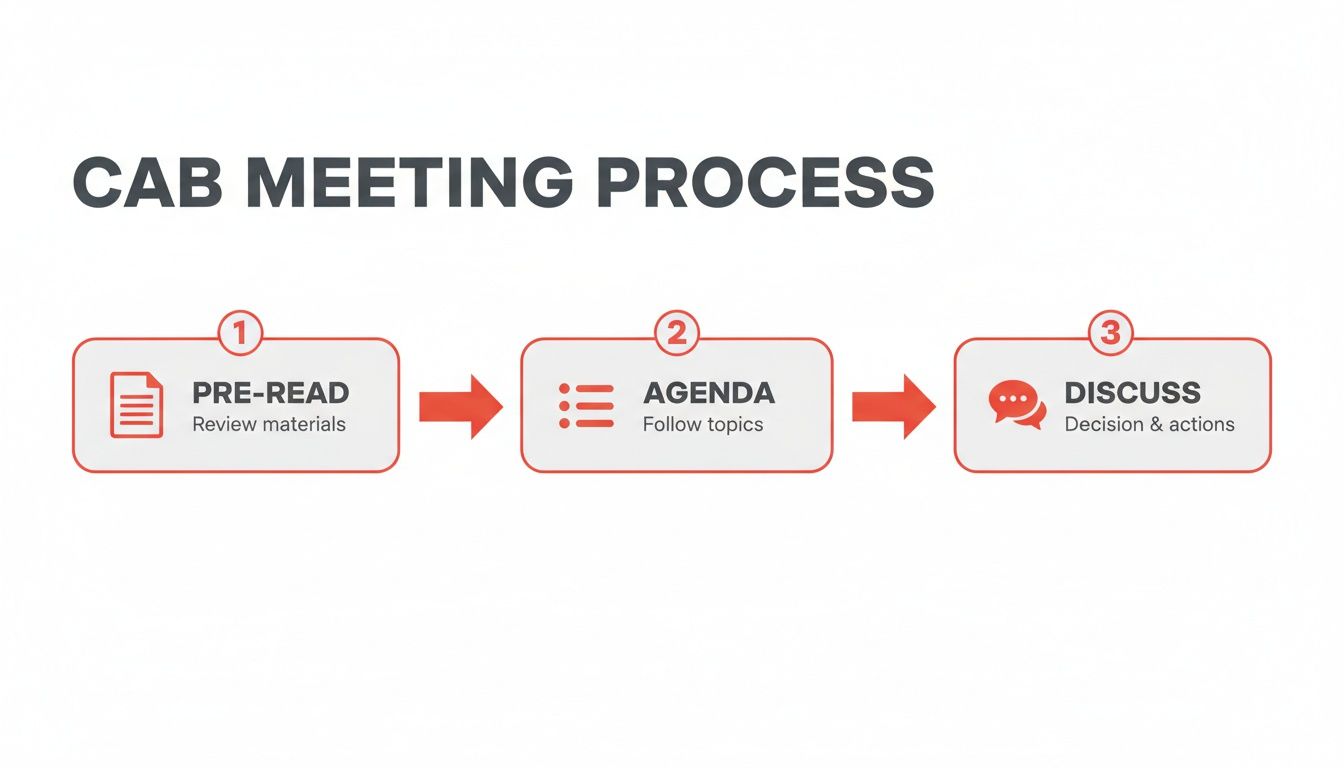
This simple flow is the engine. Preparing members with a pre-read, focusing them with a tight agenda, and then facilitating a candid discussion is what gets you the gold. But the real ROI comes from what you do after the meeting.
Closing the Loop Is Non-Negotiable
This might be the most important step of all: "closing the loop." You absolutely must communicate back to your CAB members how their input made a difference. This one single action proves their time was well-spent, keeps them engaged for the long haul, and demonstrates the CAB’s value to your own leadership team.
Honestly, skipping this is the fastest way to kill your CAB. People will stop caring if their advice vanishes into a black hole.
A simple, personalized follow-up that says, "Because of our conversation about X, we've decided to prioritize Y on the Q4 roadmap," is incredibly powerful. It shows you listened and that their voice truly matters.
This follow-up isn't just polite; it's strategic. It builds deep trust and turns members from advisors into genuine partners. When they can see their fingerprints all over your strategy, their commitment goes through the roof.
And this commitment has a real financial impact. One Forrester study pegged the value of a well-run CAB at a staggering 431% ROI over three years, thanks to things like shorter sales cycles and spending less time and money building the wrong features. You can learn more about how customer advisory boards drive business results and get a deeper look at the numbers.
Mapping CAB Outcomes to Business Impact
It's crucial to connect the dots between the conversations in the room and the metrics that matter to the business. This helps you justify the investment in the CAB and shows clear value to your executive team.
Here’s a simple framework for mapping those outcomes directly to business impact.
| CAB Outcome | Business Impact | How to Measure | Example Integration Point |
|---|---|---|---|
| Early validation of a new product concept | Reduced R&D waste | R&D cost avoidance, faster time-to-market | Link CAB meeting notes to the epic in Jira to show early strategic validation. |
| Insights on a key competitive threat | Increased win rates | Competitive win/loss analysis, sales cycle length | Update sales battlecards with new positioning based on CAB feedback. |
| Prioritization of roadmap initiatives | Higher customer retention | Churn rate, Net Promoter Score (NPS), product usage | Tag specific features in a tool like FeatureBot with "CAB-Driven Priority." |
| Identification of an upsell opportunity | Increased Customer Lifetime Value (CLV) | Expansion revenue, Average Revenue Per User (ARPU) | Create a targeted marketing campaign for the new module aimed at the CAB member segment. |
By consistently tracking these connections, you move the CAB from a "nice-to-have" listening tour to a core driver of business strategy and growth.
Measuring the ROI of Your Customer Advisory Board
Sooner or later, your leadership team is going to ask the big question: "What's the ROI on this Customer Advisory Board?" To keep your program funded and your executives engaged, you need a solid answer. It's not just about having "good conversations"—it's about demonstrating real, tangible impact.
The best way to do this is by telling a story backed by data. You need to connect the dots between your CAB activities and the numbers that matter most: revenue, product success, and customer loyalty. This means tracking both the hard data and the powerful anecdotal evidence that paints the full picture.
Tracking the Quantitative Wins
Let's start with the numbers. These are the metrics that speak directly to the C-suite and justify the resources you're investing.
You need to get serious about tracking a few key performance indicators:
- Influenced Revenue: Did a CAB member provide a warm introduction that led to a new deal? Did their testimonial help close a key account? Tie that revenue directly back to the CAB's influence.
- Product Adoption: Look at the features your CAB helped shape or validate. Measure their adoption rates. If these features are taking off, it’s a clear sign you’re building the right things because you listened to the right people.
- Member Retention: This is a powerful one. Compare the retention rate of your CAB member accounts to a control group of similar non-CAB customers. A higher retention rate among members is undeniable proof that the program builds loyalty.
The data backs this up. B2B companies with strong CABs often report 9% more new business from members within the first year. They also see an incredible 95% retention rate among participating companies. On top of that, members typically contribute 57% more to advocacy efforts like references and testimonials. If you're looking for more on this, check out some great insights on how CABs boost customer advocacy on adsy.com.
For a more structured approach to the financial side, you might also find this resource on general guidance on calculating meeting ROI helpful.
Showcasing the Qualitative Impact
Not everything that matters can be neatly tucked into a spreadsheet. Some of the most valuable outcomes from a CAB are the strategic insights and "aha!" moments that prevent costly mistakes or unlock new opportunities.
The real value isn't just in the answers you get; it's in the quality of the questions the CAB forces you to ask about your own business.
Capturing this qualitative proof is just as critical as tracking the numbers. Here’s what to look for:
- Strategic Shifts: Make a note every single time a CAB discussion sparks a change in your product roadmap, informs a new go-to-market plan, or helps you sidestep a potential product disaster. These are huge, high-value wins.
- Compelling Quotes: During your meetings, listen for those perfect, insightful soundbites. A powerful quote from a respected customer can be pure gold for an internal presentation to leadership or, with their permission, a killer testimonial for your marketing.
When you blend the hard data on revenue and retention with compelling stories of strategic influence, you build an airtight case for your CAB. You’re proving it’s not just another meeting—it’s a strategic asset that fuels real growth.
Common Questions About Customer Advisory Boards
When you're thinking about launching a customer advisory board, a lot of questions pop up. That's completely normal. Getting these details right from the very beginning can be the difference between creating a powerful strategic asset and hosting a meeting that just falls flat.
Let's dive into some of the most common questions and concerns I hear from product managers and founders.
How Many Members Should I Recruit?
The first thing everyone asks is about size. What’s the magic number for a productive CAB?
For most SaaS companies, the sweet spot is somewhere between 8 and 12 members. This range is big enough to get a healthy mix of perspectives and avoid groupthink, but it's small enough that every single person has a real chance to speak up and contribute.
Go too small, and you risk creating an echo chamber where one or two loud voices can easily dominate the conversation. But if you go too big, facilitation becomes a nightmare, and you'll find that some of your most thoughtful, introverted members will hesitate to share their best ideas. The goal here is quality over quantity, always.
Should We Compensate CAB Members?
This is a big one. My advice? Steer clear of direct financial payments. The moment you start paying members, the dynamic shifts from a strategic partnership to a purely transactional one, and you lose the authenticity you’re after.
Instead, the real pull for these busy executives is the immense non-monetary value you can offer. This is what gets them to clear their schedules. The perks that actually matter are:
- Exclusive access to your C-suite and a real peek behind the curtain at your product roadmap.
- Powerful networking opportunities with other leaders and peers they wouldn't otherwise meet.
- A genuine seat at the table to influence the direction of a tool that's critical to their own success.
Of course, covering travel expenses for in-person meetings or offering a white-glove support experience are fantastic ways to show your appreciation. These gestures acknowledge the value of their time without creating a conflict of interest.
What Are the Biggest Mistakes to Avoid?
Knowing the common pitfalls is half the battle. If I had to pick the single biggest mistake people make, it’s treating the CAB like a sales pitch. Your members are not there to watch a one-way product demo. They’ve given you their most valuable asset—their time—for a strategic dialogue.
Another critical error is failing to close the loop. If your members share fantastic feedback but never hear what happened next, they will disengage. Fast. You have to connect the dots for them and show them the impact of their contributions.
A survey of CAB practitioners found that 77% see 'product and solution direction' as the top benefit, and 63% said their boards directly shaped corporate strategy. This proves members join to make a real difference. You can find more data on how CABs influence company direction.
Finally, don't ever walk in without a plan. An unstructured agenda is a recipe for disaster. Without clear goals and a skilled facilitator, the conversation can easily derail into a series of individual support requests or unfocused brainstorming, wasting everyone’s time.
Ready to turn customer conversations into a clear product strategy? FeatureBot helps you capture, organize, and prioritize feedback without the guesswork. We don't offer a free trial but we do have a Free plan to get started at https://featurebot.com.
Ready to capture better feedback?
FeatureBot helps you collect, organize, and prioritize user feedback with AI-powered conversations.
Get Started Free