What Is a Product Roadmap and How Do You Build One?
A product roadmap is your team's high-level guide to the future. It’s a living document that visually lays out the vision, direction, and priorities for your product over a set period. More importantly, it's the strategic "why" behind what you're building, getting your entire team and key stakeholders on the same page.
The Strategic Guide for Your Product's Journey
Think of building a product like planning a cross-country road trip. You wouldn't just jump in the car and start driving. You'd have a map showing the major cities you want to hit and the general route you'll follow. A product roadmap is exactly that: the strategic map for your product's journey.
It doesn't get bogged down in every single turn or rest stop—that's what a detailed project plan or backlog is for. Instead, it clearly marks the key destinations (your strategic goals) and, crucially, explains why they matter.
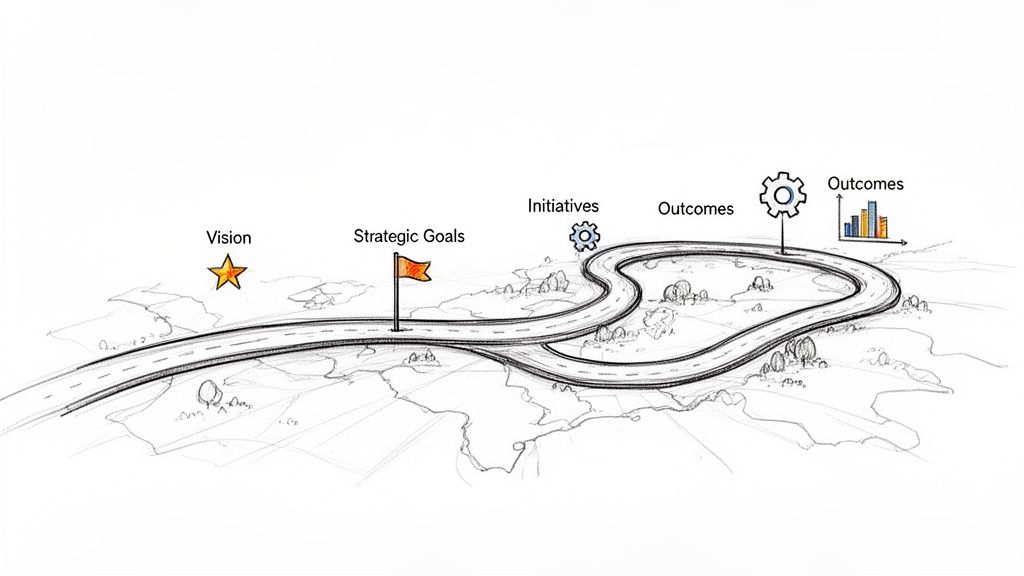
This document becomes the single source of truth connecting your company's big-picture vision to the actual work your teams are doing day-to-day. By focusing on outcomes over outputs, it stops teams from getting lost in the weeds of minor tasks and keeps everyone's eyes on the prize.
To give you a clearer picture, here's a quick breakdown of what makes up a product roadmap.
Product Roadmap at a Glance
| Element | Description |
|---|---|
| Vision | The "why" behind the product; its ultimate purpose and the problem it solves for users. |
| Goals | High-level objectives tied to business outcomes (e.g., increase user retention, enter a new market). |
| Initiatives | The big-picture themes or projects that will help achieve the goals (e.g., "Improve Onboarding Experience"). |
| Features | Specific functionalities or improvements that fall under each initiative. |
| Timeline | A general timeframe showing when work is planned (e.g., Now, Next, Later; or by quarter). |
This structure ensures that every feature can be traced back to a strategic goal, which in turn supports the overall product vision.
Who Uses a Product Roadmap and Why?
While the product manager is typically the one steering the ship, the roadmap is a critical communication tool for almost everyone in the organization. It's not just some internal document for developers; it’s the connective tissue that holds the company's efforts together.
Different teams look to the roadmap for different reasons:
- Executive Leadership: They use it to see how product plans line up with the company's financial and strategic objectives. It’s their sanity check.
- Engineering Teams: The roadmap gives them the context they need to make smarter technical decisions and plan their development sprints effectively. They know why they're building something, not just what.
- Sales and Marketing: This is their crystal ball. They rely on it to prepare launch campaigns and set realistic expectations with new customers about what's coming next.
- Customer Support: They get a heads-up on new features and changes, which allows them to prepare support documentation and get ready to help users from day one.
A product roadmap is the manifestation of your strategy and the guide to its execution. It turns a conceptual vision into a tangible plan that teams can follow.
Ultimately, this alignment is what makes a roadmap so powerful. It's not just a plan; it's a tool for making better, more informed decisions across the board. To see one in action, you can view a live roadmap from a real company and get a feel for how they communicate their future plans.
The Core Components of an Effective Roadmap
A great roadmap is so much more than a feature list—it's the story of where your product is headed and why it matters. To get beyond a glorified to-do list, your roadmap needs a solid foundation that connects the big-picture strategy to the actual work your team is doing every day. Without that connection, it's easy to get lost in the weeds.
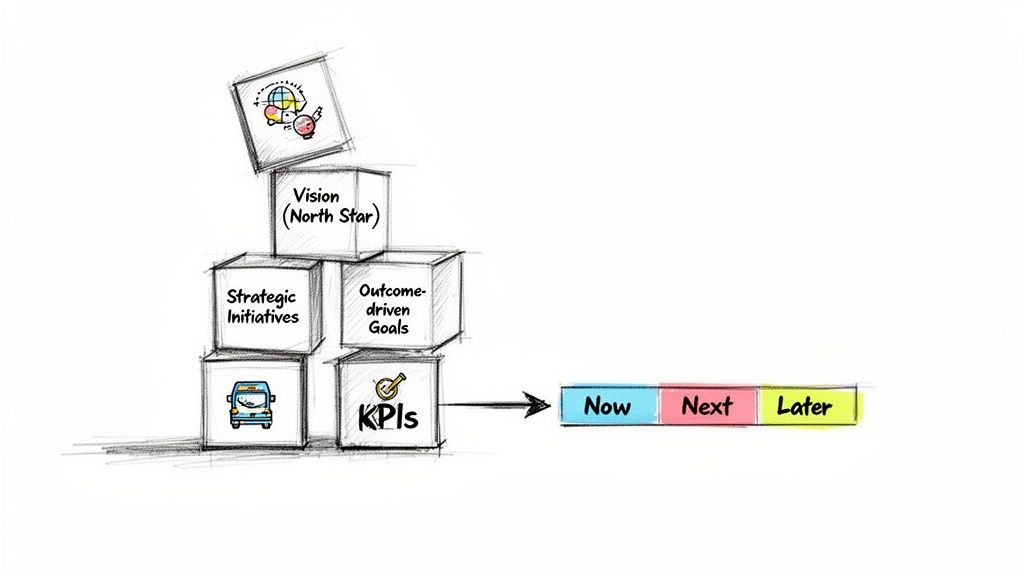
This strategic foundation is built on a few key pieces that fit together like Russian nesting dolls, starting with the broadest vision and drilling down to concrete actions.
From Vision to Actionable Steps
The most powerful roadmaps don't start with features; they start with the end goal and work backward. This simple shift ensures every single thing your team builds is directly tied to a measurable business outcome. It creates a straight line from daily tasks to company-wide success.
Here's how those core components cascade into each other:
- Product Vision: This is your north star. It’s the ultimate, long-term impact you want your product to have. It answers the big question: "Why do we exist?" A vision might be something aspirational like, "To make financial data accessible to everyone."
- Strategic Initiatives: Think of these as the major chapters in your product's story. They are the big-bet themes you'll focus on to bring your vision to life. Supporting the vision above, an initiative might be to "Simplify Investment Analysis."
- Outcome-Driven Goals: These are the specific, measurable results you need to see. They answer, "What does success actually look like?" A goal for our initiative could be to "Increase user engagement with our analytics dashboard by 25%."
A product roadmap serves as a visual summary that outlines a product's vision, direction, and priorities over time, fundamentally aligning teams around short-term and long-term goals. With 76% of product professionals prioritizing product strategy, it underscores the need to drive outcomes, not just schedules.
Structuring Your Timeline for Clarity
Once your strategy is set, you have to talk about timing. But hard deadlines for features months or years away are a recipe for broken promises and burned-out teams. A much more agile and honest approach is to group work into flexible time horizons.
A simple but effective way to do this is with the Now, Next, Later framework. This model is popular for a reason—it works.
- Now: This is what the team is building right now. These items are clearly defined, scoped, and on track for delivery in the current sprint or quarter.
- Next: This is what's on deck. These initiatives are planned and have been scoped out, but they aren't in active development just yet.
- Later: This is the stuff on the horizon. These are bigger ideas or themes that align perfectly with the vision but still need more research before they can be prioritized.
This structure provides immediate clarity without sacrificing the flexibility you need to react to customer feedback and market shifts. For teams working from different locations, it’s also crucial to adopt proven product roadmap best practices to keep everyone aligned and moving in the same direction. It turns your roadmap from a static document into a living, breathing decision-making tool.
Roadmap vs Backlog vs Project Plan
It’s easy to get these terms mixed up, but confusing a product roadmap with a backlog or a project plan is one of the fastest ways to derail your team. When these documents blur together, you end up with micromanagement, mismatched expectations, and a team that’s completely lost sight of the big picture.
Getting the distinctions right is fundamental for a healthy product development process.
Let's use a simple analogy: planning a big trip.
The product roadmap is your high-level itinerary. It answers the strategic "why." It outlines the major destinations you’re hitting—say, Paris, Rome, and Berlin—and explains why those cities are critical to your travel goals. It’s all about the vision and the major stops along the way.
The product backlog is the giant, messy list of everything you could possibly do at each stop. It’s the "what." This list includes every museum, restaurant, landmark, and walking tour you’ve heard about. It's a raw, unprioritized collection of ideas and options that you'll sift through later. If you want to dive deeper, we have a whole guide on how to prioritize a product backlog.
Finally, the project plan is the nitty-gritty "how." This is your detailed, day-by-day schedule with flight numbers, hotel confirmation codes, train tickets, and dinner reservations. It breaks down the execution into specific tasks, timelines, and resources needed to make the trip happen.
Defining Clear Lanes for Your Teams
This separation isn't just about semantics; it's about empowering your teams by giving them clear ownership and focus. When the lines get fuzzy, product managers get sucked into the weeds of execution, and engineering teams lose the strategic context they need to make smart, independent decisions.
Distinguishing a product roadmap from project plans and backlogs is crucial, as it communicates the 'why' and main priorities—focusing on outcomes and themes—rather than the 'how' and 'when' of execution. This clarity is a shared source of truth that prevents scattered requests and shifting priorities.
Keeping these documents distinct creates boundaries that foster alignment while giving everyone the autonomy to do their best work.
- Roadmap (The Why): Owned by product management, this document guides the strategic direction.
- Backlog (The What): A shared pool of potential work, refined collaboratively by product and engineering.
- Project Plan (The How): Owned by engineering or project management, this document details the execution.
This structure allows product managers to stay focused on strategy and frees up engineers to focus on building great software. It’s a simple but powerful way to create the balance needed to move a product forward.
5 Types of Product Roadmaps (and Which One to Use)
A product roadmap isn't a one-size-fits-all document. The version you show your CEO should look completely different from the one you walk your engineers through. Knowing who you're talking to—and what they actually care about—is the key to making your roadmap a powerful communication tool instead of a source of confusion.
Think of it this way: a single, dense roadmap that tries to please everyone usually ends up pleasing no one. Executives get lost in the weeds, and engineers miss the big-picture strategy. The trick is to create different "views" of your roadmap, each telling the same story but in a language your audience understands.
Let's break down the most common types and who they're for.
1. Goal-Oriented Roadmap
This one is for the C-suite. Your leadership team, investors, and board members aren't interested in the nitty-gritty of individual features. They want to see how your product strategy connects directly to the company's bottom line.
A Goal-Oriented Roadmap ties every initiative back to a specific business objective. Instead of listing features, you organize work around goals like "Increase User Retention by 10% in Q4" or "Expand into the European Market." This approach frames the conversation around outcomes, not just output, making it easy for executives to see the why behind your plan.
2. Theme-Based Roadmap
When you’re talking to your engineering and design teams, context is king. They need to understand the strategic direction to make smart implementation decisions, but they don't need rigid, far-off deadlines that are likely to change anyway.
A Theme-Based Roadmap is perfect for this. It groups related work into broad strategic buckets, like "Enhance Onboarding" or "Improve Mobile Performance."
By focusing on themes, you give your team a problem to solve, not just a list of features to build. This fosters creativity and ownership, empowering them to find the best solutions instead of just ticking boxes.
This keeps everyone connected to the customer's problem without locking you into a specific solution months in advance. You can find excellent examples and templates for this agile approach in guides to the best product roadmap tools.
3. Timeline Roadmap
Your go-to-market teams—sales, marketing, and customer support—operate on a different clock. They need to know what's coming down the pike to prepare campaigns, train staff, and manage customer expectations.
For them, a Timeline Roadmap provides that crucial visibility. It lays out major releases and milestones on a general timeline, usually organized by month or quarter. The goal isn't to commit to exact dates but to give these teams enough runway to plan their own activities effectively. It’s all about coordination and getting everyone ready for launch.
4. Release Roadmap
When you need to coordinate the nitty-gritty details of an upcoming launch, a Release Roadmap is your go-to. This is a short-term, tactical view that focuses on what's included in a specific release, often mapping out dependencies and key dates leading up to launch day.
This roadmap is essential for keeping development, QA, and operations teams in sync. It answers the question, "What do we need to do to get this specific version out the door?"
5. Portfolio Roadmap
If you're managing multiple products, things can get complicated fast. A Portfolio Roadmap provides a high-level, birds-eye view of how all your different product initiatives align across the entire company.
This is a strategic tool used by executive teams and heads of product to ensure different product lines are working in concert to achieve overarching business goals. It helps identify dependencies between products and prevents teams from working at cross-purposes.
Choosing the Right Roadmap Type for Your Audience
Not sure which roadmap to use for your next meeting? It all comes down to who's in the room and what they need to know. Using the right format ensures your message lands and everyone walks away with the clarity they need to do their job.
This table breaks down which roadmap type works best for different audiences.
| Roadmap Type | Primary Focus | Best For Audience |
|---|---|---|
| Goal-Oriented | Business outcomes and objectives | Executives, Board Members, Investors |
| Theme-Based | Strategic priorities and problems to solve | Development, Design, and Internal Teams |
| Timeline | High-level timing and major milestones | Sales, Marketing, and Customer Support |
| Release | Specific features and tasks for a launch | Engineering, QA, and Operations |
| Portfolio | Strategy across multiple products | Executive Leadership, Heads of Product |
Ultimately, the best product leaders have several versions of their roadmap ready to go. By tailoring the view to your audience, you move from simply presenting a plan to building genuine alignment and excitement around your product's future.
How Customer Feedback Fuels Your Roadmap
The best product roadmaps aren't cooked up in a conference room. They’re built on the back of real-world customer needs. This is where your high-level strategy meets the ground-level reality of your users, transforming your product from something you hope people want into something they can’t imagine living without.
But let’s be honest, collecting feedback is the easy part. The real work is turning a firehose of comments, support tickets, and feature requests from a source of noise into a strategic advantage. Guesswork and gut feelings just don't cut it anymore.
Smart product teams now use dedicated tools to capture and make sense of this feedback at scale. By gathering insights in context, you can finally move past simple vote-counting and dig into the "why" behind every request.
Turning Feedback into Actionable Insights
So, how do you translate all that customer chatter into concrete roadmap items? It's a straightforward but incredibly powerful process. By taking a systematic approach, you can ensure you're solving high-value problems that align directly with your business goals. It's about listening to the right signals, not just the loudest voice.
The core workflow boils down to three key stages:
- Capture and Organize: First, pull in feedback from every channel. Good tools will use AI to automatically cluster similar requests, which is a game-changer. It gets rid of the duplicates and instantly shows you the underlying trends you’d otherwise miss.
- Analyze and Prioritize: Next, you enrich that feedback with hard data, like a customer's monthly recurring revenue (MRR). This lets you weigh requests by their potential financial impact, not just their popularity.
- Inform and Align: Finally, use these prioritized insights to build your roadmap. You'll be focusing development efforts on solving the biggest pain points for your most valuable customers, which is the most direct path to growth.
This infographic breaks down how different teams fit into this workflow, turning high-level goals and customer insights into real, shippable features.
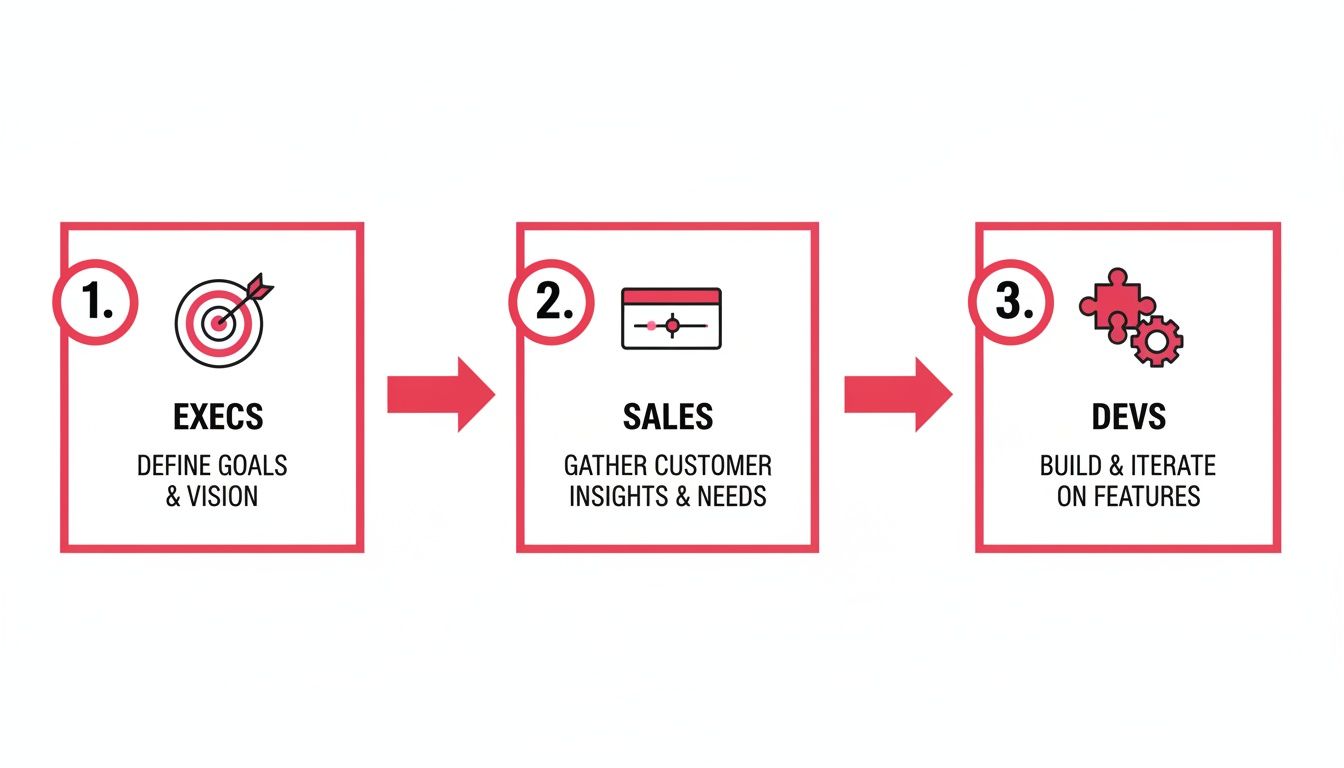
As you can see, it’s a team sport. Executive goals, sales feedback, and development capacity all have to work together to create a product strategy that actually wins.
The Business Impact of a Feedback-Driven Roadmap
Weaving customer feedback into your roadmap isn't just a nice-to-have; it delivers real, measurable results. Research shows that organizations with dynamic, feedback-driven roadmaps see up to 25% better release predictability and stakeholder satisfaction.
This data-backed approach is why 58% of product teams invest heavily in their roadmapping process—it's about driving strategy, not just managing a schedule. For SaaS startups in particular, this is a critical defense against churn, which averages 5-8% in major markets. By translating customer signals—weighted by MRR—into prioritized features, you build a stickier product.
A feedback-driven roadmap ensures you are consistently solving real problems for the people who pay for your product. It’s the most direct path to boosting customer loyalty and building a sustainable business.
Ultimately, this turns your roadmap from a static, dusty document into a living reflection of your customers' world. If you're ready to set up your own system, our guide on how to collect feedback from customers is the perfect place to start.
Common Roadmap Mistakes and How to Avoid Them
Even the most well-intentioned roadmap can go off the rails. It’s a common story: what starts as a strategic guide quickly devolves into a source of stress, turning a flexible plan into a rigid contract that everyone dreads.
The good news? These pitfalls are entirely avoidable. Recognizing the classic traps is the first step to building a roadmap that actually works for you, not against you.
One of the biggest mistakes I see teams make is treating their roadmap like a fixed-in-stone delivery schedule. The moment you slap a specific date on a feature that's months away, stakeholders treat it as a blood oath. This instantly kills your agility, leaving you no room to react to new customer feedback or a competitor's surprise move.
Another classic blunder is turning your roadmap into a "feature factory." This is where the plan becomes a long, soulless checklist of outputs instead of a strategy for achieving meaningful outcomes. The team gets so buried in shipping the next thing that they forget why they're building it in the first place—the real customer problem they set out to solve. You end up with a bloated, Frankenstein product with no clear vision.
Staying Agile and Outcome-Focused
Dodging these bullets requires a fundamental mindset shift. You have to move away from static, rigid planning and embrace a more dynamic approach to your strategy. The whole point is to build a roadmap that welcomes change and prioritizes learning over just shipping.
Here are a few practical ways to keep your roadmap from going sideways:
- Focus on Problems, Not Features: Instead of a line item that says "Add CSV Export," reframe it as "Enable users to analyze their data in external tools." This small change keeps the focus squarely on customer value and gives your team the creative freedom to find the best solution, not just the one you prescribed.
- Use Time Horizons, Not Dates: Ditch the hard deadlines for distant features. Instead, use broader buckets like "Now, Next, Later" or "This Quarter, Next Quarter." This communicates clear priorities and direction without chaining you to promises you can't realistically keep.
- Communicate Relentlessly: A roadmap is, above all, a communication tool. Don't just publish it and forget it. Revisit it with your stakeholders constantly—at least once a quarter—to show progress, talk about what you've learned, and adjust the plan together.
The best roadmaps are never set in stone. They are living documents—strategic guides that evolve as your understanding of the market and your customers deepens. Flexibility isn't a sign of bad planning; it's the hallmark of a healthy, responsive product culture.
By sidestepping these common mistakes, you can transform your roadmap from a source of friction into a powerful tool for alignment, motivation, and real, sustained growth.
Common Questions About Product Roadmaps
Even the best roadmapping guides leave a few practical questions unanswered. Once the theory is out of the way and you start building, some common hurdles pop up. Let's tackle a few of the most frequent ones.
How Often Should I Update My Roadmap?
Your roadmap is a living document, not a stone tablet. For most teams, a quarterly review is a solid cadence. It’s frequent enough to stay agile and respond to market shifts or new customer insights, but not so often that you’re constantly changing direction.
That said, don't be afraid to adjust it outside of that schedule if a huge opportunity or a serious threat appears. The goal is strategic consistency, not rigid adherence.
Who Actually Owns the Product Roadmap?
While roadmapping is a team sport, the Product Manager is ultimately the one steering the ship. They're responsible for corralling input from every corner of the business—leadership, engineering, sales, marketing, and most importantly, customer feedback—and weaving it into a coherent strategy.
So, while one person drives the process, the best roadmaps reflect a shared understanding and commitment across the entire organization.
Should Our Roadmap Be Public?
Yes, but with a bit of strategy. Sharing a high-level, public version of your roadmap can be a massive trust-builder with your customers. It shows them you're listening and gives them a reason to be excited about what's coming.
The trick is to avoid painting yourself into a corner. Instead of hard dates and granular feature lists, stick to broader themes or a "Now, Next, Later" format. Focus on communicating the problems you’re solving, not just the features you’re shipping. This keeps customers looped in without setting expectations you can't meet.
Turn customer feedback from noisy chaos into your roadmap's secret weapon. FeatureBot helps you capture, organize, and prioritize what your users are asking for with smart, AI-driven insights. This ensures your roadmap is always pointed directly at what matters most. While we don't have a free trial, our Free plan is a great way to get started today. See how it works at https://featurebot.com.
Ready to capture better feedback?
FeatureBot helps you collect, organize, and prioritize user feedback with AI-powered conversations.
Get Started Free