A Practical Guide to Product Led Growth
Product-Led Growth (PLG) is a business strategy that puts the product front and center, making it the primary driver for acquiring, converting, and keeping customers. Forget the old-school sales pitches. A PLG model lets people experience the product's value directly through a hands-on, self-service experience, usually starting with a free plan.
This direct approach makes your product the main engine for growth.
What Is Product Led Growth Really?
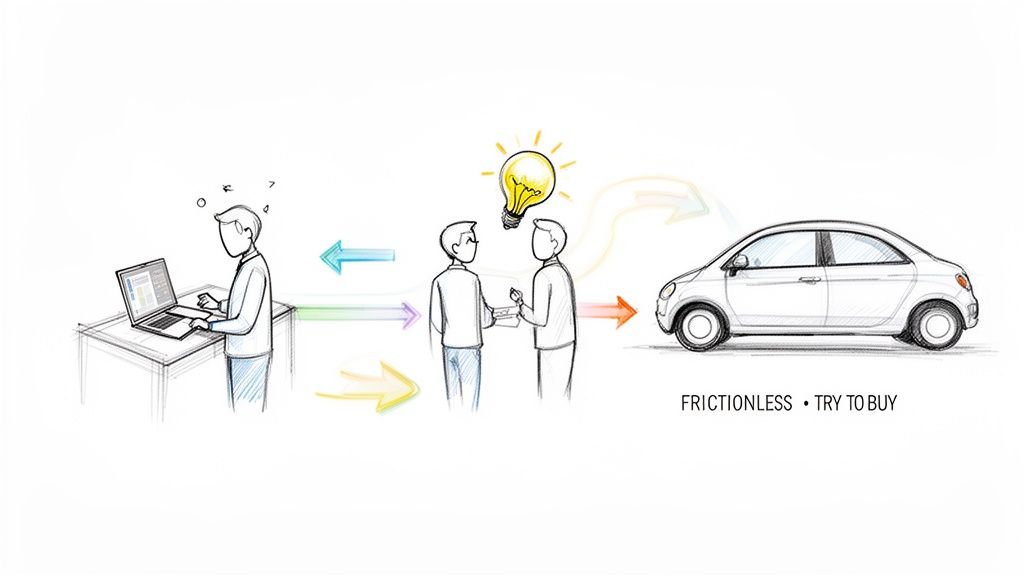
Think of it like this: you walk into a high-end kitchen store, and instead of a salesperson telling you how great a knife is, they hand it to you with some vegetables and a cutting board. You feel the weight, the balance, and see how effortlessly it slices. You've experienced its value firsthand. That's the essence of product led growth.
It's a complete shift away from the traditional sales-led approach, designed for how people actually want to buy things today—by trying them first.
A Quick Look: Product Led Growth vs Sales Led Growth
To really understand what makes PLG different, it helps to see it side-by-side with the traditional Sales-Led Growth (SLG) model. In an SLG world, the sales team holds the keys, guiding prospects through demos and conversations. With PLG, the product itself is the guide.
| Attribute | Product Led Growth (PLG) | Sales Led Growth (SLG) |
|---|---|---|
| Primary Driver | The product itself sells to the user. | Sales team sells to the buyer. |
| Customer Acquisition | Bottom-up adoption via freemium plans. | Top-down sales process with lead generation. |
| First Touchpoint | User signs up and uses the product. | Prospect talks to a salesperson or requests a demo. |
| Time to Value | Immediate. Users solve a problem right away. | Delayed. Value is promised during sales calls. |
| Key Metrics | User activation, conversion rate, time-to-value. | MQLs, SQLs, sales cycle length, CAC. |
The differences are stark. PLG focuses on the end-user experience, betting that if you deliver real value quickly, growth will follow naturally. SLG, on the other hand, relies on building relationships and navigating organizational structures to close a deal.
The Shift to a Self-Service Mindset
At its heart, product-led growth is about creating a path of least resistance for the user. The main goal is to get people to their "aha!" moment—that instant where they truly get how your product helps them—as fast as humanly possible. This demands an obsessive focus on user experience, a dead-simple onboarding process, and delivering a tangible win right out of the gate.
This model is built on a few core principles:
- Show, Don't Tell: Instead of talking about how great your product is, you let people see for themselves.
- Value Before Paywall: A solid free plan lets users solve a real problem and get hooked on your solution before ever pulling out their credit card.
- User-Centric Design: The product has to be so intuitive that users can succeed without needing a manual or a support call.
Why PLG Is Such a Powerful Growth Engine
When you get PLG right, the benefits are huge. Companies using this model often have lower customer acquisition costs (CAC), much faster growth cycles, and better customer retention. By truly understanding the voice of the customer, you can build a product that practically sells itself.
To see this in action, it's worth checking out real-world Product-Led Growth examples from some of the biggest names in SaaS.
The momentum behind PLG is impossible to ignore. Since being coined by Blake Bartlett back in 2016, the strategy has become the go-to for scaling modern companies. In fact, an incredible 91% of B2B SaaS companies are planning to invest more heavily in it. When Brex looked at the 50 fastest-growing software firms, every single one of them had a PLG motion fueling their success.
The Core Principles of a Winning PLG Strategy
Switching to a product-led growth model is way more than just tacking on a free plan. It’s a complete shift in how you think about your business, built on four core principles that work in tandem to create a self-propelling growth engine. A truly successful PLG strategy is never an accident; it's meticulously engineered to deliver value and empower the end user from the moment they sign up.
These pillars aren't just a simple checklist—they're a philosophical foundation. When you get them right, your product stops being just a tool and becomes your best salesperson, marketer, and customer success manager, all rolled into one.
Design for the End User
The first principle of product-led growth is an almost obsessive focus on the end user. This goes far beyond just having a clean interface. It's about designing a self-service experience so intuitive that anyone can sign up and solve a real problem without ever needing a demo or talking to a sales rep. The product has to be the expert guide.
Think of it like putting together IKEA furniture. The best brands give you clear, visual instructions that make you feel like a genius for building a complex piece on your own. A PLG product should feel exactly the same—simple, guiding, and empowering you to get things done on your own, right away.
A product-led approach completely flips the traditional sales model. Instead of having a human show you around, the product itself becomes the primary vehicle for acquiring, activating, and retaining customers. The whole experience is built to be self-sufficient.
This means every single feature, button, and workflow must be designed for absolute simplicity and clarity. If a user gets stuck, they won't schedule a call; they'll just leave.
Deliver Value Before the Paywall
This one is probably the most defining trait of a PLG strategy: delivering real, tangible value before you ever ask for a credit card. This is where the difference between a time-limited trial and a Free plan becomes so important. A trial just creates pressure and a sense of urgency, often expiring before a user has even had a chance to properly integrate the product into their daily routine.
A true PLG model, in contrast, typically offers a generous, permanent Free plan. This lets people experience your product's core "magic" and solve a genuine problem without a countdown clock looming over them. They can build habits and dependencies, making the upgrade to a paid plan feel like a natural next step driven by their own success, not by an arbitrary deadline.
This isn’t just about giving stuff away for free. It's a calculated, strategic move to:
- Tear down the barrier to entry so anyone can give your solution a shot.
- Let the product sell itself by proving its worth through actual use.
- Build a massive top-of-funnel pipeline of potential customers who already know and like you.
Leverage Product Usage for Virality
Great PLG companies don't just find users; they turn those users into magnets for more users. This principle is all about building growth loops directly into the product itself. Virality isn't just about slapping "share" buttons everywhere; it's about creating features that are inherently better when used with other people.
Take these examples:
- Collaboration: A design tool like Figma becomes exponentially more powerful when you invite teammates to work on a file with you.
- Sharing: A scheduling tool like Calendly grows every single time a user sends their booking link to someone else.
- Network Effects: A communication platform like Slack is pretty useless on your own, but it's absolutely essential once your team is on it.
By embedding these loops, every new user becomes a potential channel for acquiring even more users. Growth becomes an organic result of people simply using the product, creating a powerful and cost-effective acquisition cycle that scales all on its own.
Invest in a Frictionless Onboarding Experience
Finally, none of the other principles mean a thing if new users bail before they experience any value. A frictionless onboarding experience is the critical bridge that guides someone from sign-up to their "aha!" moment—that instant they truly get how your product solves their problem.
This process has to be fast, focused, and feel personal. Instead of throwing a massive product tour at them, effective onboarding quickly figures out what the user wants to accomplish and leads them straight to the feature that delivers a quick win. The whole point is to make them successful in their very first session, proving your product’s promise and giving them a powerful reason to come back.
How to Measure Product-Led Growth Success
When you're running a product-led growth strategy, the old sales playbook gets tossed out the window. Forget about tracking lead volume or how many demos your team booked. Success isn't about how many people you talk to; it's about how many people find value in your product all on their own.
This means you need a new set of vital signs. We're shifting away from vanity metrics and focusing on tangible, user-centric KPIs that tell you the real story of how your PLG engine is performing. Good data lets your team see what users are actually doing, spot opportunities, and make decisions based on evidence instead of guesswork.
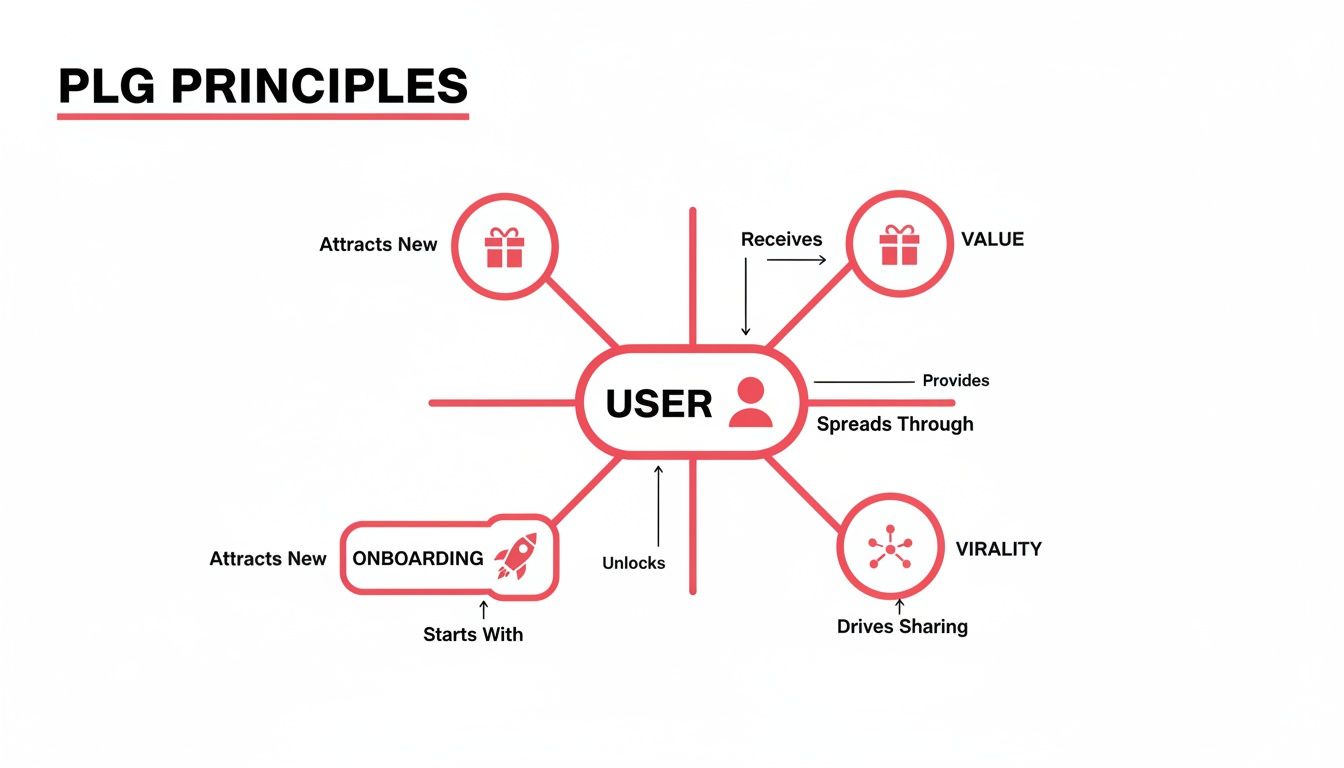
This diagram breaks down the core principles of a solid PLG strategy: User, Value, Onboarding, and Virality. The KPIs we're about to cover are how you measure each of these pillars. When they all work in harmony, you create a powerful, self-sustaining growth loop.
Time to Value (TTV)
How quickly does a new user "get it"? That's what Time to Value (TTV) measures. It’s the time it takes for someone to experience that "aha!" moment—the point where they truly understand the core benefit your product delivers. In the PLG world, speed is everything. A short TTV is a clear sign that your onboarding is working and your product's value is undeniable.
To track it, you first have to define what that "aha!" moment is for your product. Is it when a user sends their first invoice? Creates their first project board? Invites their first team member? Once you know the milestone, you can measure the average time from signup to that key action. A consistently low TTV is one of the strongest indicators of a healthy, user-friendly product.
Product-Qualified Leads (PQLs)
Forget Marketing-Qualified Leads (MQLs). In a PLG company, the real gold is in Product-Qualified Leads (PQLs). These aren't people who just downloaded a whitepaper; they are active users whose behavior inside the product signals they are ready and willing to pay.
A PQL is defined by specific product usage milestones. For instance, a PQL for a project management tool might be a free user who has:
- Created 3 or more projects
- Invited at least 2 teammates
- Used a specific premium feature 5 times
By focusing on PQLs, your sales team can stop cold-calling and start having smart conversations with people who have already voted with their time and actions.
Activation and Conversion Rates
The Activation Rate is your first major hurdle. It's the percentage of new users who actually complete the critical steps that lead to their "aha!" moment. If users don't activate, they’ll almost certainly churn without ever experiencing what makes your product great.
Right after that comes the Conversion Rate, which measures the percentage of those activated users who upgrade to a paid plan. This is where the rubber meets the road, directly connecting product engagement to revenue. It's the proof that delivering value first actually grows the business. For most PLG companies, a free-to-paid conversion rate of 2-5% is a solid benchmark to aim for.
The financial upside of getting PLG right is staggering. The median enterprise value of PLG firms is double that of the public SaaS index. Between 2016 and 2020, the total market cap of PLG companies exploded from $21 billion to $687 billion—a 32x increase. What's more, 83% of public SaaS companies that hit $100M in annual recurring revenue in their first five years have a PLG model, showing it's a faster path to hypergrowth. You can dig into more of the numbers on PLG's financial dominance from Paddle.
Net Revenue Retention (NRR)
Finally, we have what is arguably the ultimate metric for PLG success: Net Revenue Retention (NRR). This KPI calculates the total recurring revenue from a specific group of customers over time, factoring in both expansion (upgrades, cross-sells) and contraction (downgrades, churn).
An NRR over 100% is the holy grail. It means your existing customer base is organically generating more revenue over time—you're growing even without acquiring a single new customer. This metric proves you have fantastic product-market fit and are delivering continuous value. In a PLG motion, a high NRR shows that as users find more success with your product, they naturally spend more.
Building Your Cross-Functional PLG Team
Making the switch to a product-led growth model isn’t a task you can just hand off to one department. It’s a company-wide culture shift. The old way of doing things—with siloed teams and conflicting goals—just doesn't fly. To succeed, you have to build a deeply connected, cross-functional team that's completely obsessed with one thing: making the user's experience so good it drives growth on its own.
This is a huge operational change. Teams that used to work in their own little worlds now have to share everything: data, goals, and a single, unified view of the customer's journey. When you get this right, it creates an incredible feedback loop. An insight from one team immediately fuels action in another, sparking a powerful cycle of constant improvement.
How Traditional Roles Evolve
In a PLG world, every team's mission gets re-centered around the product itself. This changes what they do day-to-day and, more importantly, how they define success.
Marketing: The game is no longer about generating Marketing-Qualified Leads (MQLs). Instead, the big goal is driving product sign-ups. Marketing's new job is to get the right people into the app and then educate them inside the product with smart onboarding, helpful tooltips, and emails that guide them to that "aha!" moment.
Sales: Forget the old cold-calling playbook. Sales teams morph into product specialists who focus on Product-Qualified Leads (PQLs)—users who have already shown buying signals through their actions in the product. The goal isn't just to close a deal; it's to help these high-intent users get even more value.
Customer Success: The team shifts from putting out fires to preventing them. Armed with real-time product data, they can spot a user who’s getting stuck or is this close to discovering a killer feature. They reach out proactively to guide people toward success and stop churn before it even becomes a thought.
Getting everyone to work this closely can be tough without the right mindset and tools. To learn more about fostering this essential cohesion, check out these tips on how to improve team collaboration.
The Central Role of Shared Data
For this cross-functional machine to run smoothly, everyone needs to be looking at the same map. A central hub for all your customer data—a single source of truth—is non-negotiable. When Marketing, Sales, Product, and Success are all seeing the exact same user behaviors and feedback, alignment becomes second nature.
This is where a shared tool like FeatureBot comes in. When a user drops feedback through an in-app widget, it’s not just another ticket. It's a goldmine of context, complete with session details, potential revenue impact, and usage history. The product manager is a key player here, sifting through this data. You can explore the roles and responsibilities of a product manager in our guide to learn more.
With a single source of truth, every decision becomes more informed. Marketing sees which features are stickiest, sales knows which PQLs to call first based on their requests, and the product team builds a roadmap based on what users are actually asking for.
This data-driven alignment gets everyone pulling in the same direction. The product gets better, faster. Users are happier. And the business grows without all the friction.
Using AI and Feedback to Accelerate Growth
The whole idea of product-led growth is built on listening to your users. But as you grow, trying to manually sift through a mountain of feature requests, support tickets, and stray comments is a recipe for disaster. It just doesn't scale.
To build a product that truly sells itself, you need a smart way to turn all that user feedback into a real competitive advantage. Without the right system, crucial insights get buried, and your roadmap ends up completely detached from what your customers actually want and need.
The answer is a simple, three-step process that combines easy data capture with smart analysis. This approach will get you from drowning in messy, unstructured feedback to making sharp, data-backed decisions that actually move the needle.

This is what it looks like in practice: raw user ideas are captured, processed, and refined into a clear, prioritized product roadmap.
Capture Feedback Effortlessly
First thing's first: you have to meet your users where they already are—inside your app. Don't make them open a new tab, hunt for a contact form, or fire off an email. A simple in-app widget makes giving feedback a natural part of their experience. This one change can dramatically boost both the quality and quantity of insights you get because it catches their thoughts right in that moment of frustration or brilliance.
And we're not just talking about a static form. Modern feedback tools, like FeatureBot, use conversational AI to ask intelligent follow-up questions. It’s like having a product manager on standby, probing for more detail and turning a one-line comment into a rich conversation—all without any manual work from your team.
Analyze and Cluster with AI
Okay, so you're collecting a ton of great feedback. Now what? The next hurdle is making sense of it all. Manually reading, tagging, and organizing thousands of comments isn't just a soul-crushing time-sink; it’s also riddled with human error and bias. This is where AI completely changes the game for any PLG strategy.
AI-powered platforms can instantly analyze and group submissions based on their actual meaning, not just keywords. This process, called semantic matching, automatically clusters similar requests together. It cuts through the noise of duplicate suggestions and reveals the most urgent user needs and hidden trends you might have otherwise missed. You go from a messy list of comments to a clean, organized view of what matters most.
By automating the analysis, you free up your team to focus on strategy instead of tedious admin work. The AI does the heavy lifting to figure out what users want, so your team can focus on the why and how it aligns with the product vision.
Prioritize Based on Business Impact
This is arguably the most important step: deciding what to build next. In a typical feedback system, the loudest voices or the most-voted features often win. That’s a fundamentally flawed approach. A feature requested by 100 free-tier users might not have the same business impact as one requested by three enterprise customers who drive a huge chunk of your revenue.
This is why you need to connect user requests directly to business metrics like Monthly Recurring Revenue (MRR). By weighting feedback based on customer revenue data, you can build a roadmap that is laser-focused on growing revenue and slashing churn. It lets you prioritize features that will have the biggest impact on your bottom line, ensuring your development resources are always put to good use. Mastering this is the key to successfully closing the feedback loop and showing users you’re truly listening.
This revenue-first prioritization transforms your product from a simple collection of features into a powerful growth engine. It makes sure you’re not just building what’s popular, but what’s profitable—aligning your entire product strategy with real business outcomes.
Common Product Led Growth Pitfalls to Avoid
Adopting a product-led growth model can feel like you’ve found a cheat code for growth. But for every Slack or Miro, there are dozens of companies that get tripped up by the same preventable mistakes. These pitfalls can quickly turn a promising strategy into a frustrating cycle of missed targets and stalled momentum.
Making the switch to PLG is about more than just slapping a "free plan" on your pricing page. It requires a fundamental shift in thinking and a keen awareness of the common traps that can derail even the best-laid plans. If you can see these challenges coming, you're in a much better position to build a growth engine that actually works.
The Crippled Free Plan
One of the most frequent blunders is offering a free plan that’s more of a punishment than an invitation. This is what happens when you strip out so much core functionality that the free version is basically useless. Instead of demonstrating your product's value, it just screams "limitations," frustrating users and sending them running to your competitors.
Think about a project management tool where the free plan only lets you create one project and doesn't allow any collaboration. How is a team supposed to see how great it is? It completely misses the point. A good free plan needs to be generous enough to solve a real, albeit smaller, problem. It should help users get a win, making them successful enough that they want more, not just because they keep smacking into a paywall.
The goal of a free offering isn't to trick users into upgrading. It's to make your product so indispensable to their workflow that upgrading becomes the obvious and logical next step for their own success.
Creating a Confusing Onboarding Experience
You only get one shot at a first impression, and in PLG, your onboarding is it. A clunky, confusing, or generic onboarding flow is a surefire way to lose people before they ever experience that "aha!" moment. If users are left guessing what to do next or getting bombarded with irrelevant tooltips, they’re going to bounce. It’s that simple.
Great onboarding provides a clear, guided path to a quick win. It should:
- Focus on one key action: Push the user to complete the single most valuable task they can do in their first session.
- Be contextual: Provide help and tips that are relevant to what the user is doing right now, not some generic product tour.
- Celebrate small wins: Acknowledge when a user completes a key step. This builds momentum and keeps them engaged.
Building for Everyone and No One
This is a classic startup mistake, but it's fatal in PLG. Trying to build a product that appeals to everyone usually results in a product that excites no one. The most successful PLG companies are almost obsessive about a specific ideal customer profile (ICP). They know their users' exact pain points inside and out, and they’ve built a product that solves those problems better than anyone else.
Without that sharp focus, your product inevitably gets bloated with features that don’t serve a core purpose, making the user experience a confusing mess. You have to be crystal clear on who you're building for and—just as important—who you're not building for. This clarity drives everything from product development to marketing, ensuring you attract and keep the right users who will eventually become your biggest champions.
The excitement around this strategy is real and backed by serious money. The market for product-led growth platforms is projected to surge from $5.47 billion in 2025 to a massive $14.32 billion by 2030. This growth isn't random; it's fueled by users who now expect smooth, self-service software. That makes having a focused, valuable product more critical than ever. You can dig into more of the numbers and industry analysis on the PLG platform market at einpresswire.com.
Answering Your Top PLG Questions
When you start digging into product-led growth, a few key questions almost always pop up. Let's tackle some of the most common ones head-on, so you can get a clearer picture of how this strategy works in the real world.
Is PLG Just a Strategy for New Startups?
Absolutely not. It's easy to see why people think this, since many startups build their entire company around a PLG model from the get-go. But plenty of established players have successfully bolted on a PLG engine to their existing sales-led machine.
Look at companies like HubSpot and Atlassian. They didn't scrap their sales teams. Instead, they adopted a hybrid model. PLG became their way to efficiently capture the small and mid-market, while the traditional sales team could stay focused on high-touch, complex enterprise deals. Think of it as adding a new, highly efficient growth channel, not a complete teardown of what already works.
What’s the Real Difference Between a Free Trial and a Free Plan?
This is a huge one, and the difference is more about user psychology than you might think. A free trial puts the user on the clock. It’s a “try before you buy” sprint, creating a sense of urgency that can force a quick, and sometimes shallow, evaluation.
A Free plan, on the other hand, is a permanent, if somewhat limited, version of your product. This is the model we use at FeatureBot. It gives users the space to solve a genuine problem and truly weave your tool into their day-to-day work without any pressure. The goal is to deliver real value first. An upgrade then becomes the natural next step, driven by their own success and need for more power, not by a countdown timer.
How Does Marketing’s Job Change in a PLG Company?
Marketing undergoes a fundamental shift. The primary goal is no longer just about feeding leads to the sales team (MQLs). Instead, it’s about getting people to actually sign up for and use the product. Success is measured by how many people you can guide to that critical "aha!" moment where the product's value just clicks.
This means the marketing playbook changes to include:
- Content & SEO: The focus is on creating genuinely helpful content that attracts your ideal users and leads them straight into the product to solve a problem.
- Onboarding & Nurturing: It's not just about a welcome email. It’s about building automated email sequences and smart in-app messages that act as a guide, helping new users hit key milestones that demonstrate value.
- Product Marketing: This becomes central. The job is to constantly highlight features and use cases that pull users deeper into the product, showing them a clear path to why an upgrade is worth it.
Ready to turn user feedback into your biggest growth lever? FeatureBot uses AI to help you capture, analyze, and prioritize customer requests without guesswork. Start for free on FeatureBot.com and build a product your customers will love.
Ready to capture better feedback?
FeatureBot helps you collect, organize, and prioritize user feedback with AI-powered conversations.
Get Started Free