Roles and responsibilities of product manager: Key Tasks & Skills
At its core, a product manager's job is to define a product's vision, champion features that genuinely solve user problems, and guide a cross-functional team to bring a successful solution to life. They act as the central nervous system, connecting customer needs with business goals and technical realities.
What Does a Product Manager Actually Do
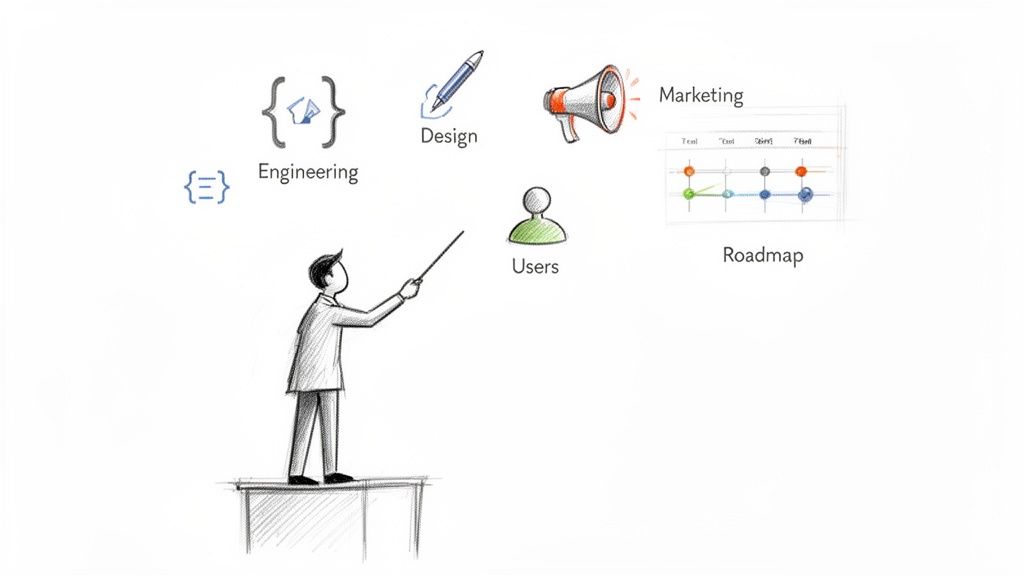
While they're sometimes called the "CEO of the product," I find it's more accurate to think of a product manager (PM) as the conductor of an orchestra. They don’t personally play every instrument—they’re not writing the code or designing the user interface—but they make sure every specialist, from engineering to marketing, is playing in perfect harmony.
The entire role boils down to answering three fundamental questions: What problem are we solving?, Why is solving it important?, and How will we know if we've succeeded?
This position is inherently cross-functional, sitting right at the intersection of business, technology, and user experience (UX). A great PM is deeply empathetic to the customer's world while also being keenly aware of the competitive landscape and the company's strategic goals. They translate all that insight into a clear product strategy and a prioritized roadmap that everyone can rally behind.
The Hub of the Product Wheel
Imagine a product manager as the hub of a wheel, connecting all the spokes. Their main job is to keep these diverse teams aligned and ensure information flows freely between them. Without that central coordination, it's easy for teams to drift into silos, building things that don't quite hit the mark with users or contribute to the bottom line.
A PM's day-to-day work can be broken down into a few core areas:
- Strategy: This is about setting the "North Star"—defining the product vision and its long-term goals.
- Discovery: It all starts with understanding your users. This means digging into their needs through research and data. Learning how to collect feedback from customers is a non-negotiable skill here.
- Prioritization: You can't build everything. A huge part of the job is making the tough calls about what to build next based on impact and effort.
- Execution: This is where the magic happens. It involves working hand-in-hand with engineering and design to get high-quality features out the door.
Each of these functions is a critical stage in the new product development process, which maps out the journey from a rough idea to a market-ready launch. Ultimately, the PM is on the hook for shipping a product that customers not only use but love—and that drives the business forward.
To give you a clearer picture, this table breaks down those core functions.
Core Functions of a Product Manager at a Glance
| Function Area | Key Objective | Primary Activities |
|---|---|---|
| Strategy | Define the product's long-term vision and purpose. | Market research, competitive analysis, defining target audience, setting business goals and KPIs. |
| Discovery | Uncover and validate real customer problems. | User interviews, surveys, data analysis, feedback collection, usability testing. |
| Prioritization | Decide what to build next to maximize value. | Creating roadmaps, backlog grooming, using frameworks (e.g., RICE, MoSCoW), stakeholder negotiation. |
| Execution | Guide the team to build and launch the right solution. | Writing user stories, working with designers and engineers, managing sprints, coordinating launches. |
While these domains look distinct on paper, in reality, a product manager flows between them constantly, ensuring the vision stays connected to the daily work of the team.
The Seven Core Responsibilities of a Modern PM
To really get what a product manager does, you have to break the job down into its core functions. While the day-to-day can feel like a blur of meetings, Slack messages, and data dashboards, a great PM is always steering the ship through seven key areas. These aren't just one-and-done tasks; they're a continuous cycle that guides a product from a rough idea all the way to a market success.
Think of these responsibilities as the different hats a PM wears. Mastering them is what allows a PM to ensure the team is always building the right thing, for the right people, at the right time. Let’s walk through each one.
1. Defining Product Strategy and Vision
First things first, a PM has to answer the big question: "Why are we even building this?" This is all about setting the product's North Star—a clear, compelling vision of where you're headed and what you want to create for your users. A powerful vision gets the whole team fired up and keeps everyone aligned, especially when the going gets tough.
The strategy is simply the map you use to get to that North Star. It defines who your customers are, what makes your product different from the competition, and what business goals you need to hit. It’s the connective tissue between the team's daily work and the company's long-term ambitions.
2. Conducting User Research and Discovery
With a vision in place, the spotlight shifts to the "who" and the "what." This is the discovery phase, where a PM essentially becomes an anthropologist, digging deep into their users' problems, needs, and daily workflows. Incredible products are built on a solid foundation of empathy, not on assumptions made in a conference room.
This means getting your hands dirty with a mix of research methods:
- User Interviews: Actually talking to people to hear about their pain points in their own words.
- Data Analysis: Diving into analytics to see what users do, not just what they say they do.
- Feedback Collection: Setting up systems to capture insights from customer support, sales, and dedicated feedback tools.
The whole point is to uncover real, painful problems that are actually worth solving. This becomes the bedrock for every decision that follows.
3. Building and Prioritizing the Roadmap
Once you know what problems need solving, the next question is "when?" This is where the product roadmap comes in. A roadmap isn't a rigid project plan; it's a high-level, strategic document that shows everyone where the product is heading over the next few quarters.
Deciding what makes it onto the roadmap—and in what order—is one of a PM's most critical jobs. You're constantly weighing trade-offs and making tough calls to ensure the team focuses on what will deliver the most impact. It’s a high-stakes game. Studies show that only 40% of products launched actually survive long-term. To make matters worse, PMs often spend a whopping 52% of their time on unplanned "fire-fighting," pulling them away from this crucial strategic work. You can see more data on this balancing act on PW Skills.
A great roadmap is not a list of features; it's a statement of intent. It communicates the customer problems you plan to solve and the business outcomes you expect to drive. It’s about the ‘why,’ not just the ‘what.’
4. Specifying Features for Development
With priorities locked in, it’s time to get specific about "how" a new feature or solution should work. The PM is responsible for translating a high-level roadmap theme into clear, detailed requirements that the design and engineering teams can run with. This usually takes the form of user stories, Product Requirement Documents (PRDs), or feature specs.
Clarity is absolutely everything at this stage. A well-written spec acts as the blueprint for the team, making sure everyone is on the same page about the problem, the user, the success metrics, and any important constraints. If you want to learn more about how to approach this, check out our guide on essential product management frameworks.
5. Guiding Product Execution and Delivery
A PM’s job doesn't stop once the specs are handed over. Far from it. They are in the trenches with engineering and design every single day during the development process. They're in the daily stand-ups, answering questions, giving feedback on early designs, and helping bust through any roadblocks that pop up.
Throughout it all, the PM acts as the voice of the customer. They're there to make sure the final solution stays true to the original vision and actually solves the user's problem in an elegant and effective way.
6. Aligning Cross-Functional Stakeholders
Products aren't built in a vacuum. A PM's ability to get everyone from different departments rowing in the same direction is fundamental to their success. This means constantly communicating with stakeholders across the entire company—from marketing and sales to customer support and the C-suite.
Good stakeholder management is about more than just sending updates. It's about sharing the vision, explaining the "why" behind roadmap decisions, and helping every department see how the product's success will help them hit their own goals.
7. Managing Launch and Continuous Iteration
Shipping the product isn't the finish line; it's the starting line. The PM orchestrates the go-to-market plan, working closely with marketing, sales, and support to make sure the launch is a success. Once it's out in the wild, the work immediately shifts to measuring its impact, gathering user feedback, and planning the next iteration.
This brings us full circle. Product management is a continuous loop: analyze the data, talk to your users, and use those fresh insights to decide what to build next. The job is never really "done."
Moving from Feedback Overload to a Clear Roadmap
If there's one responsibility that defines the product manager role, it's prioritization. You're constantly swimming in a sea of competing demands from customers, sales, marketing, and leadership. It's your job to turn that chaotic flood of feedback and ideas into a clear, strategic product roadmap that actually moves the needle.
Frameworks like RICE (Reach, Impact, Confidence, Effort) are a great starting point for structured thinking. But let's be honest, the real challenge isn't just sorting a list of features. It's about systematically understanding the why behind every request and connecting it directly to business value. That's where modern tooling comes in.
Capturing Feedback Where It Happens
The first step toward a smarter roadmap is to stop making users jump through hoops to give you feedback. Forget clunky forms and separate portals. The best insights come when you capture them directly within your product.
Imagine a user hits a snag or has a brilliant idea while using your app. A small, conversational widget can pop up, inviting them to share their thoughts right then and there. This simple shift does two things: it dramatically increases the amount of feedback you get, and it captures that feedback with all the crucial context of what the user was trying to do.
The goal is to make giving feedback feel less like a friendly chat and more like a chore. When you lower the barrier to entry, you start hearing from the silent majority—the users whose valuable insights you were missing before.
This is exactly what we're talking about. A tool like FeatureBot can embed a conversational widget right into your product to capture user ideas seamlessly.
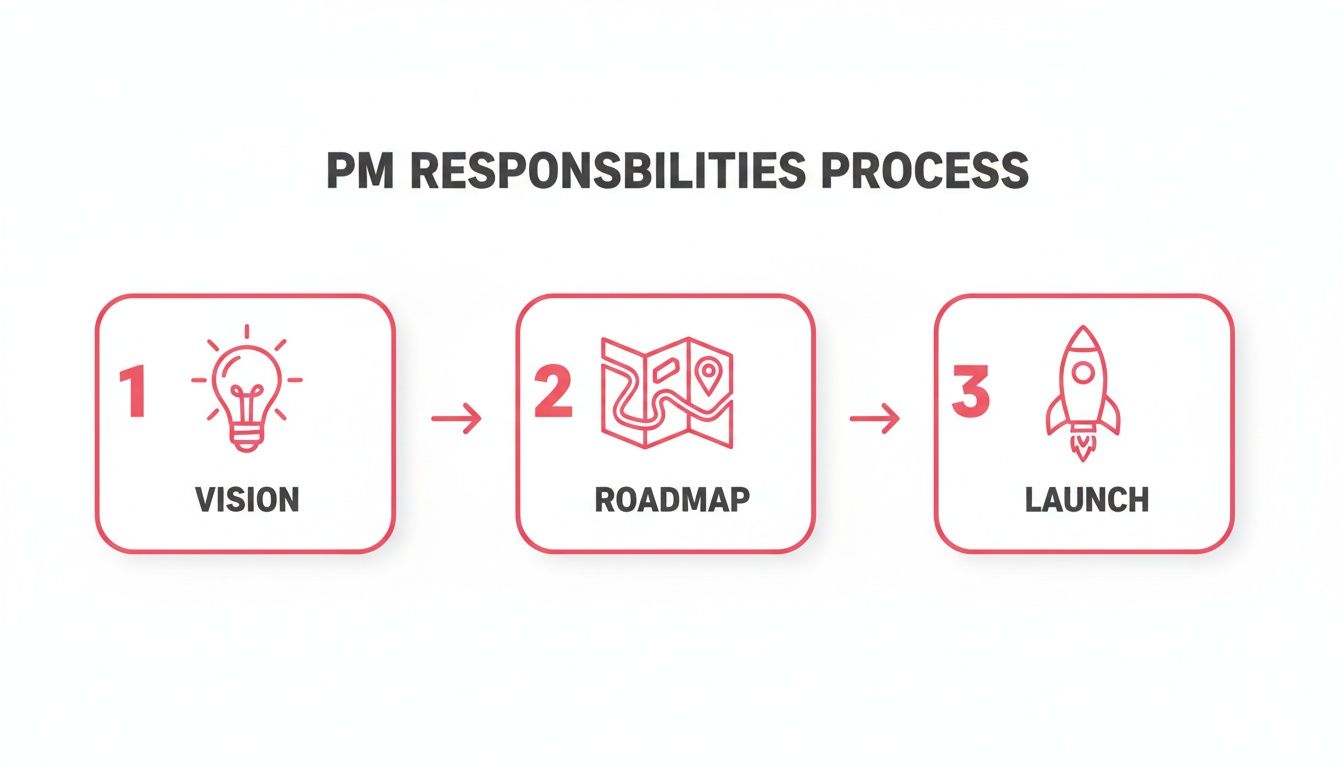
The takeaway here is simple: integrate feedback collection into the user experience itself, rather than making it a separate, disjointed process.
Moving Beyond Simple Vote Counts
One of the biggest traps a PM can fall into is prioritizing by popularity contest. Just because a feature gets the most votes doesn't mean it’s the right one to build next. Think about it: ten requests from users on a free plan don't hold the same strategic weight as a single request from an enterprise customer worth $50,000 in ARR.
This is where a PM's strategic thinking truly shines. The real power comes from enriching that raw feedback with cold, hard business data. A smart workflow looks something like this:
- Automatic Clustering: Modern tools use AI to instantly group similar requests. This cuts through the noise of duplicate suggestions and reveals the underlying themes and pain points without hours of manual sorting.
- Revenue Weighting: By connecting to your CRM or billing system, you can immediately see which features are being requested by your highest-value customers. This lets you prioritize based on potential MRR impact, tying your roadmap directly to revenue goals.
- Full User Context: Every piece of feedback should arrive with a backstory—what page the user was on, their plan type, or other key data. This gives your team the context they need to understand the problem without a dozen follow-up emails.
Closing the Loop to Build Customer Loyalty
Finally, one of the most powerful—and most often overlooked—responsibilities of a product manager is closing the feedback loop. When a user takes the time to share an idea, they're investing in your product. Leaving them hanging is a massive missed opportunity.
A truly effective feedback process doesn't stop once an idea hits the backlog. It follows the entire journey:
- Acknowledge the Idea: Instantly let the user know their feedback was received. A simple "got it!" goes a long way.
- Update on Progress: Keep them in the loop when the status changes, like when it moves to "Planned" or "In Progress."
- Celebrate the Launch: This is the magic moment. Personally notify every single user who requested a feature the instant it goes live.
That final step turns customers into evangelists. They feel heard, valued, and genuinely connected to your product's journey. It’s a surprisingly simple way to build fierce loyalty and reduce churn.
How the PM Role Changes with Company Growth
A product manager’s job description is anything but static. The role morphs dramatically as a company balloons from a tiny startup into a global enterprise. While the core mission—solving real problems for real people—never changes, the scale, context, and daily grind certainly do.
Knowing how the role evolves is key. If you're a founder, it helps you hire the right kind of PM for your current stage. If you're a PM, it gives you a roadmap for your career, showing you what skills to build as you climb the ladder.
The Startup PM: The Generalist
At a startup, the product manager is the ultimate jack-of-all-trades. Sometimes, they're even one of the founders. There’s one goal that eclipses all others: find product-market fit. This PM is deep in the trenches, doing whatever it takes to get that first version of the product out the door.
Their world is a whirlwind of diverse tasks:
- Hands-On Discovery: They’re the ones running every single user interview, digging through raw feedback, and often answering support tickets just to feel the customer's pain firsthand.
- Rapid Prototyping: They're glued to the hip of a small engineering team, making snap decisions to ship a Minimum Viable Product (MVP) and learn from it as quickly as humanly possible.
- Broad Ownership: One day they’re mapping out the grand product vision, the next they’re writing marketing copy or trying to squash a bug. The scope isn't a feature; it's the entire product.
The startup PM has to be comfortable with chaos and built for speed. Success is measured by a single, brutal metric: did the product stick?
The Scale-Up PM: The Process Builder
Once a company finds its groove and starts growing fast, the PM role shifts from "doer" to "enabler." Instead of juggling everything, they now own a specific product area or team. The goal is no longer just survival; it's about building systems that can handle the growth.
The challenge here isn't just about finding what works. It's about figuring out how to do it over and over again, efficiently, as new people join every week. The PM becomes a master of process and communication, not just product.
This means their day-to-day focus changes completely. They're bringing order to the chaos by introducing prioritization frameworks, creating a formal product roadmap, and setting up communication channels to keep a ballooning number of stakeholders in the loop.
Success is now measured by their team’s ability to ship high-impact features predictably and without breaking things.
The Enterprise PM: The Portfolio Manager
In a massive, established company, a product manager's role often feels more like that of a portfolio manager. They're usually in charge of a mature product or a single piece of a sprawling ecosystem. The game is no longer about finding the next big thing, but about optimization and incremental growth.
The environment is a whole different beast, demanding a unique set of skills:
- Navigating Stakeholders: The PM has to work through a complex web of internal teams, from legal and compliance to global marketing and sales. Getting anything done requires building consensus.
- Data-Driven Decisions: Every decision has to be backed by hard, quantitative data. A/B tests and rigorous analysis are the currency used to justify even minor changes.
- Strategic Alignment: Their main focus is making sure their slice of the product aligns with the company's overarching strategy, which often means managing dependencies across dozens of other teams.
The enterprise PM is a master of influence, data, and navigating corporate politics. Success is measured by their ability to move key business metrics—like retention, revenue, or efficiency—for their specific corner of the product empire.
A Day in the Life of a SaaS Product Manager
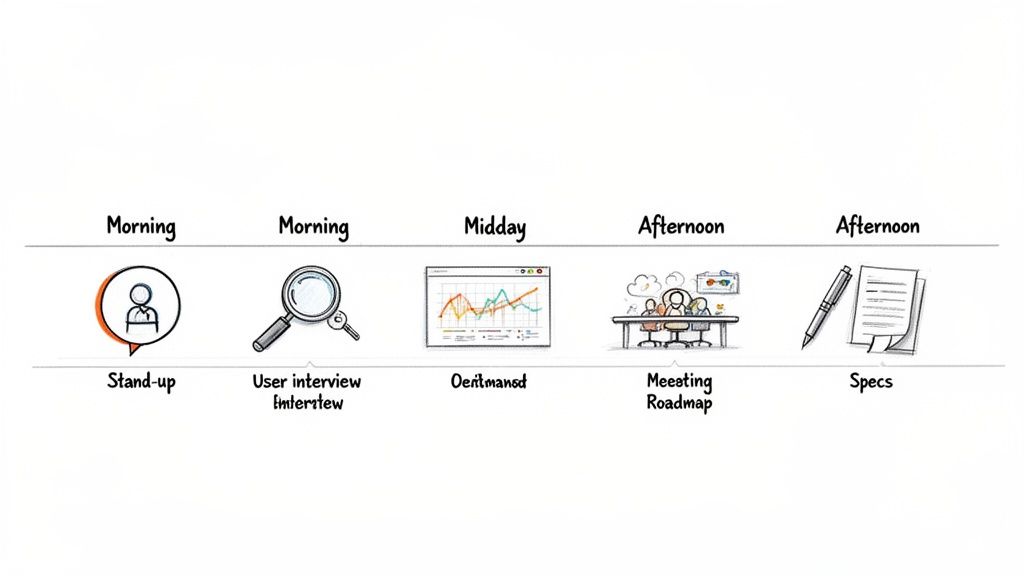
It’s one thing to talk about product management in theory, but what does the job actually look like day-to-day? To really understand the roles and responsibilities of a product manager, you have to see how those abstract duties play out in real time.
No two days are ever exactly the same, but there’s a definite rhythm to the work. It’s a constant juggle between high-level strategy, deep dives with users, and close collaboration with the team. Let's walk through a pretty typical day for a PM at a SaaS company.
Morning Focus on Team and Trends
9:00 AM: The day starts with the engineering team's daily stand-up. This is more than a simple status check. The PM's job here is to listen for roadblocks and offer immediate clarity. Are there any fuzzy user stories? Any dependencies causing a delay? This is the moment to get the team unstuck and keep the momentum going.
9:30 AM: With the engineering team humming along, it’s time to tune into the customer's voice. The PM opens up FeatureBot to see what feedback has rolled in overnight. Instead of getting buried in a spreadsheet, they find all the new ideas and requests neatly organized, with themes automatically clustered and even weighted by customer MRR.
A clear pattern is emerging. Five different customers, one of them a major enterprise account, have all requested the same integration. This isn't just a random comment; it's a strong signal. The PM tags it for a closer look later.
This quick morning ritual ensures the PM is constantly connected to what users are saying, turning raw feedback into something genuinely useful before the day really gets going.
Midday Immersion in User Problems
11:00 AM: Now for a deep dive. The PM and a product designer hop on a call with a customer who’s been having a tough time with a specific workflow. This is where true empathy comes into play.
The goal isn't to push a solution or defend the current design. It's about understanding the user's core problem—what are they really trying to accomplish? They ask open-ended questions and listen intently, digging for the pain points that aren't always explicitly stated.
12:30 PM: Immediately after the call, the PM spends 30 minutes in the product analytics platform. It's time to connect the dots between what they just heard and what the data shows. Are other users dropping off at that same step in the workflow? How does feature adoption look for that part of the product? This blend of qualitative insight and quantitative data is what separates good decisions from guesses.
Afternoon Alignment and Execution
2:00 PM: The afternoon is all about getting everyone on the same page. The PM presents the proposed quarterly roadmap to leadership, sales, and marketing. This is pure storytelling. It’s not just a list of features; it's a compelling narrative.
Every single initiative is tied directly to a business goal. Priorities are clearly justified with data, including the MRR-weighted feedback from that morning's review. It’s a collaborative session designed to build a shared understanding of why they're building what they're building.
4:00 PM: With the roadmap discussion wrapped, it’s time for some focused execution. The PM opens a document to spec out a new feature, carefully outlining the user problem, defining what success looks like, and listing the core requirements.
To finish the day, they jump into a Figma file to leave comments on some early wireframes from the designer. This back-and-forth ensures the solution being crafted is a direct answer to the user needs they uncovered earlier. The day closes not with a finished product, but with meaningful progress across every front: strategy, discovery, and delivery.
How We Measure Success: The Metrics That Matter in Product Management
Shipping features is easy. Shipping features that actually move the needle for users and the business? That’s the real job. A product manager's success isn't just about a packed roadmap; it's measured by the tangible impact their work delivers.
To get a clear picture, we have to look at Key Performance Indicators (KPIs). Think of these as the vital signs of your product. They tell you what's working, what's not, and where to focus your energy next. We can group these metrics into three core buckets: how people use the product, how it makes money, and how it makes them feel.
Product Engagement Metrics
This first group of metrics answers a simple but critical question: are people actually using this thing? High engagement is a fantastic early signal that you're building something people value.
- Daily Active Users (DAU) & Monthly Active Users (MAU): This is your product's pulse. It tells you how many unique people are showing up each day or month. A strong DAU/MAU ratio is a great sign that your product is becoming a regular habit for your users.
- Feature Adoption Rate: You just launched something new—is anyone using it? This metric shows what percentage of your users have tried a new feature. If the numbers are low, it might be a sign that the feature is hard to find, confusing to use, or simply doesn't solve the problem you thought it did.
- Retention Rate: This is the big one. What percentage of users stick around over time? High retention is the clearest sign you've found product-market fit. It means your product isn't just a novelty; it's become indispensable.
Business and Revenue Metrics
While we love seeing people use our product, it also needs to support the business. These metrics are all about connecting product decisions directly to the company's financial health, showing how your work contributes to growth.
A product manager's ability to influence revenue is what separates them from a feature manager. You have to constantly ask, "How will this decision help us hit our financial goals?"
Here are the key metrics that tie your work to the bottom line:
- Monthly Recurring Revenue (MRR): For any subscription business, MRR is the lifeblood. Product managers directly influence this by shipping features that attract new customers, convince existing ones to upgrade, or reduce the number of people who cancel.
- Customer Lifetime Value (CLV): This number predicts the total revenue you can expect from a single customer over their entire relationship with your company. PMs boost CLV by improving retention and finding smart ways to create more value, which often leads to upselling opportunities.
User Satisfaction Metrics
Finally, you have to know how people feel about your product. A product can hit all its financial targets but still leave users feeling frustrated or unheard. These metrics give you a direct line into your customers' heads.
- Net Promoter Score (NPS): The classic "how likely are you to recommend us?" question, answered on a scale of 0-10. It’s a powerful, high-level gauge of customer loyalty and overall brand health.
- Customer Satisfaction Score (CSAT): Usually asked right after a specific interaction (like using a new feature or talking to support), CSAT measures short-term happiness. It gives you instant feedback on whether a recent change was a hit or a miss.
By keeping a close eye on a balanced set of these KPIs, a product manager can get a complete, 360-degree view of their product's performance and prove the value of their work in a language everyone in the business understands.
Common Questions About the Product Manager Role
Even with a solid grasp of the job, a few questions about the roles and responsibilities of product manager always seem to pop up. It’s a role that sits at the intersection of so many different fields, so a little confusion is natural. Let’s clear up a few of the most common ones.
One of the biggest mix-ups is the difference between a product manager and a project manager. Here’s a simple way to think about it: the product manager owns the why and the what. They’re focused on the big picture—the product vision, the customer problem, and what success looks like. The project manager, on the other hand, owns the how and the when. They’re all about execution, managing timelines, and wrangling the resources to get something built and shipped.
How Technical Does a PM Really Need to Be?
This question comes up all the time. Do you need a computer science degree to be a great PM? The short answer is no, but you do need to be tech-literate. You're not expected to be writing production-ready code, but you have to be able to hold your own in a conversation with engineers.
This means you should understand the basics of your product’s architecture, be aware of technical limitations, and have a realistic sense of how much effort different features will require. Your credibility and ability to make smart trade-off decisions hinge on having this foundational knowledge. Without it, you can't be an effective partner to your engineering team.
How Do I Break Into Product Management?
There's no single, straight path into product management, which is actually one of its strengths. Great PMs come from all over—marketing, design, customer support, you name it. The trick is to start thinking and acting like a PM right where you are.
If you're looking to make the leap, start building your "product muscle" by focusing on these areas:
- Become the customer expert: Go deeper than anyone else on user needs and pain points.
- Understand the business: Figure out how your company makes money and what really moves the needle.
- Lead by influencing: Take charge of projects that involve multiple teams, even if you don’t have official authority.
Getting ready for interviews means knowing what kind of thinking is expected. A great way to prepare is by digging into the top product manager interview questions to see how hiring managers test for these skills. At the end of the day, they want to see that you can spot a problem, get a team excited to solve it, and deliver a solution that works.
Ready to move from feedback chaos to a clear, revenue-driven roadmap? While FeatureBot doesn't offer a free trial, we do have a Free plan to get started. See how AI-powered feedback management can help you build products customers love. Explore FeatureBot today.
Ready to capture better feedback?
FeatureBot helps you collect, organize, and prioritize user feedback with AI-powered conversations.
Get Started Free