A Practical Guide to Product Management Frameworks
Product management frameworks are essentially structured guides that help teams make smart, consistent decisions about what to build and why. Think of them less as rigid rules and more as proven blueprints for turning raw ingredients—like ideas, data, and user feedback—into a product that actually solves real-world problems.
What Are Product Management Frameworks?
Picture a chef's kitchen filled with incredible ingredients but absolutely no recipes. One night, the chef might whip up a masterpiece. The next? A total disaster. The entire process would be chaotic, unpredictable, and impossible for the rest of the kitchen staff to follow.
This is exactly what product development can feel like without a guiding structure.
Product management frameworks provide the recipes. They introduce a systematic way to navigate the often messy journey of building and improving a product. Instead of relying on gut feelings or just listening to the loudest voice in the room, these frameworks give everyone a shared language and a repeatable process. This alignment is crucial for getting engineering, marketing, sales, and leadership all on the same page.
The Core Purpose of a Framework
At their heart, these frameworks exist to inject clarity and objectivity into three fundamental parts of product development:
- Prioritization: They offer structured methods to figure out which features or initiatives will deliver the most value to both the customer and the business.
- Communication: A shared framework makes sure everyone understands why a decision was made. This cuts down on friction and gets the whole company pulling in the same direction.
- Decision-Making: They help replace subjective debates with data-informed analysis, leading to smarter, more consistent choices about where the product is headed.
A good framework is like a compass for your product team. It doesn't tell you the exact path to take, but it consistently points you toward your strategic destination, helping you navigate through the fog of competing priorities and customer requests.
Different Tools for Different Jobs
It's really important to know that there's no single "best" framework that works for everything. Just as a chef has different recipes for appetizers, main courses, and desserts, product managers use different frameworks for different challenges.
Some are designed specifically for prioritizing a backlog of features, while others are brilliant for uncovering deep customer needs or organizing how the work gets done. For a comprehensive look at various approaches, this practical guide to product strategy frameworks is a great resource, covering essential models like RICE, Kano, and JTBD. Understanding this distinction is the first step toward building a versatile toolkit that sets your team up to tackle any product challenge effectively.
Frameworks for Prioritization and Decision Making
Every product team I've ever worked with has faced the same "good" problem: a constant flood of great ideas, urgent customer requests, and shiny new opportunities. The real challenge isn't a lack of options—it's having way too many. Deciding what to build next, and just as importantly, what to shelve for later, is where many teams get bogged down.
This is where a good prioritization framework becomes your best friend. It gives you a structured, objective way to look at competing ideas, pulling your team out of subjective "I think we should..." debates and into clear, data-informed decisions. Instead of just going with your gut, these frameworks help you aim your limited resources at the work that will actually move the needle.
Getting this right has never been more critical. The global Product Management Software market is exploding, on track to hit a massive $35.3 billion by 2025. This growth highlights just how vital structured thinking has become for teams trying to manage complex products. Frameworks like RICE or MoSCoW are what allow product managers to allocate resources smartly, with data showing that large companies using them can cut development cycles by up to 20-30%.
To really get a handle on this, product managers are using not just these frameworks but also more advanced AI tools for feature prioritization that analyze user feedback directly.
This simple decision tree can help you figure out which type of framework might be the best fit for your team's style and current needs.
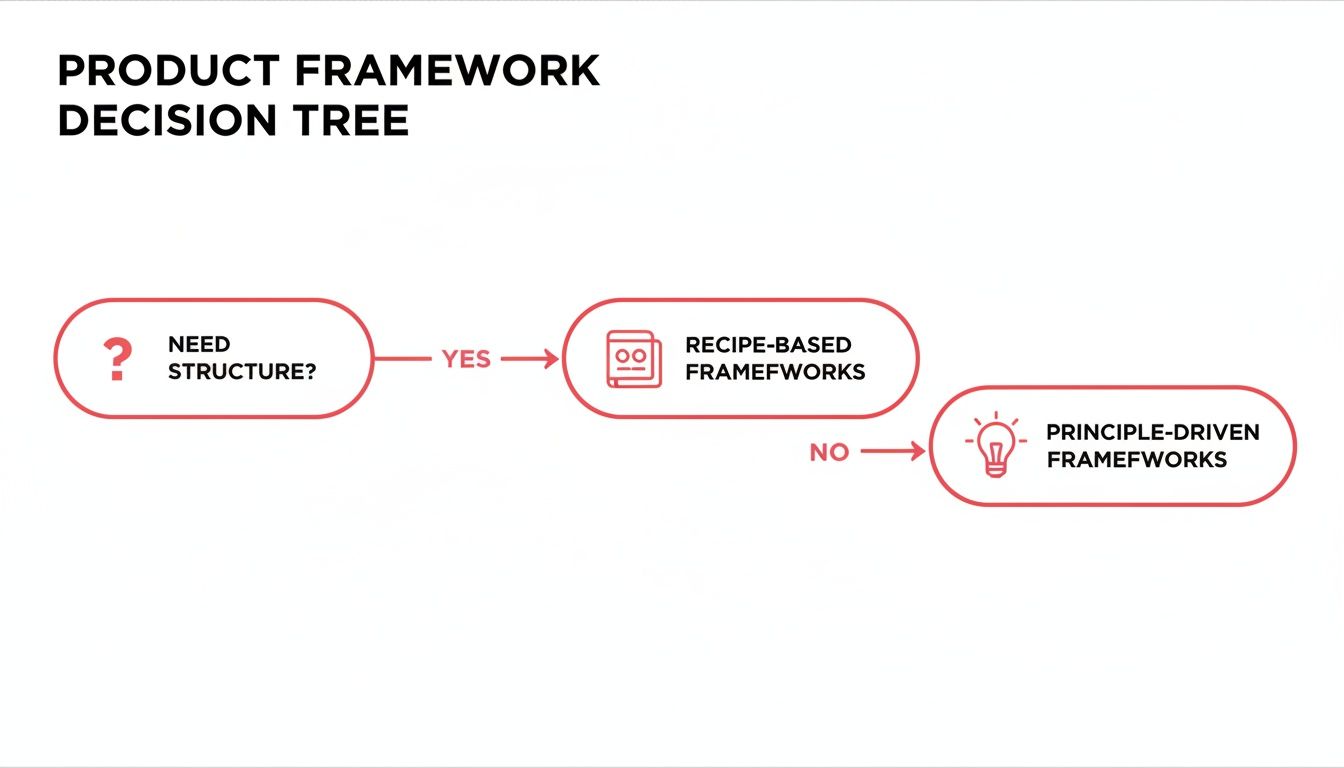
As you can see, the first question is all about structure. Do you need a repeatable recipe for making decisions, or are you looking for broader principles to guide your thinking?
The RICE Framework for Data-Driven Choices
The RICE scoring model is all about bringing hard numbers to your prioritization process. It's a quantitative method that forces you to think critically about four key factors for every single feature or project on your list.
- Reach: How many people will this actually touch in a set time period? (e.g., 500 customers per month)
- Impact: How much will this move the needle for a typical user? (Often scored simply: 3 for massive, 2 for high, 1 for medium, 0.5 for low)
- Confidence: How sure are you about your Reach and Impact numbers? (This is a gut check, expressed as a percentage: 100% for high confidence, 80% for medium, 50% for low)
- Effort: How much time and work will this take from your team? (Usually measured in "person-months" or sprints)
You crunch these numbers with a simple formula: (Reach x Impact x Confidence) / Effort. The features with the highest scores float to the top of your list. It's a fantastic method for mature products where you have solid data to back up your estimates.
The ICE Framework for Speed and Simplicity
While RICE is incredibly thorough, it can sometimes feel like a lot of work. The ICE scoring model is its faster, more intuitive cousin. It’s perfect for startups or any team that needs to make decisions quickly without getting lost in deep analysis.
ICE boils it down to just three components:
- Impact: How much will this benefit users or the business?
- Confidence: How certain are you that this is the right bet?
- Ease: How easy is this to actually build and ship?
You rate each factor on a simple 1-10 scale and multiply them together for a final ICE score. It's my go-to tool for a quick sanity check or for that first pass at grooming a long backlog when momentum is more important than perfect precision.
The MoSCoW Method for Stakeholder Alignment
Sometimes, the hardest part of prioritization isn't scoring the ideas—it's getting everyone in the room to agree on what's truly essential for a release. The MoSCoW method is built for exactly that. It's less about math and more about facilitating conversations and setting clear expectations.
It works by bucketing every feature into one of four categories:
- Must-have: Absolutely non-negotiable. Without these, the release is a failure.
- Should-have: Important, but not critical. These are high-priority but can be bumped if needed.
- Could-have: The "nice-to-haves." These are desirable features you'll only tackle if you have extra time and resources.
- Won't-have: Things you've explicitly decided not to do right now, which is key for preventing scope creep.
This framework is a powerful alignment tool. It shines when you need to get cross-functional teams and key stakeholders on the same page before a single line of code is written.
The Value vs. Effort Matrix for Quick Wins
If you want a simple, visual way to prioritize, you can't beat the Value vs. Effort matrix. It’s a straightforward two-by-two grid that helps you sort through your initiatives and quickly spot the most strategic work.
You just plot each idea on the matrix based on how much value it delivers to the customer or business versus the effort required to get it done.
By visually mapping out your options, you can immediately spot opportunities that might otherwise get lost in a long backlog. It’s a powerful tool for turning a complex list of ideas into a clear action plan.
This naturally creates four distinct quadrants:
- High Value, Low Effort (Quick Wins): Do these first. They offer the biggest bang for your buck.
- High Value, High Effort (Major Projects): These are your big, strategic bets that require careful planning.
- Low Value, Low Effort (Fill-ins): Tackle these when you have downtime, but don't let them distract you.
- Low Value, High Effort (Time Sinks): Avoid these like the plague. They drain resources for little to no return.
Comparing Prioritization Frameworks
Choosing the right framework often depends on your team's maturity, the data you have available, and whether your biggest challenge is quantitative analysis or stakeholder alignment. Here's a quick cheat sheet to help you compare these common methods.
| Framework | Best For | Key Benefit | Potential Drawback |
|---|---|---|---|
| RICE | Mature products with access to reliable user and performance data. | Enforces data-driven, objective decision-making. | Can be slow and requires significant data gathering. |
| ICE | Early-stage products, startups, or teams needing to move quickly. | Fast, simple, and intuitive for quick assessments. | Highly subjective and relies heavily on gut feel. |
| MoSCoW | Projects with many stakeholders and a need for clear scope definition. | Excellent for building consensus and managing expectations. | Can lead to classifying too many items as "Must-have." |
| Value vs. Effort | Visually-oriented teams needing to quickly identify strategic work. | Simple to understand and great for spotting "quick wins." | Lacks nuance; both value and effort can be hard to estimate. |
Ultimately, no single framework is perfect for every situation. The best teams I've seen often adapt these models or even blend them together to create a system that works for their specific context. The goal isn't to follow a rigid formula, but to have a consistent way of thinking that leads to better, more defensible product decisions.
Frameworks for Understanding Users and Opportunities
Prioritizing a feature list is one thing, but how do you come up with the right ideas in the first place? The best products don’t just have a well-organized backlog; they solve a real, burning problem for a specific group of people. This means shifting your thinking from what you can build to why anyone would actually care.
This is where a different set of frameworks comes in handy. Instead of just scoring and ranking features, these tools are all about building deep customer empathy and spotting market opportunities you’d otherwise miss. They help you get out of your own head and into the world of your users.
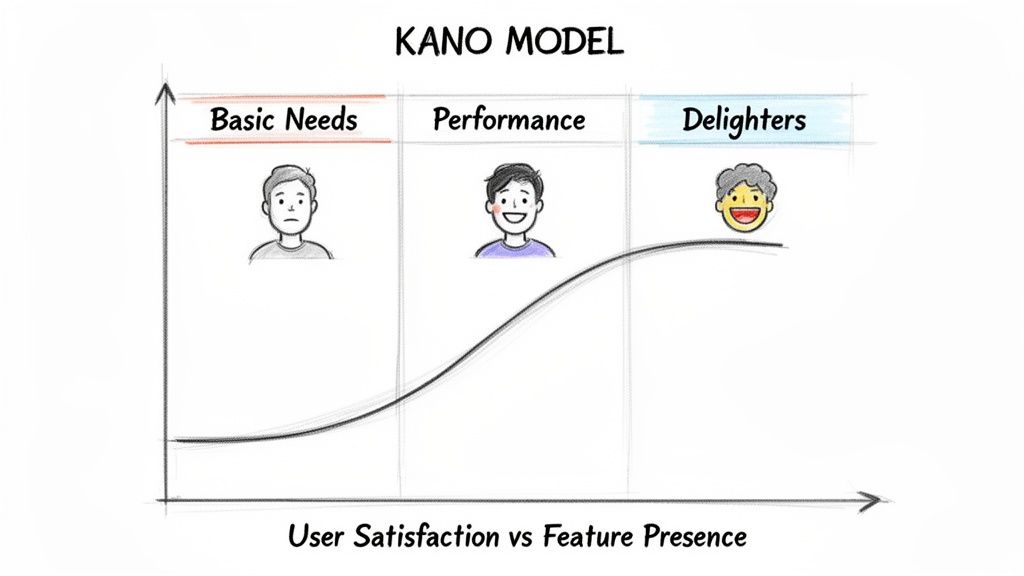
The Kano Model for User Delight
In your customers' eyes, not all features are created equal. The Kano Model is a brilliant way to understand this. It helps you categorize features based on how they impact user satisfaction, pushing you to think beyond a simple "it works" or "it's broken" mindset.
The model sorts features into three core buckets:
Basic Needs (Must-haves): These are the things users just expect. If you include them, no one throws a party. If you don't, your product feels incomplete or broken. Think of brakes on a car—you don't get excited that they're there, but you'd be furious if they weren't.
Performance Features: With these, more is always better. Faster internet speeds, higher camera resolution, more cloud storage—these are the features where satisfaction scales directly with performance. Users can easily tell you they want these to be better.
Delighters (Exciters): These are the secret weapons. The unexpected, innovative features that create a "wow" moment. Users don't even know to ask for them until they experience them. Remember the first time you tried noise-canceling headphones? That's a delighter. They create loyalty and a serious competitive edge.
Using the Kano Model helps you prioritize not just for basic satisfaction, but for loyalty and differentiation. It ensures you've covered the table stakes while still investing in the delightful surprises that make people fall in love with your product. A great way to get the insights for this is through well-structured interviews and surveys. To learn more, check out our guide on how to conduct usability testing and start gathering that crucial feedback.
Jobs-to-be-Done for Deeper Motivations
The Jobs-to-be-Done (JTBD) framework is all about a powerful shift in perspective. It argues that customers don't "buy" products; they "hire" them to get a job done. This simple concept moves the spotlight from your product's features to the user's underlying motivations.
People don't want a quarter-inch drill. They want a quarter-inch hole. The drill is just one solution they hire to get the job done.
This mindset forces you to ask much better questions. Instead of, "What features should we add to our project management tool?" you start asking, "What 'job' is a team lead trying to accomplish when they look for a new tool?" The real answer might be "gain confidence that my project is on track" or "spend less time chasing people for status updates."
By focusing on the "job," you uncover the actual problem and can innovate in ways that go far beyond just tacking on another feature. This kind of thinking is at the heart of successful product lifecycle management (PLM), a market set to grow from $36.57 billion in 2025 to an incredible $87.47 billion by 2035. Frameworks like JTBD help product managers understand customer needs so well that they can cut the risk of a failed launch by 25-35%. You can explore more about the global PLM market on Precedence Research.
Opportunity Solution Trees for Strategic Clarity
So, you understand what your users want to achieve. But how do you connect those big-picture goals to the actual work your team is doing day-to-day? Enter the Opportunity Solution Tree, a visual framework designed to do exactly that.
Created by product discovery coach Teresa Torres, this framework ensures every development effort is directly tied to a clear user need or business goal. It maps a logical path from a high-level outcome down to the specific experiments you'll run.
The tree has four main levels:
- Desired Outcome: This is your north star at the top—a clear, measurable business goal like, "Increase user retention by 15% in Q3."
- Opportunities: These are the user problems or desires that, if solved, would help you hit that outcome. For example, "Users feel overwhelmed by the initial setup process."
- Solutions: Here's where you brainstorm specific product ideas to tackle an opportunity, like "A guided onboarding wizard," "Setup templates," or "An interactive tutorial."
- Experiments: Before you commit to building a full solution, you run small, fast tests to see if the idea has legs. This could be something like, "Prototype and test a wizard with 5 new users."
This structure stops teams from jumping straight to solutions without thinking. It builds a clear, visible line from the company's strategic goals right down to the daily work of your product team, turning the roadmap into a true reflection of customer-centric opportunities.
Frameworks for Execution and Measurement
Once you’ve figured out what to build, the game changes. The conversation shifts from "Is this a good idea?" to "How do we build this well, and how will we know if it's working?" Simply pushing features out the door isn't a strategy for success. The real win comes from building efficiently and then rigorously measuring whether your work is actually making a difference for your users.
This is exactly where frameworks for execution and measurement come in. They aren't about prioritizing what's next; they're about creating a rhythm for development and a feedback loop for tracking performance. They provide the structure to turn a great plan into a product that not only ships but also succeeds and evolves.
Dual-Track Agile for Continuous Learning
Traditional Agile can sometimes feel like you're stuck on a feature assembly line. Teams get so locked into shipping the next ticket that they lose sight of the bigger picture. Dual-Track Agile breaks this cycle by splitting the team's work into two parallel streams that constantly inform each other.
Discovery Track: This is where you learn. A small group—usually a product manager, a designer, and a tech lead—is dedicated to validating ideas. They're out there talking to users, running experiments, and building rough prototypes to answer one critical question: "Are we building the right thing?"
Delivery Track: This is where you build. The full engineering team takes the validated concepts from the Discovery track and transforms them into high-quality, production-ready code. Their entire focus is on a different but equally important question: "Are we building the thing right?"
This diagram from ProdPad shows how the two tracks run at the same time.
The magic of this approach is that discovery work feeds directly into the delivery backlog. It ensures your engineers are always working on ideas that have already been de-risked and validated by real people, not just someone's gut feeling.
OKRs for Goal Alignment and Focus
If Dual-Track Agile organizes the how, then Objectives and Key Results (OKRs) define the why. This goal-setting framework was born at Intel and made famous by Google, and it's all about getting the entire company rowing in the same direction.
The structure is deceptively simple:
Objective: This is your big, ambitious, and qualitative goal. It should be inspiring and answer, "Where are we trying to go?" An example might be, "Launch a game-changing new onboarding experience."
Key Results: These are 2 to 5 specific, measurable results that prove you've reached your objective. They have to be numbers-driven and answer, "How will we know we got there?" For that objective, a key result could be, "Increase user activation rate from 40% to 60%."
OKRs are not a glorified to-do list. They're a system for defining and tracking outcomes. This forces a powerful mental shift from celebrating shipped features (outputs) to celebrating measurable impact (outcomes).
This system creates a clear line of sight from the highest-level company goals all the way down to what an individual team is working on. For product managers, it's an essential tool for connecting daily tasks to the bigger strategy, making it a critical part of any strong product roadmap development process.
The HEART Framework for Measuring User Experience
So, how do you actually measure the quality of the user experience? Hitting a business metric is great, but not if you made your users miserable in the process. That's a short-term win that leads to long-term failure. Google’s HEART framework gives you a balanced set of user-centric metrics to make sure your product is valuable, enjoyable, and effective.
HEART is an acronym for five distinct categories of measurement:
Happiness: How do users feel about your product? This is typically measured through surveys like Net Promoter Score (NPS) or customer satisfaction (CSAT).
Engagement: How deeply and frequently are people interacting with your product? Think metrics like sessions per user per week or the number of key features used daily.
Adoption: Are new users trying your product or a specific feature? You can track this with new sign-ups or the percentage of users who try a new feature within its first 7 days.
Retention: Are users coming back? This is the ultimate test of value, measured by churn rate and daily or monthly active users.
Task Success: Can people actually accomplish what they came to do, easily and effectively? This is measured with metrics like the time it takes to complete a task or the user error rate.
By keeping an eye on metrics across all five areas, you get a holistic view of your product's health. It stops you from falling into the trap of over-optimizing for one thing (like new sign-ups) at the expense of another (like long-term retention), paving the way for sustainable, user-centric growth.
Weaving User Feedback into Your Frameworks
Any product management framework, whether it's for prioritizing like RICE or for building like Dual-Track Agile, has a fundamental weakness: it’s only as good as the information you put into it. A perfectly designed framework running on vague assumptions is like a race car with dirty fuel—it’s going to sputter, stall, and never get you to the finish line.
The goal is to build a closed-loop system where the authentic voices of your customers directly inform your product roadmap. This isn't just about collecting feedback; it's about collecting the right feedback and using it intelligently.
This means we have to move beyond simplistic tactics like vote-counting. A "most requested features" list feels democratic, but it often hides the real story. Sure, 100 users might be asking for one feature, and only 10 for another. But what if those 10 users represent 80% of your monthly recurring revenue (MRR)? That changes everything.
From Generic Forms to In-the-Moment Insights
First things first: you need to capture high-quality, contextual feedback. The old ways, like generic "contact us" forms or once-a-year surveys, tend to yield low-quality data. They pull users out of their workflow and ask for input at the worst possible time. The most valuable insights come at the precise moment a user feels friction or has a brilliant idea.
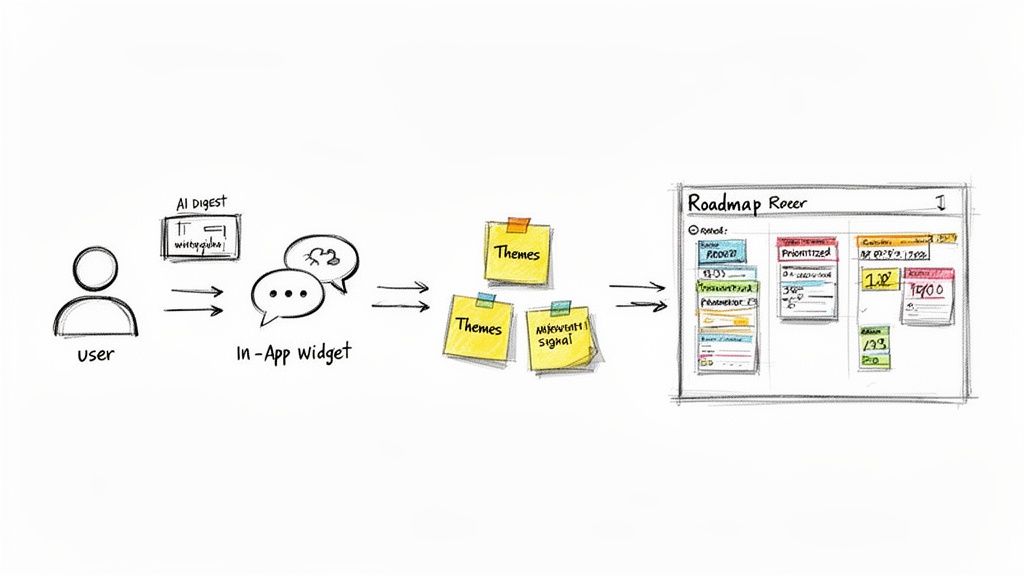
This is why so many product teams are shifting to in-app, conversational tools. A platform like FeatureBot, for instance, uses a lightweight widget that feels more like a chat than a clunky form. It prompts users to share their thoughts right then and there. Its AI can then ask smart follow-up questions to dig into the "why" behind a request, gathering the kind of rich context a static form could never dream of.
Making Your Frameworks Smarter with Quality Inputs
Once you have a steady stream of this contextual feedback flowing in, you can use it to give your existing product management frameworks a serious upgrade. The whole process becomes less about guesswork and more about data-driven decisions.
Here’s how you can plug high-quality feedback directly into your workflow:
- Spot Themes with Semantic Clustering: Instead of drowning in hundreds of individual comments, AI-powered tools can automatically group similar requests. This helps you see emerging themes and understand the true scope of a user problem—a goldmine for the Discovery track in a Dual-Track Agile setup.
- Tie Feedback to Revenue: This is where you connect feedback to real business impact. By linking feedback to customer data like MRR or ARR, you can calculate the "Impact" score in RICE or the "Value" in a Value vs. Effort matrix with far more accuracy. It’s the best way to ensure you’re working on things that keep your most valuable customers happy. You can dive deeper into the various ways to collect feedback from customers.
- Fuel Discovery with AI Digests: Imagine getting a weekly summary of new trends, urgent issues, and potential areas for exploration, all generated from your user feedback. These digests are the perfect fuel for your Discovery track, making sure your team is always investigating problems that are top-of-mind for your users right now.
This isn't just a trend; it's the new standard. By 2026, it's predicted that 76% of product leaders will increase their investment in AI to drive growth. This shift helps teams prioritize by revenue impact, not just vote counts, and can boost team capacity by up to 40%.
A continuous feedback loop doesn't just fill your backlog with ideas; it transforms your roadmap from a list of features into a strategic response to what your customers truly need and value.
Getting started is easier than you might think. Many modern feedback tools are built for lean teams and even offer a Free plan to get you up and running. This lets you prove the value of a structured feedback loop without a big upfront investment, laying the groundwork for a truly customer-centric product strategy.
So, How Do I Pick One and Get Started?
With dozens of product management frameworks out there, it’s easy to get analysis paralysis. I’ve seen teams spend weeks debating the "perfect" framework, only to end up right where they started.
The secret? Don't look for the single best framework—it doesn’t exist. Instead, find a simple one that solves your most painful problem right now. The goal is to make progress, not to achieve some kind of theoretical perfection.
Start by figuring out what’s causing the most headaches for your team. What’s the biggest bottleneck? Where does everything seem to grind to a halt? Your answer is your starting point.
Struggling with prioritization? If you’re drowning in a massive backlog and every meeting turns into a debate about what to build next, try a Value vs. Effort matrix. It’s a dead-simple, visual way to spot the quick wins and get everyone on the same page about what actually moves the needle.
Flying blind on user needs? If you have a gut feeling that your roadmap isn’t solving real problems, start with Jobs-to-be-Done (JTBD). Just a handful of JTBD-style interviews can completely change how you see your product, shifting the focus from shipping features to delivering real outcomes for your customers.
Can’t get everyone aligned? When engineering, marketing, and sales all have different ideas about what’s essential for the next release, the MoSCoW method is your best friend. It forces those critical conversations about what’s a must-have versus a nice-to-have, creating a shared understanding of the scope before a single line of code is written.
How to Actually Roll It Out
Okay, you’ve picked a framework. Now, resist the temptation to send a company-wide email announcing the “new way we do things.” A big-bang rollout is a recipe for disaster. A slower, more deliberate approach is almost always better.
Think of your first framework rollout as a product experiment. Start with a small pilot, measure what happens, get feedback from the team, and then tweak your approach. The framework is supposed to serve you, not the other way around.
A successful rollout usually looks something like this:
- Run a Pilot Project. Grab a single, well-defined project or a single team to try out the new framework. This contains the blast radius if things don’t go as planned and makes it much easier to see the actual impact.
- Show, Don't Just Tell. Use that pilot to gather proof. Did the framework help you make better decisions? Align the team faster? Clarify priorities? Success is the best way to convince skeptics and get buy-in for a wider launch.
- Expand Slowly. Once you’ve demonstrated the value and ironed out the initial wrinkles, you can start introducing the framework to other teams and projects.
The biggest mistake I see teams make is treating product management frameworks like a rigid set of rules. They aren't. They’re flexible guides designed to help you think better. The right framework should feel like it’s removing friction, not adding a bunch of bureaucratic red tape.
So, start simple. Focus on solving one problem well. And give your team the freedom to adapt the process as you learn and grow together.
Frequently Asked Questions
Let's tackle some of the most common questions product managers have when they start exploring frameworks.
Which Product Management Framework Is the Best?
This is the classic question, and the answer is always the same: there isn't one. Think of frameworks like tools in a toolbox. You wouldn't use a hammer to saw a board, right? The same logic applies here.
The right framework depends entirely on the problem you're trying to solve.
If your backlog is a chaotic mess and your team is paralyzed by indecision, a prioritization framework like RICE or a Value vs. Effort matrix will bring immediate clarity. But if you're worried you've lost touch with your customers, something like Jobs-to-be-Done (JTBD) is a much better fit to get you back on track.
How Many Frameworks Should a Team Use?
Most great product teams are actually using a mix of frameworks, even if they don't consciously label them. It’s perfectly normal to use one system for big-picture goals (OKRs), another for sorting out your backlog (RICE), and a third for structuring the actual development work (Dual-Track Agile).
The secret is to avoid getting bogged down in the process itself. Start simple. Pick one framework that solves your biggest headache right now, get good at it, and then layer in others when the need arises.
Trying to roll out five new frameworks all at once is a surefire way to create confusion, not clarity.
How Often Should We Revisit Our Frameworks?
Your frameworks should never be set in stone. They are tools, not commandments. As your team grows, your product matures, and the market shifts, your processes need to evolve too.
A good rule of thumb is to check in on your frameworks at least once or twice a year. You should also do a quick review whenever you hit a major company milestone or run into a significant new challenge.
If a framework starts feeling more like a bureaucratic hurdle than a helpful guide, that’s your cue. It's time to step back, reassess, and find an approach that better fits where you are today.
Ready to build a roadmap based on real user needs and revenue impact? FeatureBot helps you capture high-quality feedback, identify key themes with AI, and prioritize with confidence. You can get started in minutes. Learn more and sign up for our Free plan on featurebot.com.
Ready to capture better feedback?
FeatureBot helps you collect, organize, and prioritize user feedback with AI-powered conversations.
Get Started Free