10 Product Roadmap Best Practices for High-Growth Teams in 2026
A product roadmap is more than a list of features and deadlines; it's a strategic communication tool that aligns your entire organization on a shared vision. Yet, many teams struggle with roadmaps that are disconnected from customer needs and business goals. This disconnection often leads to wasted engineering cycles, features that miss the mark, and significant missed opportunities for growth. The difference between a high-impact roadmap and a document that gathers dust lies in the process behind it.
Effective roadmapping isn't about perfectly predicting the future. It's about creating a living system that translates customer insights into strategic action. This guide details 10 modern product roadmap best practices designed to move your team beyond simple timelines and feature backlogs. We will cover actionable techniques for turning raw customer feedback into a powerful, data-driven strategy.
You'll learn how to:
- Prioritize initiatives based on customer revenue impact, not just popular opinion.
- Systematically surface and validate customer problems before committing development resources.
- Integrate customer feedback directly into your existing workflows in tools like Slack and GitHub.
- Effectively communicate your roadmap decisions and close the loop with customers.
- Measure the true ROI of your roadmap by tracking feature adoption, churn reduction, and customer satisfaction.
These practices will help transform your roadmap from a static plan into a dynamic engine for sustainable growth. Let's explore how to build what truly matters.
1. Prioritize by Customer Revenue Impact, Not Vote Count
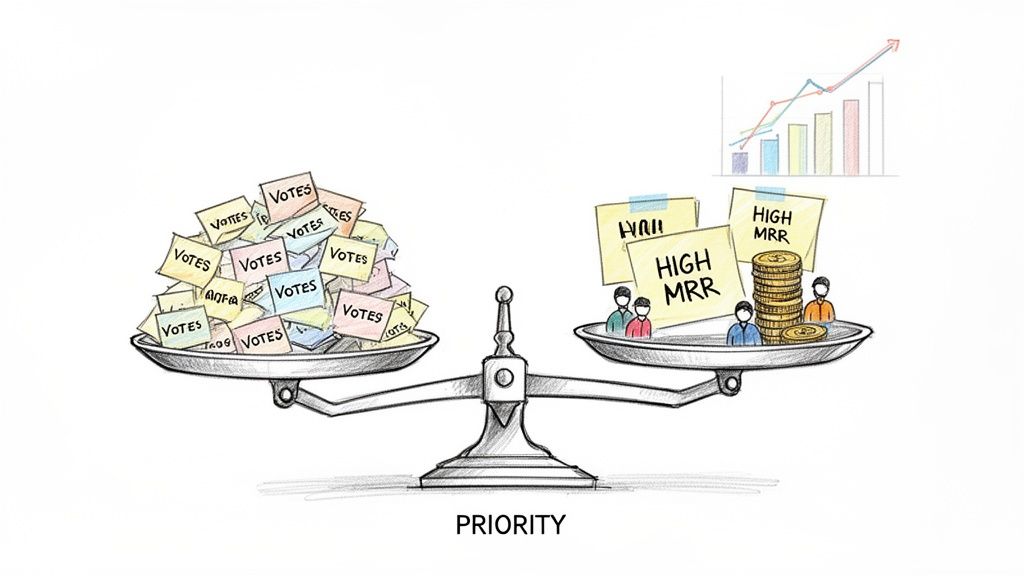
One of the most impactful product roadmap best practices is shifting prioritization from raw vote counts to revenue-weighted feedback. Instead of treating every feature request equally, this method assigns a higher value to suggestions from customers who contribute significantly to your Monthly Recurring Revenue (MRR). This ensures your development efforts are directly tied to retaining high-value accounts and driving sustainable business growth, rather than chasing popular but low-impact features.
This approach prevents your roadmap from being skewed by a high volume of requests from free-tier or low-revenue users, which may not align with your core business objectives or the needs of your most profitable customer segments.
Why Revenue-Weighted Prioritization Works
High-growth SaaS companies like Slack and HubSpot have successfully used this model. They recognized that features critical for securing and retaining large enterprise deals often differ from the requests of smaller customers. By weighting requests by the MRR of the accounts that submitted them, they could clearly identify which features would prevent churn in their most valuable cohorts and unlock new, larger market opportunities.
How to Implement Revenue-Weighted Prioritization
Getting started is more straightforward than it sounds. Here’s how to put this into practice:
- Integrate Your Data: Use tools that connect customer feedback directly to your revenue data. For example, a platform like FeatureBot can automatically link requests from Slack to customer MRR in Stripe or HubSpot, surfacing the total revenue associated with each feature idea without manual calculation.
- Combine Multiple Signals: Revenue impact is powerful, but it shouldn't be your only metric. Combine it with other factors like strategic alignment, churn risk, and the effort required for development to create a comprehensive prioritization score.
- Establish Clear Tiers: Create separate tracks for different customer segments. For instance, you might have one track for "must-have" enterprise features and another for "nice-to-have" improvements for your mid-market or Free plan users. This helps balance an immediate revenue focus with long-term user satisfaction.
- Communicate Transparently: Be clear about your prioritization criteria with customers. Explaining that you weigh requests based on multiple factors, including business impact, helps manage expectations and builds trust, even when you can't build every requested feature.
2. Cluster and Surface Feature Request Themes Automatically
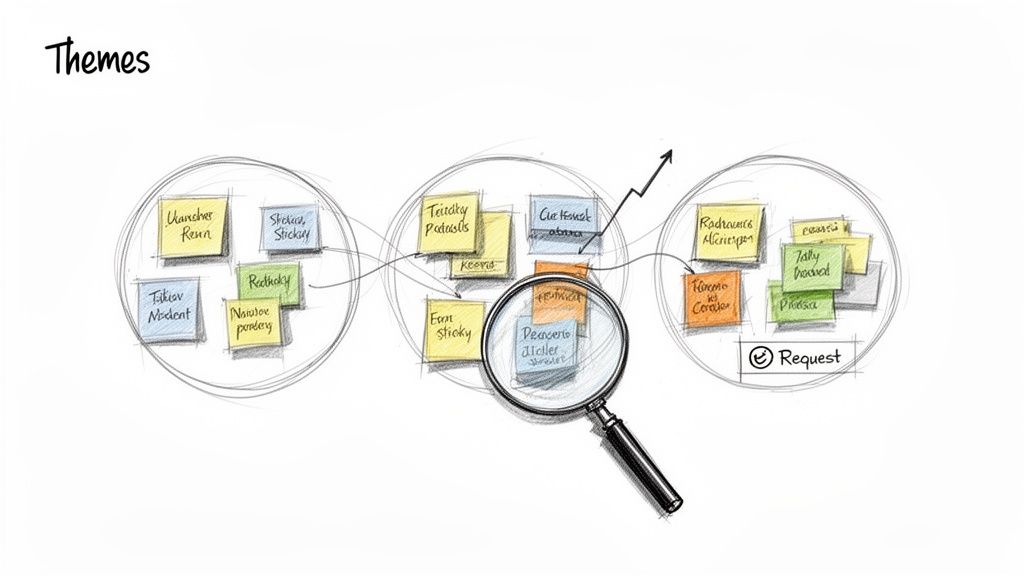
Manually sifting through hundreds of individual feature requests is inefficient and often leads to prioritizing symptoms rather than root problems. A superior product roadmap best practice is to use semantic matching and AI-powered clustering to automatically group similar requests. This approach consolidates duplicate suggestions and reveals hidden demand patterns, allowing you to prioritize broad themes instead of one-off requests.
This method transforms a noisy, high-volume feedback channel into a clear signal of what your customers truly need. By focusing on the "why" behind the requests, you can build more impactful solutions that solve problems for entire customer segments at once.
Why Automatic Clustering Works
Modern product teams at companies like Microsoft and Slack rely on this model to manage feedback at scale. For example, instead of seeing 50 separate requests like "make it faster," "slow loading," and "UI is lagging," an AI can cluster these into a single "Performance Improvements" theme. This gives product managers a clear, quantified view of the most pressing underlying issues without manual analysis.
How to Implement Automatic Clustering
Leveraging AI to find themes is easier than ever. Here’s how to get started:
- Adopt AI-Powered Tools: Use a platform that specializes in semantic clustering for customer feedback. For instance, FeatureBot uses AI to automatically group related ideas submitted via Slack, surfacing key themes from your internal and external conversations. You can get started with a Free plan to test the functionality.
- Prioritize Clusters, Not Tickets: Shift your planning process to focus on the themes, not the individual requests. A cluster representing a high-impact problem for 30 customers should be prioritized over a single, well-written request from one user.
- Review and Refine: In the early stages, manually review the AI-generated clusters to validate their accuracy and fine-tune the system. This helps build trust in the automated process and ensures the themes genuinely reflect user intent. Learn more about how to get started with customer feedback analysis.
- Track Theme Velocity: Monitor how quickly new feedback is added to existing clusters. A rapidly growing theme is a strong indicator of an emerging or urgent customer need that may require immediate attention on your roadmap.
3. Provide Full Customer Context for Every Request
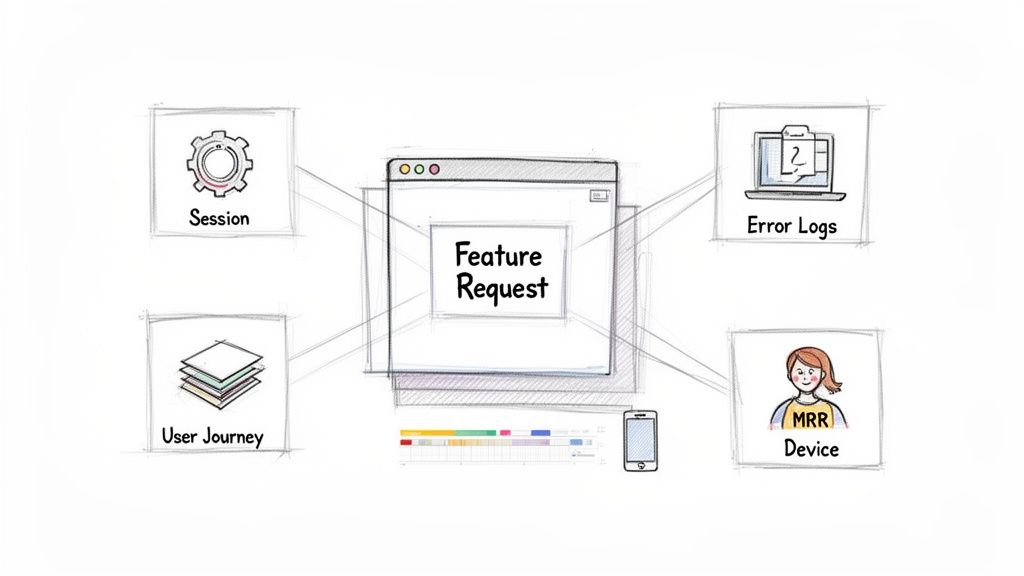
A major pitfall in roadmap planning is acting on vague feedback like "the dashboard is confusing." To make your product roadmap truly effective, you must treat every feature request not as a simple suggestion, but as an actionable data point. This means automatically capturing the full context surrounding each request, including the user's journey, session history, error logs, and the specific page they were on. This transforms ambiguous feedback into a clear starting point for root-cause analysis and precise solution design.
By attaching this rich, passive data, you avoid endless back-and-forth with customers and empower your team to understand the why behind the what. Instead of guessing, you see exactly what a user experienced leading up to their feedback.
Why Context-Rich Feedback Works
Companies that master user behavior analytics, like Mixpanel and Amplitude, build their entire value proposition on this principle. They understand that user actions tell a deeper story than words alone. Similarly, Intercom enriches support conversations by showing which in-app tours a user has seen. This context allows product teams to differentiate between a UX flaw, a missing feature, and a simple need for better user onboarding, ensuring they solve the correct problem.
How to Implement Context-Rich Feedback
Automatically collecting this information is key to making the process scalable and insightful. Here is how you can get started:
- Automate Data Collection: Implement tools that capture user context without requiring manual input. For instance, a tool like FeatureBot can be integrated to automatically attach session replays, user journey details, and technical logs to feedback submitted through platforms like Slack.
- Identify Cross-Customer Patterns: Use the aggregated context to spot trends. A dashboard view that shows "5 users got stuck at the same checkout step" is far more powerful than five isolated complaints. This helps you prioritize systemic issues over one-off problems.
- Empower Your Engineers: Share relevant technical context, like error logs and device information, directly with your engineering team. This data is invaluable for debugging and helps them build more robust and reliable solutions from the start.
- Segment User Feedback: Use behavioral context to distinguish between feedback from power users, new users, and churn-risk customers. This segmentation allows you to tailor your roadmap to address the unique needs and pain points of your most important user groups.
4. Close the Loop: Communicate Decisions and Outcomes to Customers
One of the most overlooked yet crucial product roadmap best practices is creating a systematic process to communicate feature request outcomes back to the customers who submitted them. This involves informing users whether their ideas are planned, in progress, or won't be built. Closing the feedback loop demonstrates that you value customer input, builds significant trust, and reduces duplicate requests for the same features.
This transparent communication prevents customers from feeling like their feedback goes into a black box. It ensures they feel heard and valued, which is critical for long-term loyalty and turning engaged users into advocates for your product.
Why Closing the Loop Builds Trust
Leading companies like Slack and GitHub have mastered this practice. When GitHub closes an issue or ships a feature, it automatically notifies everyone who participated in the discussion. This not only informs them that a problem is solved but also reinforces that their contribution led to a tangible product improvement, encouraging future engagement. Similarly, Linear’s transparent changelog keeps power users invested and aware of the product’s evolution.
How to Implement a Communication Loop
Building a process to close the loop with customers can be automated and scaled effectively. Here’s a practical guide:
- Automate Status Notifications: Use tools that automatically notify customers as the status of their request changes. For instance, a platform like FeatureBot can send automated updates via Slack or email when a feature moves from "Under Review" to "Planned" or "Shipped," keeping customers informed without manual effort.
- Share the 'Why' Behind Decisions: Don’t just state the outcome; explain the reasoning. If a feature is rejected, clarify why it doesn't align with the current strategy, has low demand, or presents technical challenges. This transparency helps manage expectations and educates users on your product vision.
- Tag Customers in "Shipped" Announcements: When you launch a new feature, publicly or privately tag the customers who requested it. This personal touch makes them feel directly responsible for the product's improvement and is a powerful way to re-engage them.
- Measure Your Closing Rate: Track the percentage of incoming feature requests that you either ship or formally close with a response. Aim to improve this rate over time, as it’s a key metric for customer-centric product development.
5. Segment Your Roadmap by Customer Tier and Use Case
A one-size-fits-all roadmap often fails to serve anyone well. One of the most strategic product roadmap best practices is to segment your roadmap by customer tier or use case. This approach involves creating distinct or weighted roadmaps for different customer segments, such as enterprise, mid-market, and SMBs, ensuring that the needs of your most strategic accounts are not overshadowed by the volume of requests from other groups.
This prevents the common pitfall of building features that appeal to a broad but low-revenue user base while neglecting the critical requirements of high-value segments. By tailoring your focus, you can directly support segment-specific goals like enterprise retention, mid-market expansion, or new user activation.
Why Segmented Roadmaps Drive Growth
Companies like HubSpot and Salesforce excel by recognizing that different customers have vastly different needs. HubSpot, for example, prioritizes features differently for its SMB and Enterprise hubs, understanding that a small business's marketing automation needs are worlds apart from a large corporation's. This segmentation allows them to build deep, valuable solutions for each target market, increasing retention and driving upmarket growth.
How to Implement a Segmented Roadmap Strategy
Adopting a segmented roadmap is a powerful way to align your product with specific business objectives. Here’s how to get started:
- Define Clear Segments: Use data to establish your segments. Criteria could include revenue (MRR/ARR), company size, industry, or product usage patterns. For example, you might create segments for "Power Users," "SMBs," and "Enterprise Accounts."
- Create a Core + Segment Structure: Maintain a "core" roadmap with features that benefit all users. Then, create smaller, segment-specific roadmaps or workstreams that address the unique needs of each group. This balances universal improvements with targeted value.
- Weight Feedback by Segment: Instead of just looking at total request volume, analyze which segments are asking for what. A tool like FeatureBot can tag feedback by customer segment, allowing you to filter requests and identify high-priority items for your key enterprise accounts versus your Free plan users.
- Track Segment-Specific KPIs: Monitor metrics like feature adoption, satisfaction scores, and churn rates for each segment individually. If churn is rising in your mid-market cohort, you can quickly review their specific feature requests and adjust roadmap priorities to address their pain points.
6. Base Roadmap Decisions on Weekly Digest Insights and Trend Analysis
One of the most effective product roadmap best practices is to establish a consistent ritual for reviewing aggregated customer feedback. Instead of reacting to the loudest, most recent customer complaint, this approach involves systematically analyzing weekly or bi-weekly trends, emerging themes, and AI-generated insights. This ensures your roadmap decisions are deliberate, proactive, and based on real data patterns spotted early.
This practice transforms feedback from a noisy, reactive stream into a strategic asset. By dedicating time to analyze trends, you can identify underlying customer problems and opportunities before they escalate, allowing you to build a more thoughtful and impactful product roadmap.
Why Weekly Trend Analysis Works
Companies that excel at data-informed product management, like Quora and Clearbit, understand that individual requests are just signals. The real insights lie in the patterns. By regularly reviewing digests that surface trending topics, product teams can connect the dots between seemingly unrelated pieces of feedback and prioritize features that address widespread, growing needs rather than isolated incidents.
How to Implement Weekly Feedback Analysis
Making this a routine part of your workflow is key to its success. Here’s a practical guide to getting started:
- Schedule a Dedicated Review: Block 15-30 minutes on your calendar each week for product and engineering leads to review a feedback digest. This dedicated time creates a non-negotiable habit.
- Use Automated Trend Reporting: Leverage tools designed to automate this process. For example, FeatureBot’s weekly digest automatically surfaces trends, top requests, and AI-powered recommendations directly in Slack, eliminating manual analysis. This is available even on their Free plan.
- Compare Trends Over Time: Don't just look at the current week in isolation. Compare it to the previous four weeks to identify accelerating or decelerating trends. A sudden spike in requests around a specific workflow is a strong signal to investigate.
- Treat AI as a Guide, Not a Dictator: Use AI-generated recommendations as a starting point for discussion, not a final decision. They are excellent for uncovering hidden patterns, but human strategic context is still essential.
- Measure Feedback ROI: Track which trends from your digests led to shipped features and measure their impact. This helps you refine your analysis process and prove the value of being customer-led.
7. Integrate Feedback Into Your Existing Workflow Tools
A common reason customer feedback fails to influence development is that it lives in a silo, separate from the tools where product and engineering teams spend their day. An essential product roadmap best practice is to embed this feedback directly into your existing workflows. Instead of forcing teams to log into another platform, bring customer context directly into Slack, Jira, Linear, or GitHub.
This approach ensures that customer needs are always visible and actionable. When an engineer sees a customer quote or the MRR attached to a bug report directly in their development tool, the problem becomes more tangible and its business impact is immediately clear. This direct line of sight from feedback to code reduces friction and keeps customer-centricity at the forefront of daily operations.
Why Workflow Integration Is a Game-Changer
Modern, fast-moving companies like Notion and Linear have built their product development engines around deep integrations. They understand that context switching is a major productivity killer. By piping customer feedback directly into the tools where decisions are made and work happens, they ensure that the voice of the customer is a natural part of the conversation, not an afterthought.
This model transforms feedback from a passive dataset into an active, real-time input for your development cycle.
How to Implement Feedback Integration
Integrating feedback doesn't require a complete overhaul of your current processes. You can start small and expand over time:
- Connect to Your Communication Hub: Start by integrating feedback into your team's primary communication tool, which is often Slack. Tools like FeatureBot are designed with an integrations-first philosophy, allowing you to capture, triage, and discuss feedback from Slack without ever leaving the app. You can set up dedicated channels for new ideas, bug reports, or feedback from high-value segments.
- Link Feedback to Development Tasks: Connect your feedback platform to your development management tool (e.g., Jira, Linear, GitHub). This allows product managers to link multiple customer requests directly to a single development ticket or epic. Engineers get immediate access to the original customer context, which is crucial for building the right solution.
- Create Role-Specific Views: Configure your integrations to provide tailored information. For instance, an engineer in GitHub might see linked customer bug reports, while a product manager in a dashboard sees a high-level view of feature requests prioritized by MRR.
- Use Webhooks for Automation: Leverage webhooks to trigger automated actions. For example, you can create a rule that automatically sends a high-priority Slack notification to the product team whenever a customer with an MRR over a certain threshold submits a request.
8. Validate Demand Before Building: Run Small Experiments and Validate Hypotheses
One of the most critical product roadmap best practices is to confirm demand before a single line of code is written. Instead of building features based on assumptions, this approach uses lightweight experiments to validate that a real customer problem exists and that your proposed solution effectively solves it. This prevents wasted engineering cycles on features that ultimately fail to gain traction.
This lean methodology de-risks your roadmap by treating each potential feature as a hypothesis to be tested. By gathering evidence early, you ensure your development efforts are focused on delivering measurable value, protecting your most valuable resource: engineering time.
Why Pre-Validation Works
This practice, popularized by the Lean Startup movement, is a cornerstone of how companies like Amazon and Figma operate. Figma, for instance, frequently uses feature-flagged betas with a small cohort of power users to gather qualitative feedback and measure initial adoption before a general release. This allows them to iterate on the solution with real-world input, ensuring the final feature is polished, useful, and directly addresses user needs.
How to Implement Pre-Validation
You can integrate validation experiments directly into your product development lifecycle without adding significant overhead. Here’s a practical approach:
- Create a Validation Checklist: Before any feature moves to "In Progress," ensure it passes a lightweight validation checklist. This could include identifying the core problem, defining the success metric, and outlining the validation method (e.g., survey, prototype, interview).
- Interview High-Value Requesters: Use customer feedback tools to identify the top 3-5 customers who requested a feature. Set up brief interviews to dig deeper into their pain points and ask targeted questions like, "If we built X, would it solve your problem? How?" This tests both the problem and the proposed solution.
- Run Targeted Surveys: For features with broad interest, send a simple survey to everyone who requested it. Ask direct questions like, "On a scale of 1-5, how important is this feature to you?" or "Would you be willing to join a beta program to test this?" This quantifies demand.
- Establish Demand Thresholds: Define clear, simple rules for what constitutes sufficient demand. For example, a feature might require "20+ requests OR one customer with >$10k ARR" before it is considered for the roadmap. This creates an objective, data-informed gateway for new initiatives.
- Track Post-Launch Adoption: Compare the adoption rates of features that went through a validation process versus those that did not. This data will build internal confidence in the methodology and reinforce its importance across the entire product organization.
9. Measure Roadmap ROI: Track Feature Adoption, Churn Reduction, and NPS Impact
One of the most critical product roadmap best practices is to close the loop by measuring the actual business impact of the features you ship. Instead of just moving a ticket to "Done," this approach requires you to track metrics like feature adoption, churn reduction, and Net Promoter Score (NPS) changes. This validates whether a feature truly solved the customer's problem and delivered a tangible return on investment (ROI).
This practice ensures your roadmap isn't just a list of outputs but a strategic driver of outcomes. By connecting development efforts to key business results, you can learn from every release, refine your prioritization model, and build a data-informed product culture that consistently delivers value.
Why Measuring Roadmap ROI Works
Data-driven product leaders at companies like Airbnb and Netflix pioneered this approach to move beyond intuition. For example, Notion can directly correlate the launch of new sharing features to subsequent workspace growth, proving the ROI of that development cycle. Similarly, Figma tracks design system adoption rates post-launch to confirm that new components are actually making designers more efficient.
This quantitative feedback loop provides undeniable proof of what works and what doesn't, enabling teams to double down on high-impact initiatives and avoid repeating costly mistakes.
How to Implement Roadmap ROI Measurement
Connecting features to outcomes is a systematic process. Here’s how you can get started:
- Establish a Post-Launch Template: For every major feature, create a brief analysis document that answers: Did this solve the intended problem? Who is using it? What was the impact on our key metrics?
- Track Adoption Within 30 Days: The initial month after launch is a peak window for adoption. Use product analytics tools like Amplitude or Mixpanel to monitor usage rates and identify if the customers who requested the feature are actually using it, as this is your strongest signal of success.
- Analyze Churn and NPS Data: Compare the churn rate for users who adopt a new feature against those who don't. You can also send targeted NPS surveys specifically about the new functionality to gather qualitative feedback. Learn more about how to connect features to churn reduction.
- Share Results and Learn: Make the findings transparent across the entire company. Celebrate wins when a feature moves the needle and, more importantly, conduct retrospectives on misses to extract valuable lessons for the next planning cycle.
10. Create a Conversational Feedback Collection Process (Instead of Static Forms)
One of the most effective product roadmap best practices is to move beyond static, multi-page surveys and adopt conversational feedback collection. Instead of asking customers to fill out long forms, this approach uses lightweight, in-the-moment prompts that feel more like a chat. This method gathers richer context by asking smart, automated follow-up questions based on a user's initial input, reducing friction and increasing response quality.
This conversational process captures feedback at the point of experience, providing your team with nuanced insights that traditional forms often miss. It turns feedback collection from a cumbersome task into a natural, helpful interaction, ensuring the voice of the customer is both clearer and more authentic.
Why Conversational Feedback Works
Companies like Intercom and Typeform have proven that conversational interfaces drastically improve user engagement and data quality. Instead of facing a wall of questions, users are guided through a simple, one-question-at-a-time flow. This lowers the cognitive load and encourages more thoughtful responses, giving product teams deeper insights into user pain points and desires.
How to Implement Conversational Feedback
Integrating a conversational feedback loop into your product is a powerful way to enhance your roadmap inputs. Here’s how to get started:
- Deploy In-Context Widgets: Use tools designed for conversational capture. For example, a platform like FeatureBot allows you to place a simple, one-line prompt directly in your app. Its AI can then ask relevant, context-specific follow-up questions based on the user's initial comment, their current page, or even a recent error they encountered.
- Time Your Prompts Intelligently: Trigger feedback requests at key moments of friction or success. Ask for input immediately after a user abandons a task, encounters an error, or successfully uses a new feature. This ensures the feedback is relevant and top-of-mind.
- Keep the Initial Ask Simple: Start with a single, direct question like, "How can we improve this page?" or "Got a minute to share feedback?" The goal is to make starting the conversation as effortless as possible, with no multi-step forms to deter users.
- Acknowledge and Close the Loop: Immediately confirm that feedback has been received with a simple "Thanks, this helps us improve!" This small step shows customers you're listening and values their contribution, encouraging future engagement. To dive deeper, you can also explore how to collect customer feedback effectively using these modern methods.
Product Roadmap Best Practices — 10-Point Comparison
| Approach | 🔄 Implementation Complexity | ⚡ Resource Requirements | 📊 Expected Outcomes | 💡 Ideal Use Cases | ⭐ Key Advantages |
|---|---|---|---|---|---|
| Prioritize by Customer Revenue Impact, Not Vote Count | Medium — CRM & MRR mapping, weighting rules | Moderate — revenue data, CRM integration, analytics | Focuses roadmap on revenue drivers; reduces churn among high-value accounts | B2B SaaS with uneven customer value | Aligns product to revenue; improves ROI |
| Cluster and Surface Feature Request Themes Automatically | Medium–High — NLP models and tuning | High — ML infra, labeling, continuous tuning | Faster insight discovery; fewer duplicates; earlier theme detection | High-volume feedback environments scaling PM teams | Reveals hidden demand; saves analysis time |
| Provide Full Customer Context for Every Request | High — session, logs, journey capture and linking | High — instrumentation, storage, privacy controls | More actionable tickets; fewer clarification loops; better root-cause analysis | Complex workflows, bug triage, engineering handoffs | Enables accurate fixes and faster resolution |
| Close the Loop: Communicate Decisions and Outcomes to Customers | Low–Medium — status workflows, templates, automation | Low–Moderate — notifications, changelog tooling, cadence | Increased trust, fewer duplicate requests, improved NPS | Customer-facing products needing transparency | Builds trust and engagement; reduces churn |
| Segment Your Roadmap by Customer Tier and Use Case | Medium — segmentation logic and multiple roadmap views | Moderate — customer data, roadmapping tools, coordination | Targeted delivery; improved upsell and satisfaction per segment | Products serving enterprise, mid-market, SMB or multiple use cases | Focuses engineering on strategic segments; reduces feature creep |
| Base Roadmap Decisions on Weekly Digest Insights and Trend Analysis | Low–Medium — automated reports, alerts, and cadence | Low — analytics, AI summaries, regular review meetings | Regular informed decisions; early trend spotting; less reactivity | Teams needing structured decision rhythm and trend monitoring | Creates disciplined, proactive prioritization |
| Integrate Feedback Into Your Existing Workflow Tools | Low–Medium — multiple connectors and mapping rules | Moderate — integration maintenance, mapping, SLAs | Higher adoption; faster decisions; fewer tool switches | Teams using Slack/Jira/GitHub/Linear as core tools | Reduces context switching; increases developer visibility |
| Validate Demand Before Building: Run Small Experiments and Validate Hypotheses | Low–Medium — experiment infrastructure and tracking | Moderate — landing pages, betas, analytics, user interviews | Lower build waste; higher adoption; validated solution fit | Unproven features or high-effort initiatives | Prevents wasted development; builds early advocates |
| Measure Roadmap ROI: Track Feature Adoption, Churn Reduction, and NPS Impact | High — attribution, instrumentation, cohort analysis | High — analytics stack, long-term monitoring, reporting | Clear business impact metrics; improves future prioritization | Mature products needing exec/board-level evidence | Links features to business outcomes; accountability for impact |
| Create a Conversational Feedback Collection Process (Instead of Static Forms) | Medium — conversational UI with NLP and follow-ups | Moderate — AI/NLP, UX, contextual capture | Higher feedback volume and quality; better completion rates | Products aiming to increase response rates with low friction | Lower friction collection; richer, contextual responses |
Turn Your Roadmap into a Growth Engine
Navigating the complex world of product development requires more than just a list of features; it demands a strategic, living document that serves as the North Star for your entire organization. We've explored ten essential product roadmap best practices, moving beyond generic advice to provide a framework for building a roadmap that is not just a plan, but a powerful engine for sustainable growth. The journey from a reactive backlog to a proactive, outcome-driven roadmap is transformative, and it begins by fundamentally changing how you listen to, interpret, and act on customer feedback.
The core theme connecting these practices is the shift from assumption to evidence. Instead of relying on vote counts or the loudest voice in the room, you now have a blueprint to prioritize based on tangible revenue impact, validate ideas with small experiments, and measure success through concrete metrics like feature adoption and churn reduction. This is the essence of modern, effective product management.
Key Takeaways for Immediate Impact
To distill these concepts into actionable priorities, focus on these critical shifts in your process:
- From Guesswork to Data-Driven Decisions: Stop treating your roadmap as a wish list. By implementing practices like prioritizing by customer revenue and segmenting by user tier, you ensure every development cycle is optimized for maximum business impact. This isn't about ignoring smaller customers; it's about making conscious, strategic trade-offs based on clear data.
- From Manual Chaos to Automated Insight: The manual effort of sifting through feedback is a major bottleneck. Adopting automated theme clustering and integrating feedback directly into tools like Slack and GitHub frees up your team's most valuable resource: time. This allows you to spend less energy on data entry and more on high-level strategic thinking and customer conversations.
- From a Static Document to a Dynamic Conversation: A roadmap should not be a one-way broadcast. Best practices like closing the feedback loop and using conversational collection methods transform it into an ongoing dialogue with your users. This builds customer loyalty and provides a continuous stream of validation, ensuring you're always building what the market truly needs.
Your Action Plan: Putting Best Practices into Motion
Mastering these product roadmap best practices is not an overnight change but an iterative evolution. Start by choosing one or two areas to focus on. Perhaps you begin by implementing a system to tie every feature request to its customer context and revenue. Or maybe you start by setting up a weekly digest to analyze feedback trends.
The goal is to create a repeatable, scalable system where customer signals are captured, analyzed, and prioritized with ruthless efficiency. This disciplined approach eliminates the noise and surfaces the high-impact opportunities that will move the needle for your business. By connecting your roadmap directly to customer needs and business outcomes, you de-risk your development efforts and build a powerful competitive advantage. The result is a product that not only solves problems but also creates delighted, loyal customers who feel heard and valued, ultimately driving retention and expansion.
Ready to stop guessing and start building a revenue-driven roadmap? FeatureBot automates the entire feedback-to-roadmap workflow, from conversational collection in Slack to AI-powered theme analysis and revenue-weighted prioritization. Get started with our Free plan at FeatureBot and turn your customer feedback into your most valuable growth asset.
Ready to capture better feedback?
FeatureBot helps you collect, organize, and prioritize user feedback with AI-powered conversations.
Get Started Free