Roadmap for product development: Turn Feedback into Action and Drive Results
A product roadmap is more than a list of features. It should be your team's single source of truth—a living document that visualizes your product’s direction, priorities, and the strategic goals you're chasing. When done right, it connects that high-level vision to the actual work your team is doing every day. A great roadmap ensures everyone, from engineering to the C-suite, is rowing in the same direction.
Why Most Product Roadmaps Miss the Mark
Let’s be honest—a lot of product roadmaps end up as outdated wish lists, collecting digital dust in a forgotten folder. They start with the best of intentions but quickly become disconnected from what’s actually happening. This usually happens for a few common, painful reasons.
Too often, teams fall into the trap of just chasing competitor features. This reactive cycle means you're always a step behind, solving someone else's customer problems instead of your own. Other times, the roadmap becomes a dumping ground for every shiny new idea that pops up, completely lacking a strategic filter. You end up with a plan that's a mile wide and an inch deep.
The Real Cost of a Broken Roadmap
The fallout from a weak product roadmap is both severe and expensive. Engineering hours get poured into projects that don't actually move the needle, which is a fast track to team frustration and burnout. When there's no clear "why" behind the work, developers and designers become disengaged, left wondering what the point of their daily tasks even is.
Ultimately, this disconnect between the team’s effort and the company's goals leads to failed launches that completely miss what customers were expecting. To get this right, you first have to understand the foundational stages of product development and where roadmapping fits in.
A roadmap isn’t just about planning what to build; it’s a communication tool that creates alignment. When it fails, communication breaks down, and the entire product strategy follows.
The data paints a pretty sobering picture here. A shocking 13% of companies maintain detailed product roadmaps beyond a single year. Without a long-term vision, development just becomes reactive firefighting. The consequences are huge: 23% of product investments fail because of unclear strategies, and startups face a brutal 90% new product failure rate, often because their plans ignored what real users were saying.
To avoid becoming another statistic, we need to move past the common pitfalls that plague traditional roadmapping. It’s about shifting our mindset from a rigid plan to a flexible, customer-focused strategy.
Below is a quick comparison of where things often go wrong versus where they need to be.
Common Roadmap Pitfalls vs Customer-Centric Solutions
| Common Pitfall | Customer-Centric Solution |
|---|---|
| Feature-Driven Wish List | Outcome-Oriented Goals |
| The roadmap is a long list of features with no clear connection to business objectives. | The roadmap focuses on desired outcomes (e.g., "Increase user retention by 15%") and the initiatives that will achieve them. |
| Top-Down Mandates | Collaborative Input |
| The plan is dictated by executives with little input from engineering, sales, or customer success. | The roadmap is built with cross-functional input, incorporating insights from all teams that interact with customers. |
| Rigid & Outdated | Dynamic & Adaptive |
| The roadmap is set in stone once a year and quickly becomes irrelevant as the market changes. | The roadmap is treated as a living document, regularly updated based on new data, user feedback, and shifting priorities. |
| Internal Assumptions | Validated Customer Needs |
| Priorities are based on what the team thinks users want. | Priorities are driven by qualitative feedback, quantitative data, and direct customer validation. |
By recognizing these common traps, you can start building a roadmap that actually serves its purpose: guiding your team to build products that customers love and that drive real business growth.
For a deeper dive into building a roadmap that works, check out our guide on product roadmap best practices.
Building Your Foundation with Smart Customer Feedback
A powerful roadmap isn’t built on internal hunches; it’s built on genuine user insights. To create a truly impactful roadmap for product development, you need a system that does more than just log feature requests. It has to uncover the real problems your users are trying to solve. The whole point is to turn a chaotic inbox of ideas into an organized, context-rich database that actually fuels your strategy.
So many teams get stuck because their feedback channels are just too passive. A simple "contact us" form or a cluttered email inbox will rarely give you the full picture. This is where embedding lightweight, conversational feedback channels right inside your product can be a game-changer. Imagine a user suggesting something, and instead of just logging it, an AI-powered tool asks smart follow-up questions to dig into the "why" behind their idea.
That simple interaction transforms a basic suggestion into a deep insight. It’s the difference between hearing, "I want a CSV export," and truly understanding, "I need to share performance data with my manager who doesn't have an account." That kind of context is pure gold for your development team.
From Noise to Actionable Signals
Once you start collecting rich feedback, the next hurdle is managing the sheer volume of it. It’s easy to get buried under duplicate requests and a mountain of seemingly random comments. Modern feedback tools get around this by automatically grouping similar suggestions using semantic analysis. This cuts straight through the noise to pinpoint core user needs and emerging trends.
For instance, this automated clustering can show a product manager that 20 different requests for various reporting tweaks are all pointing to the same high-value problem: users can't easily prove the tool's ROI to their bosses.
The infographic below shows the dangerous domino effect that happens when roadmaps are built on a weak strategic foundation—often because they're disconnected from what users are actually saying.
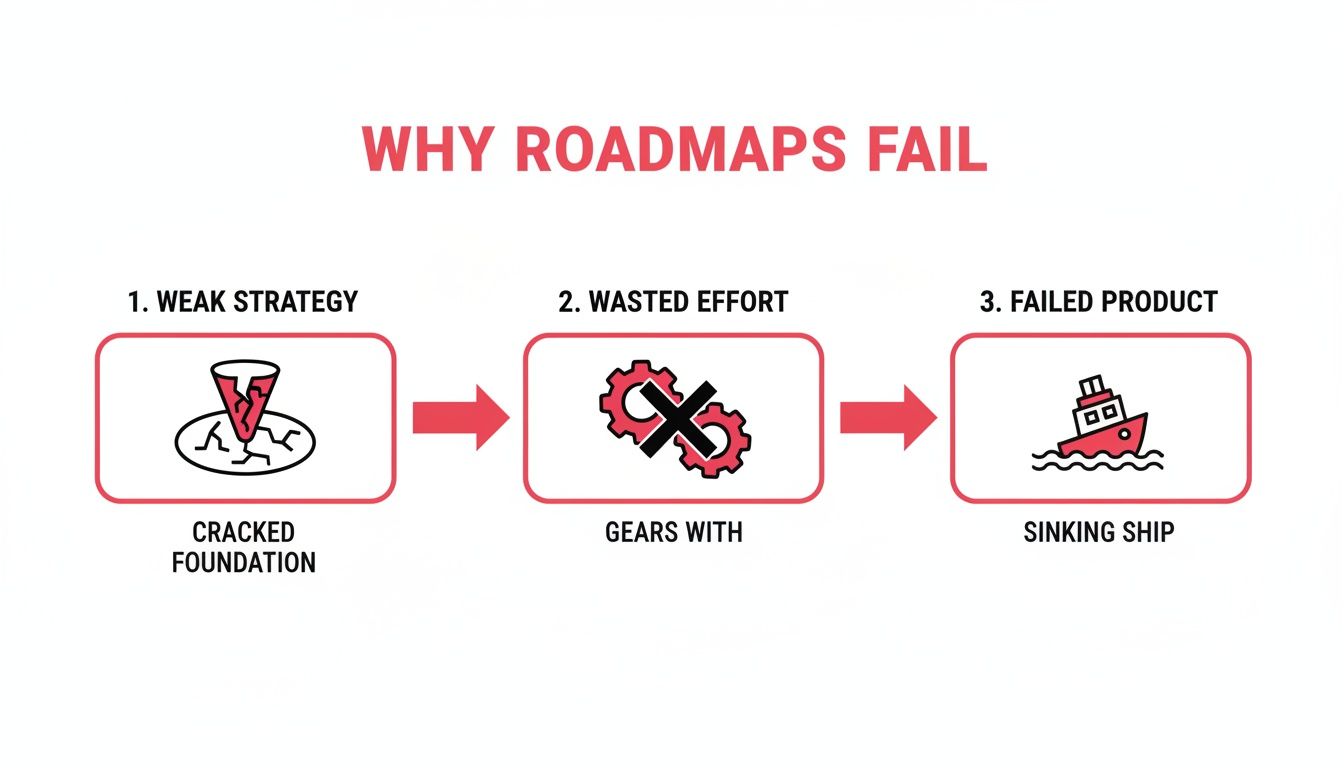
This visual really drives home how a poor feedback loop leads directly to wasted engineering cycles and, ultimately, a product that misses the mark. Without a clear signal from your users, even the most brilliant teams can end up building features nobody asked for.
The Power of Full Context
Capturing what users say is important, but understanding their context is absolutely critical. To give your development team the whole story, every piece of feedback should come loaded with crucial data points.
- User Segmentation: Is this from a free user or a high-value enterprise client? Knowing who is asking is key to prioritizing their request.
- Behavioral Data: Where was the user in your app when they had this idea? What did they do right before? This helps reproduce issues and map out user journeys.
- Technical Details: Automatically capturing session info, browser type, and even console errors helps engineers squash bugs that much faster.
A feature request without context is just an opinion. A feature request with user data, session replays, and revenue impact is a business case.
This level of detail turns a simple suggestion into a comprehensive bug report or a data-backed feature proposal. To get even more out of this feedback, you can use tools like sentiment analysis to dig deeper into what your customers really need and how they feel about your product.
Building a System, Not Just a Process
Ultimately, the goal is to create an integrated system where user feedback flows seamlessly right into your product development lifecycle. Tools like FeatureBot are designed to bridge that exact gap, turning unstructured comments into clear, actionable items. You can start organizing your user insights with a Free plan and scale up from there.
When you implement a smart feedback system, you stop guessing what users want and start co-creating your product with them. If you’re looking to get more formal with this, it helps to understand the broader concept of Voice of the Customer. You can learn more about how to capture and analyze the Voice of the Customer in our detailed guide. This kind of structured approach ensures your roadmap for product development is always aligned with what matters most—the people using your product every single day.
How to Prioritize Features with Confidence
So, you've got a steady stream of rich customer feedback pouring in. Great! Now for the hard part: deciding what to build next.
Prioritization is where your grand strategic vision smacks into the harsh reality of limited engineering time. If you’re just relying on gut feelings or counting upvotes, you're setting yourself up to build a popular product for the wrong people.
To create a roadmap for product development that actually fuels growth, you need to be objective. This means leaning on data-driven frameworks that force you to evaluate requests based on their real business impact, not just their popularity. It's how you make those tough trade-offs with confidence.
Moving Beyond Upvotes with the RICE Framework
A fantastic starting point for getting objective is the RICE scoring model. It’s a simple but powerful formula that helps you quantify the potential value of any feature idea by looking at four key factors.
- Reach: How many people will this actually affect in a given timeframe? Think specific numbers, like 500 customers per month.
- Impact: How much will this really matter to an individual user? I like to use a simple scale: 3 for massive impact, 2 for high, 1 for medium, and 0.5 for low.
- Confidence: Let's be honest, our estimates can be shaky. How sure are you about your Reach and Impact numbers? Express it as a percentage: 100% for high confidence, 80% for medium, and 50% for when you're taking a bit of a guess.
- Effort: How much time will this soak up from your product, design, and engineering teams? "Person-months" is a good unit to use here.
The formula is dead simple: (Reach x Impact x Confidence) / Effort.
Running your ideas through this calculation gives you a single, comparable score for everything on your list. It immediately highlights which initiatives deliver the most bang for your buck.
The Real-World Scenario: Free Users vs. Enterprise Clients
Let’s walk through a classic dilemma I've seen play out dozens of times at SaaS companies.
- Feature A: A minor UI tweak for the main dashboard. It's been requested by 500 users on your Free plan. The work is minimal—maybe one person-week.
- Feature B: A complex integration with a big-name enterprise CRM. Only five enterprise clients have asked for it, but together they represent $250,000 in ARR. The effort is significant—at least three person-months.
If you're just counting votes, Feature A is the obvious winner. But is that tweak really going to move the needle for your business? This is where a more financially-minded model is a game-changer.
Prioritizing for Revenue with MRR-Weighted Scoring
While RICE is great for getting a baseline, you can sharpen your focus by tying prioritization directly to revenue. MRR-weighted scoring is a pragmatic approach that gives more weight to feedback from the customers who pay you the most.
The logic is simple: the voice of a customer paying you $10,000 a month should probably be a bit louder than the voice of a user on a Free plan. Instead of just tallying votes, you sum the total Monthly Recurring Revenue (MRR) tied to each feature request.
Let’s look at our scenario again, this time with an MRR-weighted lens.
| Feature Request | Number of Requests | Associated MRR |
|---|---|---|
| Feature A (UI Tweak) | 500 | $0 (from free users) |
| Feature B (CRM Integration) | 5 | $20,833 (from enterprise clients) |
Suddenly, the choice is crystal clear.
Feature A might be more popular, but Feature B delivers enormous value to the customers who are literally keeping the lights on and funding future growth. This kind of data-driven approach strips the emotion and internal politics out of the decision.
By weighting feedback by revenue, you ensure your roadmap is optimized for business growth, not just user satisfaction. It transforms your roadmap from a wish list into a strategic financial plan.
This method also makes it much easier to justify your decisions to stakeholders. Saying, "We are prioritizing this integration because it directly supports over $20,000 in MRR," is a whole lot more compelling than, "Lots of people asked for this."
If you want to go deeper on this and other data-backed strategies, you can learn more about different methods of prioritization in our comprehensive article.
Using frameworks like RICE and MRR-weighted scoring gives you the clarity you need to build a roadmap that doesn't just look good, but actually delivers measurable results. It’s about making sure every minute your team spends is a smart investment in the company’s future.
Designing a Roadmap Everyone Can Understand
Once you've wrestled your priorities into a logical order, the next hurdle is turning that list into something visual. A truly effective roadmap for product development isn't just a fancy spreadsheet; it’s a story. Its job is to paint a clear, compelling picture of where the product is going and, just as importantly, why you're heading in that direction.
The single biggest mistake I see teams make is creating one roadmap and expecting it to work for everyone. That’s a recipe for confusion. An executive who needs a 30,000-foot view of quarterly goals requires a completely different visual than an engineer who needs to see dependencies for the next sprint. The trick is to tailor the format to who you're talking to.
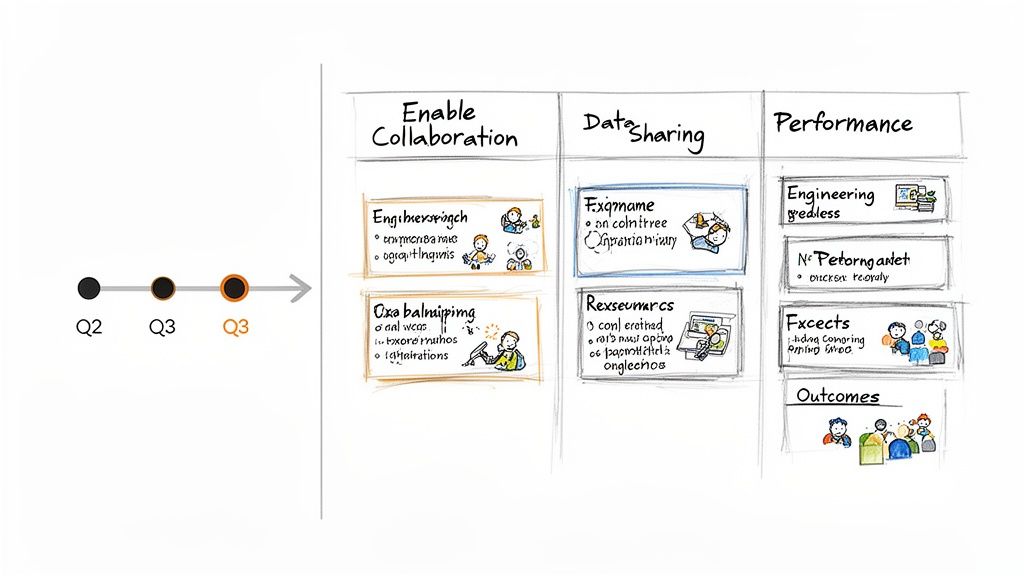
This isn't just a small detail—it's critical. Considering that 40% of product managers name stakeholders as their roadmap's main audience, speaking the right visual language is non-negotiable for getting buy-in and keeping everyone on the same page.
Choosing the Right Roadmap Format for Your Audience
Not all roadmaps are built the same way. Some are designed for high-level strategic chats, while others are all about tactical execution. Knowing which one to pull up for a meeting saves you from a world of hurt and ensures people get the info they need without being bogged down by details that don't matter to them.
Picking the right visualization is key to communicating your product strategy effectively. Each format serves a different purpose and speaks to a different audience.
Roadmap Formats for Different Audiences
| Roadmap Type | Best For (Audience) | Key Focus | Example Tool/Method |
|---|---|---|---|
| Timeline-Based | Executives, Board, Sales, Marketing | When major features/milestones will be delivered. Shows sequencing and sets broad expectations. | Gantt Chart, Quarterly Swimlanes (e.g., in Aha! or Jira) |
| Theme-Based | Development Teams, Internal Stakeholders | Why work is being done. Groups initiatives under strategic goals like "Improve User Onboarding." | Kanban-style board, Mind map |
| Now-Next-Later | Entire Company, Customers (public-facing) | Priority without strict deadlines. Simple buckets for what's in progress, up next, and in the backlog. | Trello Board, Productboard |
Ultimately, the goal is to make your communication intentional. A well-chosen format prevents misinterpretations and helps every stakeholder feel confident about the product's direction.
A great roadmap frames initiatives as customer solutions, not just feature lists. Instead of 'Add CSV Export,' it should say, 'Enable users to share data with their teams.' This small change shifts the entire focus from output to outcome.
This customer-centric framing is everything. It’s a constant reminder that you’re not just shipping code; you’re solving real problems for the people who pay the bills. That mindset is what separates good products from products people can't live without.
Practical Tips for a Clear and Dynamic Roadmap
A roadmap that actually gets used needs to be more than just pretty—it has to be a living, breathing document.
For starters, get your engineering leads involved early to set realistic timelines. They know the codebase and can give you the ground-truth estimates you need to avoid overpromising. It’s also crucial to highlight dependencies. If Project A is a blocker for Project B, that relationship has to be crystal clear on the roadmap to prevent nasty surprises and bottlenecks down the road.
Visual cues are your best friend here. Don't be afraid to use simple tools to make information jump off the page:
- Color-code initiatives to link them back to company-wide strategic goals.
- Use status tags (e.g., On-Track, At-Risk, Blocked) so anyone can get a pulse check in five seconds.
Your roadmap should evolve from a static plan into a dynamic guide that keeps the entire organization aligned. Tying it directly to your feedback loop is the final piece of the puzzle. Tools like FeatureBot help you channel raw user insights directly into your planning process. You can even get started with a Free plan to see how it works. By connecting real user needs to your roadmap, you ensure it’s not just a document—it’s the true heartbeat of your product strategy.
Keeping Your Roadmap Alive and Relevant
So you’ve built a powerful roadmap for product development. That's a huge accomplishment, but the work isn't over. In fact, it’s just beginning.
A great roadmap isn’t a static document you frame and hang on the wall. It’s a living guide that has to breathe and adapt to new information, shifting markets, and, most importantly, evolving customer needs. Its real value comes from being a dynamic tool for communication and keeping everyone aligned.
The moment your roadmap is "done," it's already starting to get stale. That's not a sign of failure—it's a sign of a healthy, responsive product process. The trick is to get into a simple, consistent rhythm of sharing updates and folding in new learnings. Without a solid maintenance plan, even the most data-driven roadmap will quickly lose its punch and become a source of confusion rather than clarity.
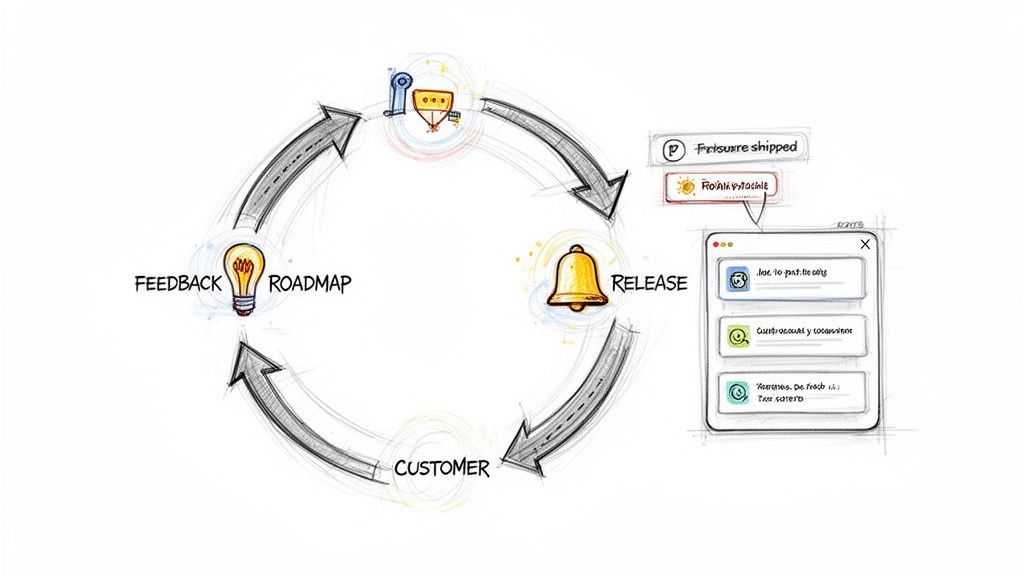
Establish a Clear Communication Cadence
A roadmap is useless if no one knows what it says. Keeping your teams in sync requires a simple but reliable schedule for sharing updates. This isn't about calling massive, time-sucking meetings every week; it's about giving the right level of detail to the right audience at the right time.
- For Leadership and Executives: A high-level monthly or quarterly review is usually perfect. Focus on progress toward strategic goals and flag any major shifts in priority. Keep it brief and tied to the business outcomes they actually care about.
- For Sales and Marketing: Give them bi-weekly or monthly updates on what’s coming down the pike. This lets them prep campaigns, update sales collateral, and manage customer expectations without being blindsided by a surprise launch.
- For Customer Support: Your support team needs a weekly heads-up on new features, bug fixes, and upcoming changes. They're on the front lines and have to be ready to answer user questions on the spot.
This kind of proactive communication kills the dreaded "Hey, when is X feature launching?" questions that derail product teams. It builds trust and ensures everyone is working from the same playbook.
Close the Loop with Your Customers
One of the most powerful—and often forgotten—parts of roadmap maintenance is talking back to your users. When you ship a feature that a customer specifically asked for, you have a golden opportunity to create a moment of genuine delight.
Closing the feedback loop isn't just good customer service; it's a powerful retention strategy. Notifying a user that their idea was heard, prioritized, and built turns a passive user into a loyal advocate for your brand.
Trying to manually track who requested what is a nightmare, especially as you scale. This is where modern feedback tools become absolutely essential. Platforms like FeatureBot can automatically link user feedback to specific items on your roadmap. When a feature moves to "shipped," you can trigger automated, personalized emails to every single user who asked for it.
Instead of a generic changelog update, a user gets a message that says, "Remember that idea you shared about exporting reports? We built it because of you." That simple act transforms a product update from a transaction into a real relationship. You can get started with a Free plan to see just how impactful this can be.
Let AI Help You Evolve Your Roadmap
Staying on top of incoming feedback can feel like a full-time job. As your user base grows, the stream of comments, ideas, and bug reports can become a firehose. This is where AI can act as a force multiplier for your product team.
Imagine getting a concise, automated digest every Monday morning that summarizes the most important feedback trends from the past week. Instead of you manually sifting through hundreds of comments, an AI-powered assistant can surface the insights that truly matter.
- Spotting Trends: The digest might highlight that mentions of "slow loading times" have spiked by 40%, flagging a potential performance issue before it becomes a five-alarm fire.
- Finding New Opportunities: It could also point out a cluster of new requests for a specific integration, clueing you into an emerging customer need you hadn't even considered.
- Suggesting Roadmap Moves: Based on these trends, the AI can even offer specific suggestions, like, "Consider prioritizing 'Performance Optimization' in the next cycle due to rising user friction."
This doesn't replace a product manager's strategic thinking, but it arms them with powerful, data-backed signals to make better decisions. It ensures your roadmap evolves in lockstep with what your customers need, keeping your development efforts focused on what will have the biggest impact. By combining a regular communication cadence with smart, automated tools, your roadmap remains a valuable, living asset that guides your team to success.
Common Questions About Product Roadmaps
Even with the best frameworks and tools in your corner, building and maintaining a roadmap for product development is never a set-it-and-forget-it task. It's a living thing, and it’s totally normal to hit a few bumps or have questions pop up along the way.
Let's walk through some of the most common questions product teams grapple with and give you some clear, actionable answers. Getting these details right is what helps you move from theory to consistent execution, building confidence in your process so you can focus on shipping what matters.
How Often Should We Update Our Product Roadmap?
There's no single magic number here, but finding a healthy rhythm is crucial. For most teams I've worked with, a high-level strategic review quarterly is the sweet spot. This is your chance to zoom out, check your progress against the big-picture goals, and make sure your roadmap still aligns with where the company is headed.
But that doesn't mean you lock it in a vault for three months. Your roadmap needs to be a living document, not a stone tablet.
This means smaller, tactical adjustments might happen every few weeks. A wave of new customer feedback, a competitor's move, or an unexpected technical hurdle can all trigger a minor shuffle in priorities.
The goal is agility, not chaos. You need to clearly distinguish between major strategic pivots (which should be rare and heavily debated) and minor priority shuffles (which are just a normal part of agile development). This is where having a tool that gives you real-time insights can be a lifesaver, helping you make smart adjustments without derailing your long-term vision.
What Is the Difference Between a Product Roadmap and a Release Plan?
This is a big one, and a distinction that often trips up new product teams. Let’s break it down with an analogy: planning a cross-country road trip.
The Product Roadmap is your high-level map. It shows the major cities you plan to visit (outcomes) and the general route you'll take to get there (themes). It’s all about the "why" and the "what"—why are we going to these cities, and what problems will we solve when we get there?
The Release Plan is the turn-by-turn GPS navigation. It’s a super-detailed, tactical document for one leg of the journey. It lists the exact streets to take (features), the estimated time of arrival (sprint timelines), and who’s responsible for driving (development tasks). This is purely about the "how" and the "when" for a specific launch.
Your roadmap sets the destination; your release plan tells you how to navigate the next hundred miles. Both are essential, but they speak to very different audiences and serve very different purposes.
A roadmap communicates strategic intent to inspire and align stakeholders. A release plan communicates tactical details to guide the development team's execution.
How Do We Say No Without Upsetting Customers?
Learning to say "no" gracefully is easily one of the most underrated—and most important—skills in product management. When you decline a feature request, you aren't dismissing the customer. You're protecting the product's focus. The key is to do it with empathy and transparency.
Here’s a simple, three-step approach that works:
- Acknowledge and Thank: Always, always start by thanking the user for their input. This immediately validates their effort and shows you're listening. A simple, "Thanks so much for taking the time to share this idea," goes a long, long way.
- Explain Your Focus (Briefly): Be honest without oversharing. Avoid the empty promise of, "We'll add it to the roadmap." Instead, try something like: "Right now, our team is focused on improving X, so this isn't in our immediate plans. But we've logged your feedback, as it helps us understand what's important for future priorities."
- Show Them It Matters: Make sure their feedback doesn't just vanish into a black hole. Using a dedicated feedback tool like FeatureBot helps you manage this communication and gives you an easy way to circle back with that user if your priorities ever shift. It keeps the conversation open.
Transforming a noisy inbox full of customer feedback into a clear, actionable roadmap is the secret to building products people actually want to use. With FeatureBot, you get an AI-powered system that captures, organizes, and prioritizes user requests based on real business impact. We don't offer a free trial, but you can get started today with a Free plan on featurebot.com and see the difference for yourself.
Ready to capture better feedback?
FeatureBot helps you collect, organize, and prioritize user feedback with AI-powered conversations.
Get Started Free